
Hangzhou IUWON Technology Co., Ltd. is one of the most reliable manufacturers and suppliers of automatic rolling shutter machine in China. With abundant experience, we warmly welcome you to buy custom made automatic rolling shutter machine from our factory. Good service and reasonable price are available.
Production Workflow
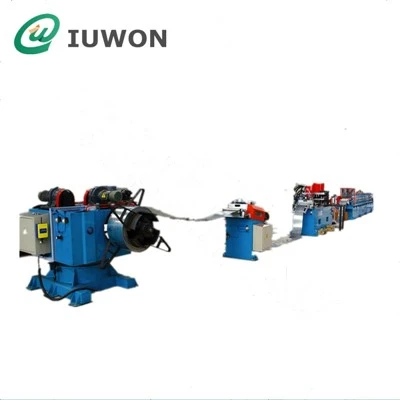
The steel or aluminum coil is loaded onto the hydraulic decoiler. Expansion arms clamp the inner diameter of the coil to stabilize strip feeding during continuous production.
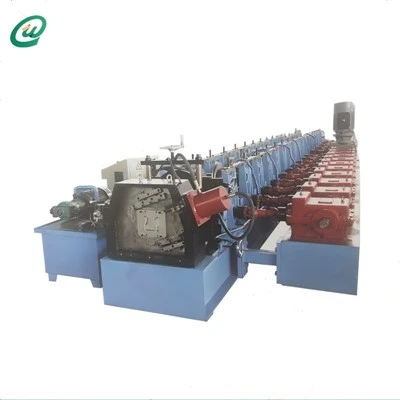
The strip enters the feeding guide system and passes through forming rollers. Each roller station gradually bends the strip into the required shutter slat profile while controlling edge deformation and slat straightness.
Depending on shutter design, the production line may integrate:
- Ventilation perforation punching
- Embossing rollers
- Locking hole punching
- PU foam filling preparation
The formed shutter slat is then cut to preset length using a hydraulic cutting system.

Roll Forming Section
The forming section typically contains 12–20 roller stations depending on slat geometry and material thickness.
Rollers are commonly manufactured from:
- GCr15 bearing steel
- Cr12 tool steel
Roller surfaces are heat treated to reduce wear caused by continuous contact with galvanized or painted strip material.
Improper roller alignment may cause:
- Slat curvature
- Edge deformation
- Locking failure between slats
- Uneven shutter winding
Supported Materials
The machine typically processes:
- Galvanized steel coil
- Color-coated steel strip
- Aluminum strip
- Stainless steel strip
Typical material thickness:
- 0.3–1.2 mm
Common coil width depends on shutter profile dimensions and cover width requirements.
Shutter Profiles Produced
The machine can produce:
- Flat rolling shutter slats
- Curved shutter slats
- Wind-resistant shutter sections
- Perforated ventilation slats
- PU foam shutter profiles
- Bottom rail profiles
Different roller tooling determines slat height, interlocking geometry, and winding radius.
Punching and Perforation System
The hydraulic punching unit creates:
- Ventilation holes
- Observation perforations
- Locking openings
- Installation holes
Punching dies are generally manufactured from SKD11 or Cr12MoV steel to resist edge wear during continuous punching cycles.
For perforated commercial shutters, hole spacing consistency affects ventilation uniformity and slat structural rigidity.
Hydraulic Cutting System
The cutting section shears finished slats according to programmed dimensions.
Typical cutting methods:
- Stop cutting
- Flying tracking cutting
Flying cutting systems maintain strip movement during cutting and reduce production interruption at higher line speeds.
Typical cutting tolerance:
- ±1.0 mm
PLC Control System
The PLC control cabinet synchronizes:
- Feeding speed
- Roller rotation
- Punching sequence
- Cutting length
Touchscreen interfaces allow operators to adjust:
- Production length
- Batch quantity
- Line speed
- Punching interval
Encoder systems monitor strip movement to reduce cutting deviation during continuous operation.
Production Environment
The machine is generally installed in:
- Rolling shutter manufacturing plants
- Sheet metal fabrication workshops
- Commercial door production facilities
Typical workshop requirements:
- Three-phase industrial power supply
- Reinforced concrete floor
- Coil loading space
- Ambient temperature between 5°C and 40°C
Dust accumulation near encoder systems may affect feeding accuracy during long production cycles.
Maintenance Requirements
Routine maintenance generally includes:
- Roller bearing lubrication
- Hydraulic oil replacement
- Punching die inspection
- Chain tension adjustment
- Encoder calibration
Roller surface wear may gradually affect:
- Slat interlocking accuracy
- Profile straightness
- Shutter winding performance
Hydraulic oil temperature is commonly maintained below 55°C during continuous production.
Technical Parameters
| Item | Typical Range |
|---|---|
| Material Thickness | 0.3–1.2 mm |
| Material Type | GI / PPGI / Aluminum / Stainless Steel |
| Forming Speed | 8–20 m/min |
| Roller Stations | 12–20 Stations |
| Punching Type | Hydraulic Punching |
| Main Motor Power | 5.5–15 kW |
| Control System | PLC + Touchscreen |

Configure Your Rolling Shutter Production Line
FAQ
Q: What shutter profiles can this machine produce?
A: The machine forms flat slats, curved slats, perforated shutter sections, wind-resistant profiles, and PU foam shutter slats.
Q: What materials can be processed?
A: The line processes galvanized steel, color-coated steel, aluminum strip, and stainless steel between 0.3 mm and 1.2 mm thickness.
Q: Does the machine support perforated shutter production?
A: Yes. Hydraulic punching units can create ventilation holes and perforated patterns during continuous roll forming.
Q: What affects shutter slat interlocking accuracy?
A: Roller alignment, strip leveling, material thickness consistency, and punching synchronization directly affect slat locking performance.
Q: Can the machine produce foam-filled shutter slats?
A: Yes. The line can form hollow shutter profiles designed for PU foam injection after roll forming.
Q: What information is required before machine customization?
A: Machine design generally requires:
Shutter profile drawing
Material thickness
Coil width
Perforation layout
Required production speed
Slat cover width
Hot Tags: automatic rolling shutter machine, China automatic rolling shutter machine manufacturers, suppliers, factory, C Channel Roll Forming Machine, Metal C Channel Roll Forming Machine, profile roll forming machine, Steel Roll Former