Hangzhou IUWON Technology Co., Ltd. is one of the most reliable manufacturers and suppliers of solar industry roll forming machine in China. With abundant experience, we warmly welcome you to buy high quality solar industry roll forming machine from our factory. Good service and reasonable price are available.
Forming Process and Mechanical Workflow
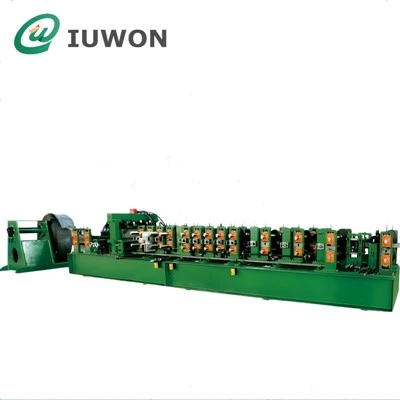
The production process begins at the hydraulic decoiler, where steel coils ranging from 1.5 mm to 3.0 mm thickness are unwound under controlled tension. A leveling unit removes coil set deformation before the strip enters the servo feeder.
The servo feeder positions the strip according to punching coordinates. Hydraulic punching cylinders then create installation holes, cable slots, grounding holes, or assembly openings required for photovoltaic bracket systems.
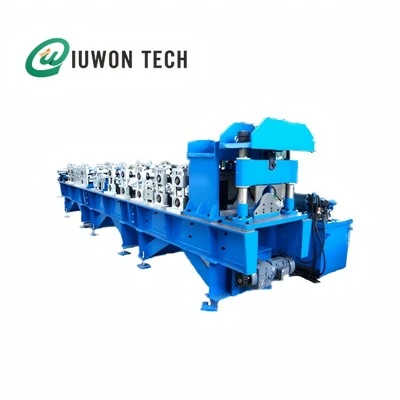
After punching, the strip enters the roll forming section. Each roller station applies incremental deformation to avoid edge cracking and material springback. Depending on profile complexity, the machine generally uses 14 to 24 forming stations.
The formed profile then passes through a hydraulic cutting system or flying shear unit. The cutting section tracks line speed to maintain continuous production without stopping the material flow.

Main Structural Components
Hydraulic Decoiler
The decoiler supports steel coils weighing between 3 and 10 tons. Expansion arms clamp the coil inner diameter mechanically or hydraulically to prevent coil slip during feeding.
Leveling and Servo Feeding Unit
The leveling section uses multiple corrective rollers to flatten residual coil curvature. Servo feeding motors control strip advancement accuracy during punching operations, particularly for profiles requiring repeated hole spacing.
Punching System
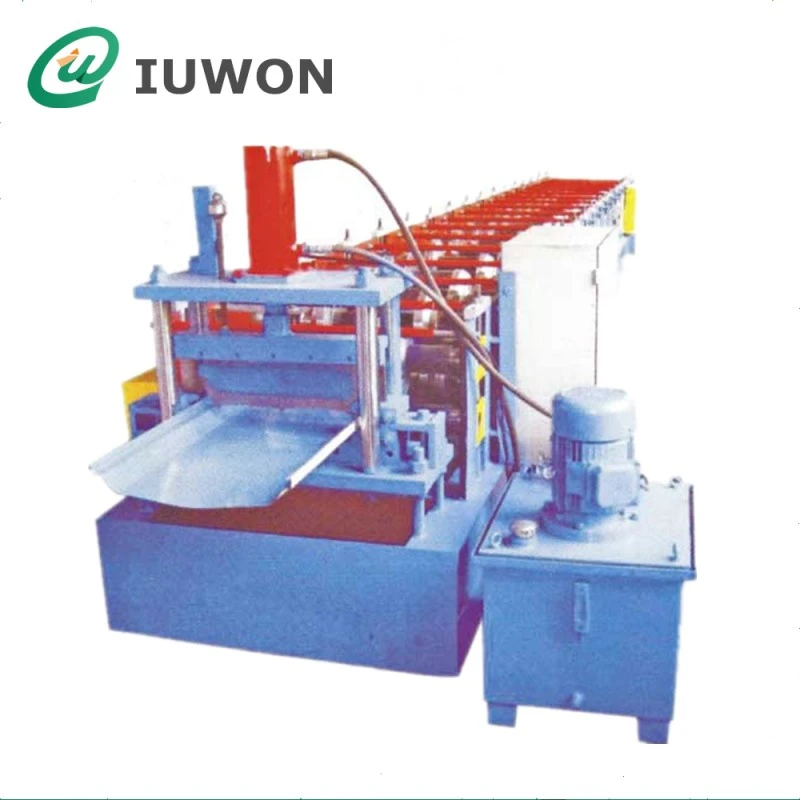
The punching unit uses hydraulic cylinders and interchangeable dies. Common punching operations include:
• Slotted mounting holes
• Round grounding holes
• Elongated connection holes
• Embossed reinforcement points
Punching dies are normally manufactured from Cr12MoV or SKD11 tool steel to resist edge wear during continuous production.
Roll Forming Stations
Rollers are typically manufactured from GCr15 bearing steel and heat treated to improve surface hardness. Roller shafts transfer forming torque through gearbox-driven transmission systems.
During operation, each roller pair bends only a small portion of the final profile geometry to reduce material stress concentration.
Hydraulic Cutting Unit
The cutting section shears the formed profile to programmed lengths. Typical cut tolerance remains within &plusln;1.0 mm depending on line speed and material thickness.
Production Environment and Operating Conditions
This equipment is normally installed in photovoltaic structure fabrication plants operating under continuous batch production conditions.
Typical workshop requirements:
• Three-phase industrial power supply
• Flat reinforced concrete floor
• Overhead crane access for coil loading
• Ambient operating temperature between 5°C and 40°C
In high-humidity environments, electrical cabinets generally require sealed ventilation systems to reduce moisture accumulation inside PLC and servo control components.
Profile Types Produced
The machine can form:
• Solar mounting rails
• Hat-shaped mounting sections
• Tracker support components
Profile geometry depends on:
• Roller tooling configuration
• Punching layout
• Material yield strength
• Required load-bearing capacity
For photovoltaic ground structures exposed to wind loads, profiles often include reinforcement ribs to increase section stiffness.
Installation and Integration
The machine line is typically installed in linear production layouts. Foundation leveling directly affects roller alignment and profile straightness.
Commissioning procedures generally include:
• Roller center alignment
• Servo feed calibration
• Punch synchronization testing
• Cutting length verification
• Trial forming with production material
The PLC system can integrate with automatic stacking systems or MES production management systems through industrial communication protocols.
Maintenance Requirements
Roll forming lines operate under continuous rotational loading and require periodic inspection of:
•Roller surface wear
• Bearing lubrication
• Hydraulic oil contamination
• Servo positioning accuracy
• Punching die edge condition
Improper roller alignment may produce:
•Profile twisting
•Edge waviness
•Hole offset deviation
•Section asymmetry
Hydraulic oil temperature is generally maintained below 55°C to reduce seal degradation and viscosity instability during long production cycles.
Typical Engineering Applications
Rooftop Solar Mounting Systems
The machine produces lightweight mounting rails used for aluminum-framed photovoltaic panels installed on metal roofs and concrete rooftops.
01
Ground-Mounted Solar Structures
Thicker galvanized steel profiles are formed for utility-scale solar farms exposed to wind uplift and long-span structural loading.
02
Solar Carport Systems
Formed channels and structural members support photovoltaic roof assemblies integrated into parking structures.
03
Tracker Support Structures
Precision-punched profiles are used in solar tracking systems requiring repeated mounting tolerances and rotational alignment.
04
Technical Parameters
| Item | Typical Range |
|---|---|
| Coil Width | 100–500 mm |
| Material Thickness | 1.0–4.0 mm |
| Forming Speed | 10–30 m/min |
| Roller Stations | 14–24 Stations |
| Main Motor Power | 11–30 kW |
| Punching Type | Servo Hydraulic |
| Control System | PLC + Touchscreen |
FAQ
Q: What solar profiles can this machine produce?
A: The machine forms photovoltaic mounting rails, C channels, U channels, strut channels, and ground-mount support profiles from galvanized steel or aluminum coil.
Q: What material thickness can the machine handle?
A: Typical processing range is 1.0–4.0 mm depending on profile structure and material yield strength.
Q: Does the machine support inline punching?
A: Yes. The line integrates servo feeding and hydraulic punching for mounting holes, slotted holes, and connection openings during continuous production.
Q: How profile accuracy controlled during production?
A: The machine uses sequential roller forming, servo-controlled feeding, and PLC synchronization to reduce twisting, hole deviation, and cutting length error.
Q: What information is required before machine customization?
A: Buyers usually provide:
•Profile section drawing
•Material thickness
•Hole layout
•Production speed requirement
•Coil width and material type
Hot Tags: solar industry roll forming machine, China solar industry roll forming machine manufacturers, suppliers, factory, Photovoltaic Bracket Roll Forming Machine, solar panel frame strut roll forming machine, Solar PV Bracket Roll FormingMachine