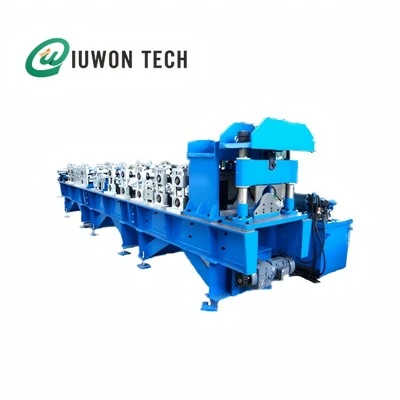

Hangzhou IUWON Technology Co., Ltd. is one of the most reliable manufacturers and suppliers of glazed tile roll forming machine in China. With abundant experience, we warmly welcome you to buy custom made glazed tile roll forming machine from our factory. Good service and reasonable price are available.
Primary structural components:
- Decoiler unit (manual or hydraulic)
- Feeding & guiding device with pre-shearing option
- Roll forming stand (14–20 stands)
- Hydraulic die press (10–30 ton stamping force)
- Hydraulic post-cutting unit
- PLC control cabinet with HMI touchscreen
- Run-out table or automatic stacker
- Hydraulic power stand (oil filtration grade 6–8)
Working Principle & Process Flow
The producing process operates in three distinct phases:
Phase 1: Primary Roll Forming
The flat steel strip passes through 8–14 forming stands (profile-dependent). Each stand applies an angular change of 2°–5° per pass to avoid coating cracking or substrate over-stressing. The roller pass sequence is designed via CAD software to distribute forming stress evenly and minimize material springback.
Phase 2: Hydraulic Die Stamping
After cross-section forming, the sheet enters the hydraulic stamping stand. A hydraulic cylinder (10–30 ton rating) drives the upper die downward onto the sheet while the lower die provides the mating cavity. The dies close under programmable pressure and dwell time (0.3–0.8 seconds) to emboss the tile pattern. Die depth tolerance is held within ±0.15 mm.
Phase 3: Post-Forming Cutting
The stamped sheet proceeds to a hydraulic shear that cuts each tile to programmed length. The cutting sequence is: decelerate → stop → cut → re-accelerate. Cut length tolerance: ±1.0–1.5 mm over a 900 mm repeat length.
Production workflow:
Speed limitation factor:
The intermittent stamping cycle creates a natural speed ceiling. Typical forming speed: 2–8 m/min (excluding cutting stop time). Attempting to exceed this range causes incomplete pattern depth, positional drift between stamped patterns, and surface scuffing from dies contacting a moving sheet.
Component Specifications & Material Data
Roll Forming stand
| Parameter | Specification |
|---|---|
| Forming stands | 14–20 stands (profile-dependent) |
| Roller material | 45# forged steel or Cr12MoV/GCr15 tool steel |
| Surface treatment | Hard chrome plating, 0.05 mm thickness |
| Hardness | HRC 58–62° after heat treatment |
| Shaft diameter | Φ70–80 mm |
| Shaft material | 45# steel, quenched and tempered |
| Shaft machining | CNC lathe + grinding (two passes for precision) |
| Frame structure | 350H steel beam, welded, stress-relieved after welding |
| Roller stand type | Independent arch structure (non-plate design) or wall panel |
| Transmission | Chain drive (1" single chain) or gearbox drive (optional) |
| Main motor | 5.5–7.5 KW, frequency-controlled |
Hydraulic Stamping stand
| Parameter | Specification |
|---|---|
| Stamping force | 10–30 tons (cylinder rating) |
| System pressure | 12–18 MPa |
| Dwell time | 0.3–0.8 seconds (programmable via PLC) |
| Die material | High-grade tool steel, chrome-plated |
| Die depth tolerance | ±0.15 mm |
| Hydraulic pump | Variable-displacement piston pump |
| Oil tank capacity | 100–200 liters |
| Thermal management | Oil cooler + temperature sensor + filtration circuit |
Hydraulic Cutting Unit
| Parameter | Specification |
|---|---|
| Cutting mode | Hydraulic stop-cutting (post-forming) |
| Blade material | Cr12 or Cr12MoV, quenched to HRC 58–62° |
| Cutting frame | 20 mm steel plate, welded, heat-treated to prevent deformation |
| Hydraulic motor | 4–5.5 KW |
| Hydraulic pressure | 10–16 MPa |
| Cutting tolerance | ±1.0–1.5 mm |
| Cutting action | Machine decelerates → stops → hydraulic cylinder drives blade → machine re-accelerates |
Decoiler
| Parameter | Specification |
|---|---|
| Type | Manual or hydraulic (5-ton capacity standard) |
| Coil ID range | Φ480–530 mm (standard: Φ508 mm) |
| Coil OD max | Φ1300–1600 mm |
| Coil width max | 1219–1300 mm |
| Coil weight max | 5000 kg |
PLC Control System
| Parameter | Specification |
|---|---|
| PLC brand | Delta / Siemens / Mitsubishi / Panasonic |
| HMI | Touchscreen (7" or 10") |
| Encoder | Omron (photoelectric, for length measurement) |
| Inverter | Delta / Yaskawa / Siemens |
| Low-voltage components | Schneider |
| Control functions | Automatic length measurement, quantity counting, parameter setting, fault warning, emergency stop |
| Voltage | 380V/50Hz/3-phase (220V/440V/60Hz customizable) |
Material Processing Capabilities
| Parameter | Range |
|---|---|
| Suitable materials | Galvanized steel coil (GI), pre-painted galvanized steel (PPGI), pre-painted galvalume steel (PPGL), aluminum coil |
| Material thickness | 0.3–0.8 mm (standard); 0.4–0.6 mm (optimal range) |
| Feed width | 760–1250 mm (profile-dependent: 914/1000/1200/1220/1250 mm) |
| Yield strength | ≤235 MPa (standard); 280–320 MPa (heavy-duty config) |
| Tensile strength | ≤550 MPa |
Operating Conditions & Environmental Requirements
| Condition | Specification |
|---|---|
| Ambient temperature | 0–40°C (hydraulic oil viscosity must be maintained) |
| Humidity | ≤85% RH (non-condensing) |
| Power supply | 380V ±10%, 50Hz ±1%, 3-phase (or customized) |
| Floor space (single line) | 15–25 meters linear length |
| Machine dimensions | Approx. 5500–7500 × 1500–1800 × 1400–1500 mm (L×W×H) |
| Machine weight | 2.8–7.0 tons |
| Hydraulic oil grade | 40# anti-wear hydraulic oil |
| Oil cleanliness | Grade 6–8 (filtration system required) |
Engineering Applications & Installation Contexts
The machine produces metal glazed tiles for the following specific construction applications:
Residential
Villa roof systems, garden-style residence roofing, urban flat-slope roof renovation projects. The tiles replace traditional clay tiles with 60–70% weight reduction while maintaining equivalent weatherproofing.
Commercial
Hotel and resort roofing, exhibition center roof cladding, theater acoustic ceiling panels. The stamped tile pattern provides both structural rigidity and aesthetic surface texture.
Heritage Restoration
Temple roof renovation, antique building facade restoration, scenic area pavilion construction. The PPGI surface replicates ceramic glaze appearance with 25-year color retention (depending on coating specification).
Industrial
Factory roof waterproofing and thermal insulation upgrades, warehouse roof paving. The interlocking tile design prevents water infiltration at pitch angles ≥15°.
Installation, Commissioning & Maintenance
Installation Sequence
- Foundation preparation: Level concrete floor with anchor bolt patterns per layout drawing.
- Machine positioning: Align decoiler → forming stand → stamping press → cutter → run-out table in linear sequence.
- Hydraulic system connection: Fill oil tank with 40# hydraulic oil, purge air from lines.
- Electrical connection: Wire 3-phase power to control cabinet, connect encoder and limit switches.
- Calibration: Run test coil, adjust roller gaps per profile drawing, set stamping depth and dwell time.
- Production trial: Verify cut length tolerance (±1.5 mm), check tile pattern depth consistency.
Maintenance Intervals
- Daily: Check hydraulic oil level and temperature; inspect cutting blade edge condition.
- Weekly: Lubricate chain drive; check roller surface for coating buildup or chrome wear.
- Monthly: Verify PLC parameter backup; inspect die alignment; measure cutting tolerance drift.
- Annually: Replace hydraulic oil and filters; check roller bearing clearance; inspect frame weld integrity.
Critical Failure Modes
- Roller wear: Chrome plating loss causes sheet surface scratching; measurable by profilometer.
- Hydraulic seal degradation: Oil leakage at 12–18 MPa pressure; detectable by pressure drop during stamping cycle.
- Encoder drift: Cut length variation >±2 mm indicates encoder or servo drive calibration issue.
- Die misalignment: Pattern depth variation >±0.2 mm across tile width; requires die re-shimming.
Technical Contact & Quotation Request
For technical consultation, profile feasibility analysis, or factory acceptance test scheduling, please provide:
1. Target tile profile drawing or sample photo
2. Material specification (GI/PPGI/PPGL/Aluminum, thickness range)
3. Production volume requirement (meters/day or tiles/day)
4. Voltage and frequency at installation site
5. Available floor space (length × width)
Customization & Configuration Options
| Option | Technical Specification |
|---|---|
| Profile customization | Custom roller sets and die cavities based on customer drawing or physical sample; CAD-based pass design with finite element simulation |
| Transmission upgrade | Gearbox drive (higher torque, lower backlash) vs. standard chain drive |
| Decoiler upgrade | Hydraulic decoiler with coil car (auto-loading) vs. manual decoiler |
| Pre-shearing | Hydraulic pre-cutter for head/tail trimming before forming |
| Embossing unit | Additional hydraulic press stand for surface texture patterns |
| Electrical standards | 220V/380V/440V; 50Hz/60Hz; 1-phase/3-phase |
| Control brand selection | Siemens / Delta / Mitsubishi / Panasonic PLC and HMI |
| Safety package | Emergency stop buttons at operator stands, safety guards around stamping press, overload protection on hydraulic pump |
Hot Tags: glazed tile roll forming machine, China glazed tile roll forming machine manufacturers, suppliers, factory, Cable Ladder Roll Forming Machine, capping roll forming machine, deck roll former, r panel roll former, steel roofing roll forming machine, Stud And Track Roll Forming Machine