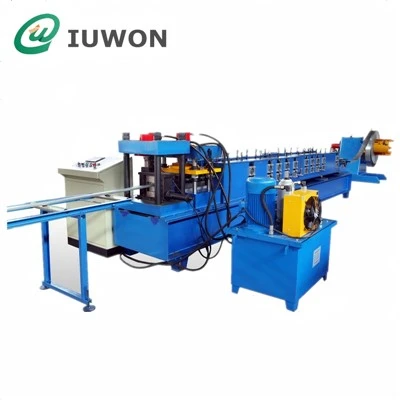

Hangzhou IUWON Technology Co., Ltd. is one of the most reliable manufacturers and suppliers of down spout machine in China. With abundant experience, we warmly welcome you to buy custom made down spout machine from our factory. Good service and reasonable price are available.
Equipment configuration can be developed around:
- Downspout Profile: Rectangular, square, or other supported profiles defined by product drawings.
- Material Specifications: Coil material, thickness, width, and surface coating.
- Finished Pipe Length: Standard commercial lengths and project-specific cutting requirements.
- Connection Design: End geometry and additional processing required for pipe joints.
- Product Range: Dedicated tooling or adjustment arrangements for different sizes.
- Production Workflow: Coil feeding, forming, cutting, and finished-part handling.
The objective is to help manufacturers produce downspouts that fit their drainage systems and production schedules, rather than simply form metal into a pipe shape.
Downspout Design: Dimensions, Shape, and Connection Compatibility
Downspout dimensions are determined by drainage-system design, building requirements, local market preferences, and compatibility with associated components. A forming machine must reproduce the specified geometry consistently throughout production.
Rectangular downspouts are commonly selected where a flat-sided profile suits the building appearance or installation space. Round profiles may be preferred in other drainage systems. These shapes require different forming considerations, so the machine configuration should follow the intended product design.
| Product Design Factor | Manufacturing Consideration |
|---|---|
| Cross-sectional width and depth | Determines the forming geometry and finished profile dimensions |
| Corner radius | Influences roller design and the appearance of rectangular or square profiles |
| Wall thickness | Affects forming force, springback, and dimensional control |
| Longitudinal seam or closure | Determines how the formed strip edges meet or connect, where applicable |
| End connection | May require specific end dimensions, flaring, notching, or other processing |
| Finished length | Defines cutting settings and the handling arrangement |
| Surface finish | Influences roller contact, guides, and material handling |
| Dimensional tolerance | Establishes the inspection criteria for production acceptance |
A critical distinction is that nominal width and depth alone do not fully define a downspout. Corner geometry, edge configuration, closure method, and connection dimensions can affect how the finished pipe fits elbows, outlets, connectors, and brackets.
Before tooling is designed, manufacturers should provide a complete cross-section drawing and identify all features that affect assembly.
In continuous roll forming, the metal strip passes through a series of roller stations. Each station introduces a controlled amount of deformation until the strip reaches the required cross-section.
For downspout production, the forming sequence must account for the material's mechanical properties, the target geometry, and the method used to close or join the formed section.
Three factors are especially important:
- Progressive deformation
The profile is formed gradually rather than through one abrupt bend. The forming sequence must distribute deformation appropriately to reduce unwanted distortion, edge damage, and variation in the finished cross-section.
- Roller alignment and tooling geometry
Roller positioning and profile design influence dimensional consistency. Poorly matched tooling or incorrect setup can contribute to uneven corners, profile asymmetry, or inconsistent edge alignment.
- Material behavior and springback
Metal tends to recover some of its deformation after leaving the forming rolls. The amount depends on material grade, thickness, strength, and forming geometry. Tooling and setup should therefore be developed for the specified material rather than assuming all coils will behave identically.
For manufacturers processing multiple materials or thicknesses, the actual working range must be confirmed during machine design. A setup developed for one material specification should not automatically be applied to another without checking the resulting profile.

Managing Seams, Edges, and Surface Appearance
The appearance and assembly quality of a metal downspout depend on more than its overall dimensions. Edge alignment, corner definition, seam condition, and coating integrity can all affect the finished product.
| Manufacturing Issue | Possible Cause | Equipment or Process Consideration |
|---|---|---|
| Uneven rectangular corners | Forming sequence or roller geometry not suited to the profile | Review roller design and forming progression |
| Misaligned longitudinal edges | Incorrect strip guidance or forming setup | Check feeding alignment and edge positioning |
| Distorted profile after forming | Uneven deformation or material springback | Verify tooling, material properties, and setup |
| Scratches on pre-painted surfaces | Contact with worn rollers, guides, or handling equipment | Inspect contact surfaces and material transfer points |
| Inconsistent pipe dimensions | Changes in material thickness, setup, or roller alignment | Define inspection points and setup controls |
| Poor joint fit | End dimensions or connection features outside specification | Verify the complete connection drawing and relevant tolerances |
The required seam arrangement depends on the downspout design. Some products use a longitudinally closed section, while others have different edge or joining configurations. The production process must be selected to match the actual construction of the finished pipe.
For coated steel and other appearance-sensitive materials, manufacturers should also establish acceptable surface standards before commissioning the line. Preventing damage during feeding, forming, cutting, and stacking is generally more effective than relying on finished-product inspection alone.
Downspout Cutting and Finished-Length Control
Downspouts are often sold in standard lengths, while construction projects may require specific dimensions. Cutting accuracy affects material utilization, packaging, transport, and installation.
The minimum and maximum finished lengths.
The proportion of standard lengths versus custom lengths.
The required cutting tolerance.
Whether the material is cut before or after the relevant forming operations.
Whether the product requires special end geometry.
How long sections will be discharged, supported, and stacked.
Cutting performance must be assessed together with the forming process. The practical output of a line can be affected by cutting frequency, the time required to handle finished sections, and any additional processing at the pipe ends.
For manufacturers supplying several markets, maintaining a controlled list of standard lengths can simplify production planning and reduce unnecessary changeovers. Custom lengths can then be scheduled according to confirmed order requirements.
Producing Multiple Downspout Sizes Without Losing Production Efficiency
Downspout manufacturers may supply several combinations of profile dimensions, materials, thicknesses, and finishes. The more frequently these specifications change, the more important it becomes to plan tooling and changeover procedures carefully.
A machine configuration should be evaluated against the actual product portfolio rather than the total number of sizes alone.
| Production Pattern | Main Consideration | Configuration Direction |
|---|---|---|
| One or two high-volume sizes | Stable output and repeatable setup | Evaluate a dedicated configuration for the main products |
| Several sizes with infrequent changes | Changeover time and tooling storage | Review adjustment requirements and interchangeable tooling |
| Frequent changes between product sizes | Setup time and operator workload | Assess whether supported automatic adjustment is justified |
| Multiple material thicknesses | Different forming behavior and machine loading | Confirm the supported material range and setup requirements |
| Project-based orders | Variable lengths and delivery schedules | Coordinate cutting settings and production planning |
Automatic size adjustment should only be specified when the machine is designed to support the required dimensions and combinations. It should not be assumed that one machine can produce every rectangular, square, or round profile.
A useful planning method is to group products by compatible tooling and material specifications, then schedule long production runs where demand permits. This can reduce unnecessary setup time while preserving flexibility for customer-specific orders.
Matching Downspouts with Gutters, Elbows, and Accessories
A downspout is one part of a complete rainwater drainage system. Manufacturers that produce or supply multiple system components need to ensure that product dimensions and connection details remain compatible.
| Related Component | Compatibility Requirement |
|---|---|
| Gutter outlet | The downspout opening or upper connection must suit the outlet design |
| Elbows and offsets | Cross-section and connection geometry must match the pipe |
| Pipe connectors | Joint dimensions must support the intended connection method |
| Wall brackets | Bracket dimensions must accommodate the finished profile |
| Pipe extensions | End geometry must allow sections to connect as designed |
| Ground-level drainage connection | The lower pipe end must suit the specified discharge arrangement |
Compatibility should be checked through drawings and dimensional tolerances, not inferred from product names or nominal sizes. Even when two components are described as the same nominal size, differences in corner radii, edge construction, or connection dimensions may prevent proper assembly.
For manufacturers developing a new product range, it is useful to establish the interface dimensions first. The forming tooling can then be designed around the required finished profile and its relationship with the other drainage components.
Material Selection and Production Requirements
The selected material influences forming behavior, surface appearance, corrosion resistance, and the suitability of the finished downspout for its installation environment.
| Material Consideration | Impact on Production |
|---|---|
| Material grade | Influences strength, ductility, and forming behavior |
| Thickness range | Affects forming loads, tooling design, and dimensional control |
| Galvanized coating | Requires consideration of surface contact and coating protection |
| Pre-painted finish | Makes surface marking and handling control particularly important |
| Aluminum or other alternatives | May require a different tooling approach based on material properties |
| Coil consistency | Variations in thickness or mechanical properties can affect finished dimensions |
Material suitability should be established against the intended building application and local requirements. Corrosion exposure, environmental conditions, and expected service life influence the choice of metal and coating, while the forming line must be designed for the specified material.
For quotation purposes, manufacturers should provide the material grade where known, thickness range, coil dimensions, coating type, and any requirements for protecting the finished surface.
Information Needed to Configure a Downspout Roll Forming Line
A machine proposal should be based on the finished product and its production requirements. The following information helps establish the forming arrangement, cutting system, and any additional processing needed.
| Required Information | Purpose |
|---|---|
| Cross-section drawing | Defines profile dimensions, corners, edges, and closure method |
| Material grade and thickness | Establishes forming requirements and the supported working range |
| Coil width and weight | Determines feeding and decoiling requirements |
| Finished lengths | Defines cutting range and handling requirements |
| Connection details | Identifies any special end-processing requirements |
| Product range | Establishes tooling and changeover needs |
| Target output | Supports evaluation of production speed and process bottlenecks |
| Factory conditions | Helps confirm installation space, power supply, and handling arrangements |
If drawings are not final, preliminary dimensions and sample photographs can support an initial technical review. The final machine specification should be confirmed after the profile geometry, material range, tolerances, and connection requirements have been agreed.
Request a Downspout Proposal
IUWON can review your downspout specifications to evaluate a suitable roll forming configuration for your intended products and manufacturing workflow.
To support the assessment, provide the profile drawing, material and thickness, finished lengths, connection design, expected output, and number of sizes to be produced. If your product range includes different profiles or surface finishes, identify the most common specifications and the anticipated frequency of changeovers.
Contact IUWON to discuss your downspout production requirements and request a machine configuration based on your actual product drawings.
Hot Tags: down spout machine, China down spout machine manufacturers, suppliers, factory, downpipe making machine, downspout cutting forming line, downspout machine manufacturer, downspout roll forming machine, pipe forming machine for rainwater drainage, water drainage pipe forming machine