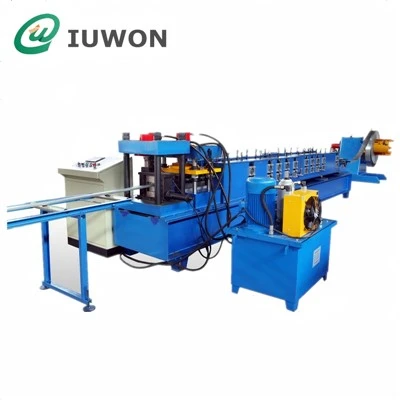
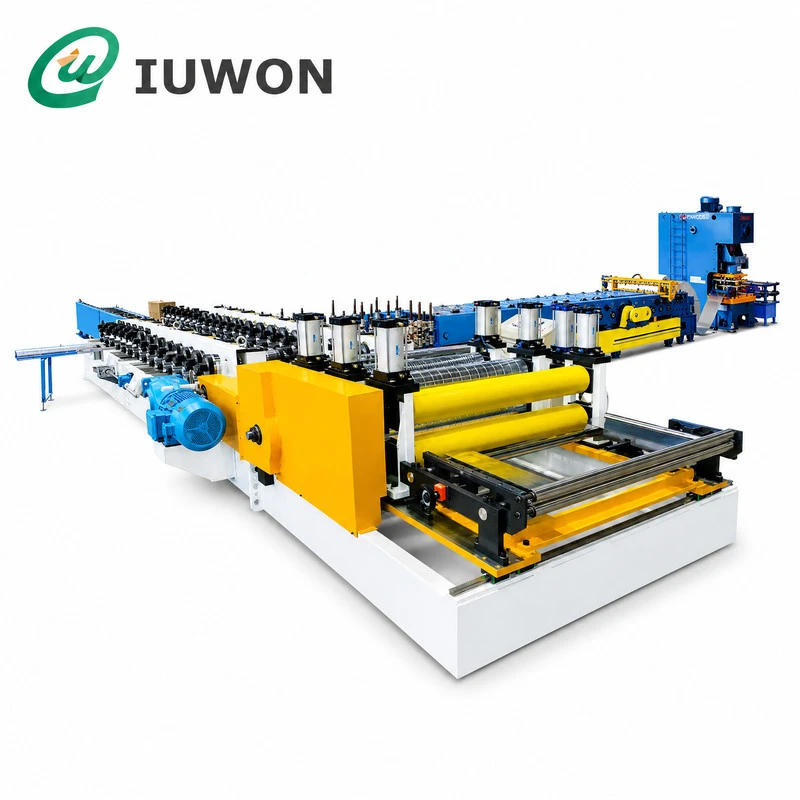
Hangzhou IUWON Technology Co., Ltd. is one of the most reliable manufacturers and suppliers of round downpipe roll forming machine in China. With abundant experience, we warmly welcome you to buy custom made round downpipe roll forming machine from our factory. Good service and reasonable price are available.
Typical machine configuration
- Circular profile forming based on the required pipe diameter.
- Coil-fed processing for compatible metal materials.
- Longitudinal seam forming or closing according to the specified pipe construction.
- Length measurement and cutting for standard or customized pipe lengths.
- PLC-based production control.
- Optional tooling or adjustment arrangements for additional diameter specifications, subject to machine design.
Round Downpipe Machine Technical Parameters
The following table combines reference values published in IUWON's existing downpipe equipment information. Final specifications must be confirmed for the selected round-downpipe model, tooling, and production configuration.
| Parameter | Reference Specification |
|---|---|
| Machine Type | Round Downpipe Roll Forming Machine |
| Finished Product | Circular metal rainwater downpipe |
| Pipe Diameter | Customized according to product drawings; confirm supported range |
| Example Diameter Specifications | 80 mm / 100 mm; confirm the required finished dimension |
| Applicable Material | Galvanized steel, pre-painted steel, aluminum; other materials subject to confirmation |
| Material Thickness | 0.4–0.7 mm reference range |
| Forming Speed | Approximately 10–15 m/min |
| Forming Stations | 10–16 stations, subject to the selected configuration |
| Forming Method | Cold roll forming |
| Seam Processing | Longitudinal seam-closing arrangement according to product design |
| Cutting System | Hydraulic post-cutting reference configuration |
| Length Control | PLC and encoder-based length measurement |
| Cutting Length Tolerance | ±1.5 mm reference value; confirm in the technical agreement |
| Control System | PLC touchscreen; brand and configuration to be confirmed |
| Coil Width | Calculated according to pipe diameter, seam design, and material development |
| Power Supply | Confirm according to machine configuration and destination country |
Technical note: The figures above are preliminary selection references, not a guarantee that every parameter is available in one standard machine. Pipe diameter, material thickness, forming speed, station count, cutting method, and length tolerance should be confirmed together before quotation. Actual production output also depends on pipe length, cutting cycles, seam processing, and material handling.
Pipe Diameter and Strip Development: The Starting Point for Tooling Design
A round downpipe's nominal diameter does not independently determine the material width or complete forming configuration. The strip must be developed around the finished circumference and the requirements of the longitudinal seam.
For example, a theoretical circumference calculated from a 100 mm diameter is approximately 314.2 mm. This is a geometric reference only, not the final coil width required for production. The actual strip width must account for the specified diameter reference, seam allowance, edge geometry, and forming design.
Manufacturers should therefore provide:
- Required pipe diameter and whether it refers to the inside or outside diameter.
- Material thickness and grade.
- Longitudinal seam or locking configuration.
- Finished cross-section and dimensional tolerances.
- Any connection features that influence the pipe ends.
This information allows the forming tooling to be developed around the actual product rather than relying on nominal diameter alone.
Forming a Consistent Circular Profile
Round downpipe production involves progressively curving flat metal strip until the edges reach the position required by the specified seam design. The forming sequence must distribute deformation appropriately to maintain the intended diameter and roundness.
Progressive forming
Each roller station introduces a controlled amount of deformation. The roller arrangement should be matched to the strip width, thickness, material properties, and required circular geometry.
Diameter and roundness control
A pipe may have the correct nominal diameter but still fit poorly if its cross-section is distorted. Roller alignment, forming progression, material variation, and seam closure all influence the finished profile.
Springback compensation
After forming, metal can recover some of its deformation. The extent depends on material strength, thickness, and geometry. A setup suitable for one coil specification may therefore need adjustment or validation when the material changes.
For production acceptance, manufacturers should establish inspection criteria for outside or inside diameter, roundness, straightness, seam alignment, cut length, and surface condition.
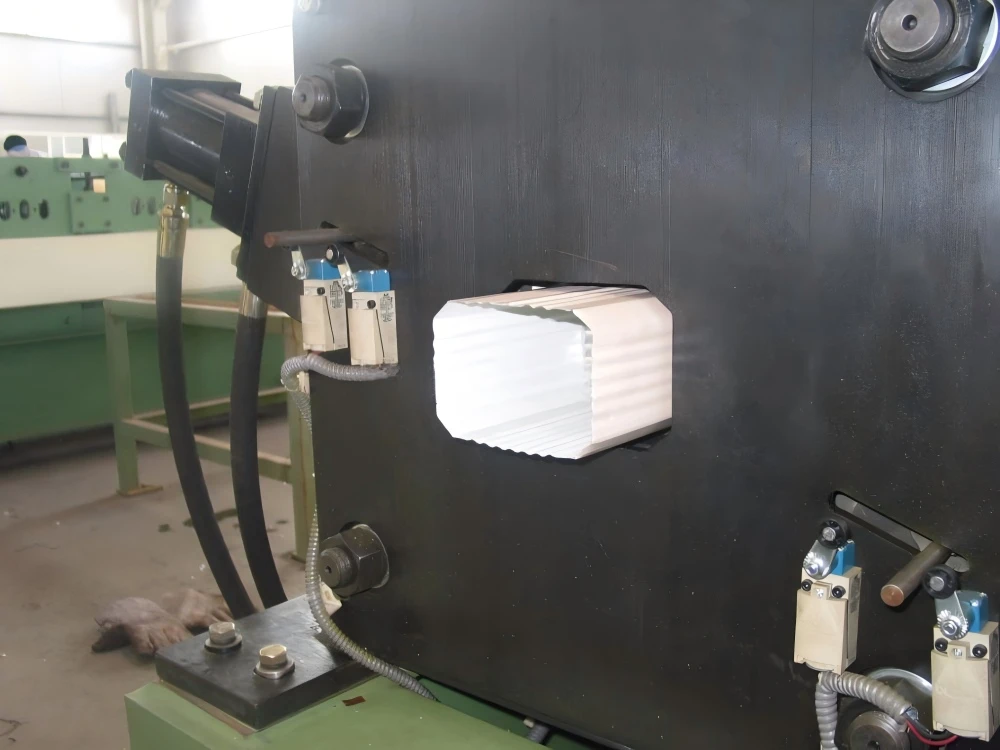
Longitudinal Seam Design and Closure Quality
The seam is a critical feature of a round downpipe because it affects the pipe's cross-section, appearance, and connection compatibility. The required seam construction must be identified before the machine's forming sequence and closing mechanism are finalized.
| Seam Requirement | Manufacturing Consideration |
|---|---|
| Edge alignment | The two longitudinal edges must reach the intended relative position |
| Seam geometry | Tooling must match the specified lock or joining design |
| Circular profile | Seam closure should not create unacceptable local distortion |
| Surface appearance | Contact and closure operations should meet the required finish standard |
| Joint compatibility | Finished dimensions must match the intended elbows and connectors |
| Water drainage performance | The completed pipe must meet the product's applicable design and quality requirements |
Not every round downpipe uses the same seam construction. Where a particular locking or joining process is required, the selected equipment must be configured for that method. Any claim regarding leak resistance should be supported by the actual pipe design and appropriate product testing.
Cutting Lengths and Preparing Pipes for Installation
Downpipes are supplied in standard commercial lengths or cut to suit specific building projects. Cutting accuracy affects material utilization, transport, packaging, and the alignment of adjacent sections during installation.
The cutting arrangement should be selected according to the required length range, tolerance, production speed, and pipe-handling method.
Key considerations include:
- Maintaining the specified length across repeated cutting cycles.
- Supporting the pipe to minimize deformation during cutting.
- Producing suitable end conditions for the intended connection method.
- Coordinating cutting cycles with forming and seam closure.
- Handling finished pipes without scratching the coating or bending long sections.
Where the product requires flared ends, special connectors, or other end treatments, these operations should be specified separately. A standard length-cutting unit should not be assumed to perform additional end-forming functions unless the configuration includes them.
Producing Different Diameters Efficiently
Downpipe manufacturers may supply several diameters to meet different drainage-system specifications. Whether a single machine can produce multiple sizes depends on the supported diameter range, roller tooling, adjustment mechanism, and material specifications.
| Production Scenario | Configuration Consideration |
|---|---|
| One main diameter | Evaluate a dedicated setup for the primary product |
| Several diameters with infrequent changes | Review interchangeable tooling and manual adjustment requirements |
| Frequent changes between sizes | Evaluate supported automatic adjustment and actual changeover time |
| Different thicknesses | Confirm machine capacity and tooling suitability for each material specification |
| Mixed standard and custom orders | Plan cutting settings, tooling changes, and production scheduling |
A machine designed for one diameter should not automatically be assumed to cover a broad size range. Each required diameter must be checked against the proposed configuration.
For manufacturers with frequent size changes, automation may reduce setup work when the selected machine supports the required combinations. For factories producing long runs of a limited product range, a dedicated configuration may be more practical.
The decision should be based on order frequency, batch size, material variation, and the cost of production changeovers.
Material and Surface-Finish Requirements
Round downpipes may be produced from galvanized steel, pre-painted steel, aluminum, or other suitable materials, depending on the equipment configuration and intended application.
| Material Factor | Production Impact |
|---|---|
| Material grade | Influences formability and springback |
| Thickness | Affects forming load and dimensional control |
| Protective coating | Requires suitable roller contact and handling practices |
| Coil consistency | Variations can affect finished diameter and seam alignment |
| Surface appearance | Determines acceptable marking and finish quality |
Pre-painted and coated materials require particular attention to roller condition, guide alignment, and finished-pipe handling. Surface damage can occur not only during forming but also during cutting, discharge, stacking, and packaging.
Material suitability should be confirmed against the intended installation environment and applicable product requirements. The machine specification should identify the exact material grades and thicknesses the manufacturer expects to process.
Compatibility with Elbows, Connectors, and Drainage Accessories
Round downpipes form part of a larger rainwater drainage system. Manufacturers supplying complete drainage products need to ensure that the pipe dimensions match the associated fittings.
| Component | Dimension to Verify |
|---|---|
| Gutter outlet | Inlet size and connection arrangement |
| Round elbow | Diameter and connecting-end geometry |
| Pipe connector | Internal or external fitting dimensions |
| Wall bracket | Finished outside diameter and clearance |
| Pipe extension | Joint design and overlap dimensions |
| Ground-level outlet | Lower-end connection requirements |
Nominal diameter alone does not guarantee compatibility. Differences in actual diameter, seam position, end geometry, or manufacturing tolerances may affect assembly.
Before production begins, manufacturers should compare the downpipe drawing with the drawings of its matching elbows, connectors, and brackets. Establishing these interface dimensions early can reduce fitting problems and rework.
Information Required for a Machine Quotation
To evaluate a suitable production configuration, IUWON needs the finished-pipe specifications and expected manufacturing conditions.
| Required Information | Purpose |
|---|---|
| Pipe drawing | Defines diameter, seam, and connection details |
| Diameter range | Establishes tooling and adjustment requirements |
| Material grade and thickness | Confirms the required forming capability |
| Coil width and weight | Determines decoiling and feeding requirements |
| Finished lengths | Defines the cutting range and handling arrangement |
| Seam construction | Determines the required closing process |
| Length and diameter tolerances | Establishes inspection and acceptance criteria |
| Target output | Supports production-speed and process-capacity assessment |
| Factory location and power supply | Helps determine installation requirements |
If drawings are not finalized, preliminary dimensions and sample photographs can support an initial review. The final machine specification should be agreed after the diameter reference, material range, seam design, cutting requirements, and production target have been confirmed.
Request a Round Downpipe Roll Forming Machine Proposal
IUWON can review your product drawings and manufacturing requirements to evaluate a suitable configuration for round metal downpipe production.
For an accurate quotation, provide the required diameter, material thickness, seam design, finished lengths, cutting tolerance, expected output, and number of sizes to be produced.
If you plan to manufacture several diameters, list the sizes separately and indicate which products account for most of your orders. This helps establish whether a dedicated setup, interchangeable tooling, or an adjustable configuration is the most appropriate direction.
Contact IUWON to discuss your round downpipe production requirements and request a machine proposal based on your actual product specifications.
Hot Tags: round downpipe roll forming machine, China round downpipe roll forming machine manufacturers, suppliers, factory, downspout cutting forming line, rainwater drainage system pipe machine, round downpipe roll forming machine, round tube rainwater pipe machine, steel downpipe forming line, water drainage pipe forming machine