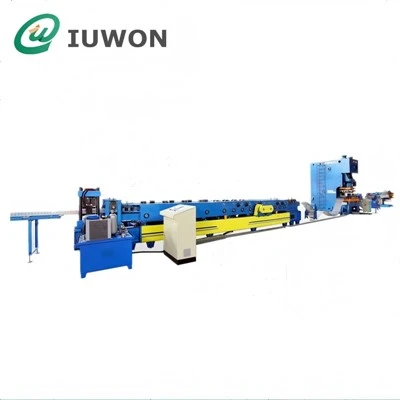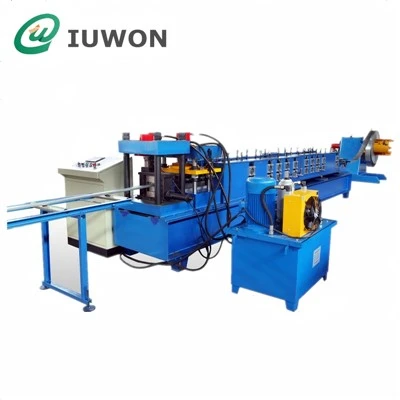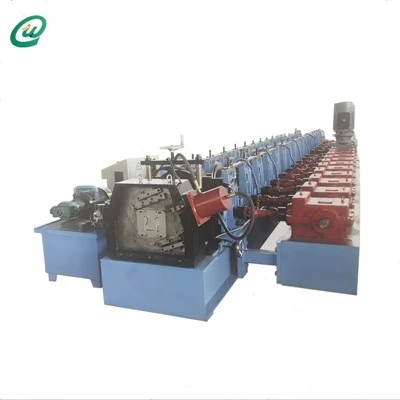

Hangzhou IUWON Technology Co., Ltd. is one of the most reliable manufacturers and suppliers of solar pv bracket roll forming machine in China. With abundant experience, we warmly welcome you to buy custom made solar pv bracket roll forming machine from our factory. Good service and reasonable price are available.
Profile Geometry for PV Mounting Structures
Solar mounting profiles are commonly designed with folds, ribs, slots, or channels that provide structural rigidity and create convenient fastening surfaces. The profile shape also determines how the component connects with bolts, nuts, clamps, or other mounting hardware.
The roller tooling progressively creates these features from the steel strip. For profiles with repeated mounting holes or slots, punching can be incorporated into the production sequence so that the finished section is ready for subsequent assembly.
Depending on the required component, the machine can be configured for:
Solar mounting brackets
PV support channels
Mounting rails
Base support sections
Roof mounting profiles
Ground-mount structural members
Solar carport support profiles


Main Technical Parameters
| Parameter | Typical Specification |
|---|---|
| Application | PV Mounting Structures |
| Material | Galvanized Steel / Al-Zn Coated Steel |
| Material Thickness | 1.50–3.00 mm |
| Coil Width | According to Profile |
| Yield Strength | ≤ 550 MPa |
| Forming Speed | 8–20 m/min |
| Forming Stations | 12–22 |
| Shaft Diameter | 60–90 mm |
| Shaft Material | 40Cr |
| Roller Material | GCr15 / 45# Steel |
| Main Motor | 11–22 kW |
| Transmission | Gearbox |
| Cutting | Hydraulic Cut-Off |
| Punching | Optional Servo / Hydraulic |
| Length Control | Encoder + PLC |
| Control | PLC + Touchscreen |
| Power Supply | 380 V / 50 Hz / 3 Phase |
Integrated Punching for Solar Connections
A photovoltaic mounting profile often requires a series of holes or slots for structural connections. Their spacing can be related to module dimensions, rail positioning, support-point intervals, or the selected fastening system.
The production line can incorporate programmable punching equipment to process these openings at predetermined positions. Depending on the profile design, punching can take place while the strip is flat or after selected forming operations.
The forming section then establishes the final bracket geometry. For heavier profiles, the machine can be equipped with reinforced roller stands and larger shafts to accommodate higher forming loads.
Line Configuration
| Component | Configuration |
| Coil Loading | Forklift / Coil Car |
| Decoiler | Hydraulic |
| Decoiler Capacity | 3–10 Tons |
| Strip Leveling | 5–7 Roller |
| Feeding Guide | Adjustable |
| Hole Processing | Servo / Hydraulic Punching |
| Forming Unit | Dedicated PV Tooling |
| Drive | Gearbox + Coupling |
| Cut-Off | Hydraulic |
| Measuring | Encoder |
| Discharge | Run-Out Table |
| Control Cabinet | PLC + HMI |
| Profile Tooling | Fixed / Interchangeable |
| Surface Protection | Optional Film Application |
Applications Across Solar Mounting Systems
The formed components can be incorporated into different photovoltaic support arrangements depending on the project structure and installation method.
Rooftop PV Systems
Mounting profiles can be used with roof attachments, rails, clamps, and brackets to establish a support interface between the roof structure and solar modules.
Ground-Mounted Arrays
Heavier formed sections can serve as structural members within ground-mounted solar systems, where higher section strength may be required.
Solar Carports
Formed steel members can be incorporated into carport structures that combine vehicle shelter with PV module installation.
Agricultural & Commercial Solar Projects
Customized mounting sections can be produced for farms, warehouses, factories, and large roof installations where repeated profile production is required.
The final component selection depends on the structural arrangement, module layout, wind and snow loads, support spacing, and fastening method of the solar system.
Profile Matching & Tooling Selection
PV mounting systems often contain several profiles with different functions. A mounting rail may require a narrow channel for sliding nuts, while a structural bracket may need deeper folds for increased stiffness. The roller tooling should therefore be developed from the finished profile rather than treating every solar component as the same type of section.
Before machine design, the following information can be used to determine the forming and punching configuration:
| Design Data | Purpose |
| Profile Drawing | Defines roller geometry |
| Material Thickness | Determines forming load |
| Steel Grade | Determines machine capacity |
| Coil Width | Defines feeding width |
| Hole / Slot Shape | Determines punching die |
| Hole Pitch | Determines punching control |
| Profile Length | Determines cut-off system |
| Surface Coating | Determines roller treatment |
| Required Output | Determines line speed |
| Mounting Method | Helps determine profile details |
For projects requiring several PV profiles, separate tooling sets can be supplied for different sections. This allows rails, brackets, channels, and support members to retain their individual geometries while using a production platform suited to the solar mounting system.
Hot Tags: solar pv bracket roll forming machine, China solar pv bracket roll forming machine manufacturers, suppliers, factory, Photovoltaic Bracket Roll Forming Machine, roll forming machine for solar structure, solar frame manufacturing line, solar mounting frame roll forming machine, solar panel frame strut roll forming machine, Solar PV Bracket Roll FormingMachine