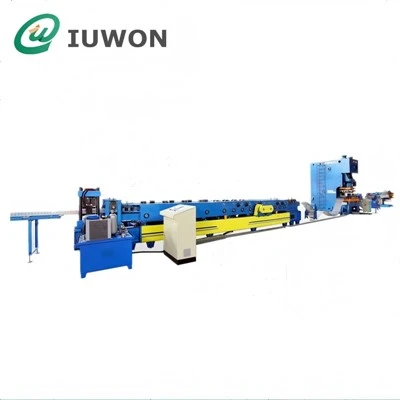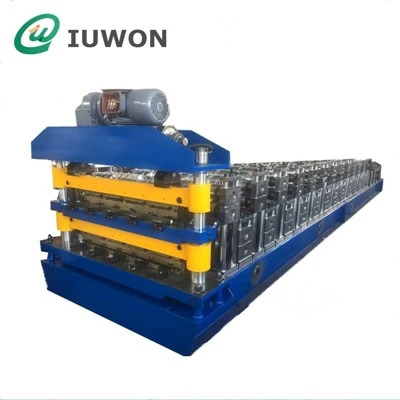

Hangzhou IUWON Technology Co., Ltd. is one of the most reliable manufacturers and suppliers of shelf roll forming machine in China. With abundant experience, we warmly welcome you to buy high quality shelf roll forming machine from our factory. Good service and reasonable price are available.
Shelf Components & Corresponding Dimensions
A storage shelf is generally assembled from several formed parts. Each component has a different structural function, so its section dimensions should be considered separately when configuring the machine.
Typical Shelf Component Parameters
| Component | Typical Dimension | Material Thickness | Main Function |
|---|---|---|---|
| Shelf Panel | W 600–1800 × D 300–800 mm | 0.60–1.20 mm | Carries stored goods |
| Shelf Support Beam | H 40–100 mm | 1.50–3.00 mm | Supports shelf panel |
| Front/Rear Beam | H 40–100 mm | 1.50–3.00 mm | Reinforces shelf edges |
| Panel Stiffener | H 15–40 mm | 0.60–1.20 mm | Reduces panel deflection |
| Upright Profile | W 40–100 mm | 1.50–3.00 mm | Vertical rack support |
| Cross Brace | W 30–60 mm | 1.20–2.00 mm | Stabilizes rack structure |
| Side Support | W 30–80 mm | 1.00–2.00 mm | Connects panel and frame |
| Shelf Lip | 15–40 mm | 0.60–1.20 mm | Strengthens panel edge |
The actual dimensions depend on the shelf load, rack height, bay width, storage method, and connection design. The machine tooling is manufactured according to the final profile drawing rather than these typical ranges alone.


Shelf Panel Forming & Load Distribution
The shelf panel is the component directly supporting cartons, containers, boxes, or other stored goods. A flat sheet can deflect under load, so many shelf panels use longitudinal ribs, return edges, or folded sides to improve stiffness.
The forming machine can produce these features continuously before the panel is cut to the required shelf length. Where the shelf design includes separate reinforcing ribs, an additional forming or stiffening section can be incorporated.
For perforated or slotted shelving, punching can be positioned before forming. The hole arrangement can be selected according to ventilation, fastening, or adjustable-storage requirements.
Shelf Panel Production Parameters
| Parameter | Typical Range |
|---|---|
| Panel Width | 300–1000 mm |
| Finished Length | 600–2000 mm |
| Material Thickness | 0.60–1.20 mm |
| Material | Galvanized / Cold-Rolled Steel |
| Yield Strength | ≤ 550 MPa |
| Reinforcement Ribs | 1–5 Rows |
| Forming Speed | 8–20 m/min |
| Forming Stations | 12–20 |
| Shaft Diameter | 50–70 mm |
| Main Motor | 7.5–15 kW |
| Cutting | Hydraulic / Flying Cut |
| Length Control | Encoder |
| Control | PLC + HMI |


Shelf Support Beams & Upright-Related Profiles
The shelf panel does not normally carry the entire load independently. Support beams underneath or along the panel edges transfer the load toward the vertical structure.
A support beam may use a box-like, C-shaped, Z-shaped, or folded section depending on the rack design. Compared with the shelf panel, these members generally use thicker steel and deeper sections.
Uprights form the vertical framework of the shelving system. Their profile often includes repeated holes or slots so that shelf levels can be adjusted. If the production line is intended to manufacture uprights, a dedicated punching system is required in addition to the roll forming section.
Structural Shelf Components
| Component | Typical Profile Size | Typical Thickness | Processing |
|---|---|---|---|
| Shelf Support Beam | 40–100 mm Height | 1.5–3.0 mm | Roll Forming + Cut |
| Front Beam | 40–80 mm Height | 1.5–2.5 mm | Roll Forming |
| Rear Beam | 40–80 mm Height | 1.5–2.5 mm | Roll Forming |
| Upright | 40–100 mm Width | 1.5–3.0 mm | Punching + Forming |
| Cross Brace | 30–60 mm Width | 1.2–2.0 mm | Forming + Cut |
| Panel Stiffener | 15–40 mm Height | 0.6–1.2 mm | Roll Forming |
| Side Support | 30–80 mm Width | 1.0–2.0 mm | Forming + Punching |
For adjustable shelving, the upright hole pitch must remain consistent over the entire profile. A servo punching system can be synchronized with material feeding to maintain the programmed hole spacing.
Complete Shelf Production Configuration
A shelving production line can be organized around the specific component being manufactured. A typical panel production sequence is:
Coil Loading → Leveling → Punching → Profile Forming → Length Cutting → Stacking
For support beams and upright profiles, the punching and forming sequence can be modified according to the connection design.
Recommended Machine Configuration
| Production Section | Configuration |
|---|---|
| Decoiler | Hydraulic / Manual |
| Coil Capacity | 3–5 Tons |
| Leveling | Optional 5–7 Roller |
| Servo Feeder | Optional |
| Punching Unit | Hydraulic / Servo |
| Roll Forming | Dedicated Shelf Tooling |
| Reinforcement Beading | Optional |
| Cut-Off | Hydraulic / Flying |
| Measuring | Encoder |
| Stacking | Automatic / Manual |
| Control System | PLC + Touchscreen |
| Tooling Change | Dedicated Tool Set |
Different shelf components should not necessarily share the same roller set. A shelf panel, support beam, and upright have different cross-sectional requirements, so dedicated tooling is normally prepared for each profile.
For a shelving manufacturer producing several panel widths, the machine can be configured around the required product range. If the cross-section remains unchanged, production length and selected punching patterns can be adjusted through the control system.
The final machine specification should therefore be established from the shelf panel drawing, support-beam section, upright profile, material grade, thickness, load requirement, and connection method. This approach ensures that the forming equipment corresponds to the actual shelving system rather than treating all rack components as one generic profile.
Hot Tags: shelf roll forming machine, China shelf roll forming machine manufacturers, suppliers, factory, drawer channel making machine, metal storage rack line, rack beam profile forming line, rack steel sheet forming line, roll forming rollers, storage shelving profile forming line