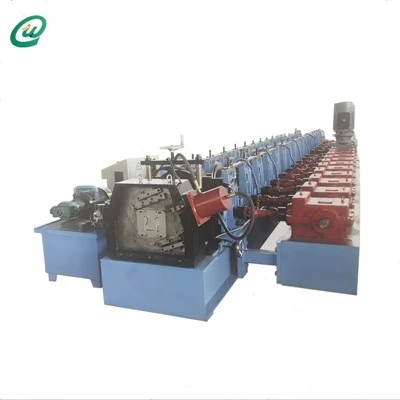

Hangzhou IUWON Technology Co., Ltd. is one of the most reliable manufacturers and suppliers of roll forming equipment racking & shelving in China. With abundant experience, we warmly welcome you to buy custom made roll forming equipment racking & shelving from our factory. Good service and reasonable price are available.
Racking Components & Production Requirements
Different rack members require different forming strategies. A rack upright normally combines roll forming with continuous punching, whereas a shelf panel may require stiffening ribs and edge folds. A pallet rack beam generally uses a deeper closed or semi-closed section to obtain the required load-bearing characteristics.

Main Component Specifications
| Racking Component | Typical Dimensions | Material Thickness | Main Processing |
|---|---|---|---|
| Rack Upright | 60–120 mm W × 60–100 mm D | 1.5–3.0 mm | Punching + Roll Forming |
| Pallet Rack Beam | 80–160 mm H × 40–80 mm W | 1.5–3.0 mm | Roll Forming + Cutting |
| Box Beam | 40–100 mm H | 1.2–2.5 mm | Roll Forming |
| Shelf Panel | 300–1000 mm W | 0.6–1.2 mm | Forming + Ribbing |
| Shelf Support | 30–80 mm H | 1.0–2.5 mm | Roll Forming |
| Cross Brace | 30–60 mm W | 1.0–2.0 mm | Forming + Cutting |
| Back Panel | 200–800 mm W | 0.6–1.2 mm | Forming / Punching |
| Guide Rail | 40–100 mm W | 1.5–3.0 mm | Roll Forming |
The actual profile dimensions are established from the rack design, required loading, bay width, beam span, shelf depth, and connection method.
Upright Punching & Beam Connection
Rack uprights are different from ordinary structural columns because they usually contain a continuous series of connection openings. These openings determine where beams or shelf supports can be installed.
The production line can integrate a servo punching system with the roll forming section. The punching unit processes the hole or slot pattern at a controlled pitch before the strip enters the main forming stations.
Depending on the rack design, the punching system can produce:
Teardrop-shaped slots
Keyhole slots
Rectangular openings
Round holes
Adjustment holes
Brace connection holes
Base plate mounting holes
The beam profile can then be formed separately with its own dedicated roller tooling. This allows the upright and beam to maintain the dimensional relationship required for assembly.
Upright Production Parameters
| Parameter | Typical Range |
|---|---|
| Material | Galvanized / Cold-Rolled Steel |
| Thickness | 1.5–3.0 mm |
| Upright Width | 60–120 mm |
| Upright Depth | 60–100 mm |
| Hole Pitch | 25–100 mm |
| Hole Length | 20–60 mm |
| Forming Speed | 6–15 m/min |
| Forming Stations | 16–24 |
| Shaft Diameter | 60–90 mm |
| Main Motor | 11–22 kW |
| Punching | Servo / Hydraulic |
| Cutting | Hydraulic |
| Length Control | Encoder |
| Control | PLC + HMI |
Shelf Panels, Beams & Reinforcement Profiles
The horizontal elements of a storage system can be manufactured with different sections according to their position and load.
Shelf panels generally use longitudinal ribs, folded edges, or stiffening features to improve rigidity. Their width and depth are selected according to the storage unit dimensions.
Pallet rack beams usually require a substantially deeper section. Their profile may incorporate multiple folds or return edges to increase stiffness and provide a connection interface with the upright.
For lighter shelving, compact beams and shelf-support profiles can be produced from thinner galvanized steel.
Shelf & Beam Parameters
| Component | Width / Height | Thickness | Typical Feature |
|---|---|---|---|
| Light-Duty Shelf | 300–600 mm | 0.6–1.0 mm | Ribbed Bottom |
| Medium Shelf | 400–800 mm | 0.8–1.2 mm | Folded Edge |
| Heavy Shelf | 500–1000 mm | 1.0–1.5 mm | Reinforcement Ribs |
| Shelf Beam | 40–80 mm H | 1.0–2.0 mm | Hook / Slot Connection |
| Pallet Beam | 80–160 mm H | 1.5–3.0 mm | Reinforced Section |
| Box Beam | 40–100 mm H | 1.2–2.5 mm | Closed / Semi-Closed |
| Support Rail | 30–80 mm H | 1.0–2.0 mm | Panel Support |
The roller tooling is designed separately for each cross-section. This is particularly important for beams because relatively small changes in section depth or flange geometry can affect the connection with the upright.
Production Line Configuration
A complete racking profile production system can contain several processing stages. The exact arrangement depends on whether the product is an upright, beam, shelf panel, or reinforcement member.
Typical Equipment Arrangement
Coil Decoiling → Leveling → Servo Feeding → Punching → Roll Forming → Cutting → Discharge
For profiles without holes, the punching stage can be removed. For upright production, synchronized punching is generally more important because the opening pattern must remain consistent throughout the profile.
| Machine Section | Configuration |
|---|---|
| Decoiler | Hydraulic / Manual |
| Coil Capacity | 3–10 Tons |
| Leveling | 5–7 Roller |
| Servo Feeder | Optional |
| Punching Unit | Servo / Hydraulic |
| Forming Unit | Dedicated Rack Tooling |
| Drive System | Gearbox |
| Cut-Off | Hydraulic / Flying |
| Length Measurement | Encoder |
| Run-Out Table | Heavy-Duty |
| Automatic Stacker | Optional |
| Control System | PLC + HMI |
For manufacturers producing multiple rack components, separate roller sets can be supplied for upright profiles, beams, shelf panels, and braces. This approach avoids forcing different components into one universal tooling arrangement.
The equipment can also be configured around the manufacturer's existing product drawings. Important inputs include steel grade, thickness, profile dimensions, hole/slot geometry, hole pitch, shelf width, beam span, finished length, and required load capacity.
This makes the production line suitable for manufacturers supplying different storage systems, from light-duty shelving to heavier warehouse pallet racking.
Hot Tags: roll forming equipment racking & shelving, China roll forming equipment racking & shelving manufacturers, suppliers, factory, metal storage rack line, Rack Roll Forming Machine, roll forming systems, Rollforming Equipment Racking Shelving, storage rack roll forming machine, warehouse shelving roll forming machine