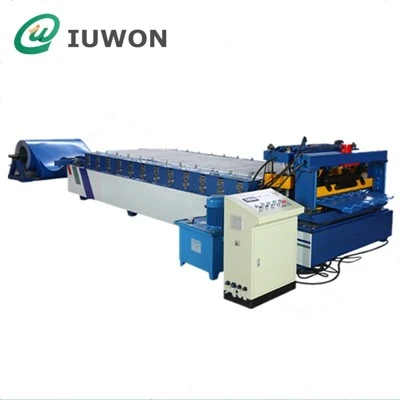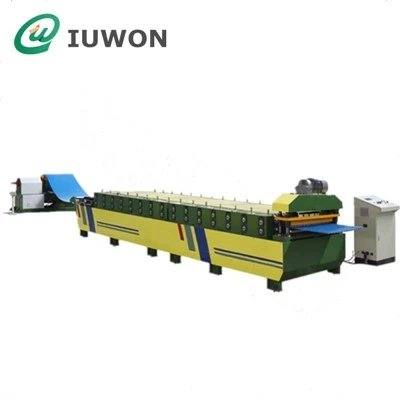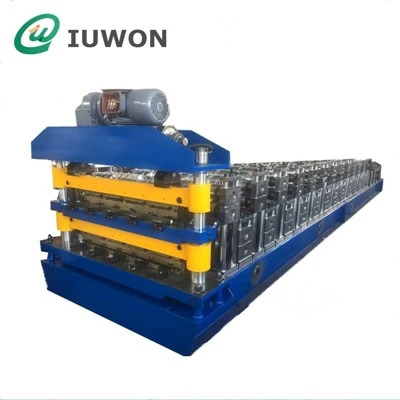

Hangzhou IUWON Technology Co., Ltd. is one of the most reliable manufacturers and suppliers of step tile roll forming machine in China. With abundant experience, we warmly welcome you to buy custom made step tile roll forming machine from our factory. Good service and reasonable price are available.
Step Tile Roll Forming Machine Structure
A typical production line is arranged as:
Coil Loading → Decoiling → Leveling → Roll Forming → Step/Tile Forming → Length Control → Cutting → Run-Out
The line can be configured with different levels of automation depending on production volume.
The main equipment includes:
Hydraulic or manual decoiler
Coil feeding and leveling section
Roll forming section
Step-forming / tile embossing unit
Hydraulic cutting system
PLC control cabinet
Hydraulic power station
Run-out table
Optional automatic stacker
Unlike a conventional corrugated roofing line, the forming section is combined with a controlled tile-pattern forming process to create the characteristic stepped appearance.

Typical Machine Specifications
| Item | Typical Specification |
|---|---|
| Machine Type | Step Tile Roofing Roll Forming Machine |
| Suitable Material | PPGI / PPGL / GI / GL Steel |
| Material Thickness | 0.30–0.80 mm |
| Coil Width | 1000–1250 mm |
| Effective Panel Width | 750–1100 mm |
| Tile Step Height | 20–40 mm |
| Tile Step Length | 250–400 mm |
| Forming Speed | 3–8 m/min |
| Forming Stations | 18–24 stations |
| Shaft Diameter | 70–80 mm |
| Shaft Material | 45# / 40Cr Steel |
| Roller Material | 45# Steel / GCr15 |
| Main Motor | 7.5–15 kW |
| Hydraulic Motor | 3–5.5 kW |
| Drive Type | Gearbox / Chain Drive |
| Cutting Method | Hydraulic Cut-to-Length |
| Control System | PLC + Touchscreen |
| Length Tolerance | ±1–2 mm |
| Voltage | 380V / 50Hz / 3 Phase |
| Installation | Complete Production Line |
Final specifications should be determined from the customer's roof profile drawing and material requirements.
Tile Profile Configuration
The appearance and mechanical behavior of a step tile panel are strongly influenced by the geometry of the repeated tile section.
Common configurable dimensions include:
| Profile Feature | Typical Range |
| Tile Height | 20–40 mm |
| Tile Pitch | 250–400 mm |
| Panel Width | 750–1100 mm |
| Rib Height | 20–45 mm |
| Sheet Thickness | 0.30–0.80 mm |
| Panel Length | 1.5–12 m |
| Side Lap Width | 20–60 mm |
| Forming Radius | According to material thickness |
Different tile dimensions require different roll tooling and step-forming arrangements. Therefore, the tooling should be developed from the actual cross-sectional and longitudinal profile rather than selecting rollers from a generic tile machine.
For projects using a non-standard tile pattern, the production line can be engineered around the customer's CAD drawing.
How the Step Pattern Is Formed
The production process can be divided into two forming directions.
Longitudinal Forming
The steel strip first passes through several roll stations that gradually create the main ribs and side geometry.
Each station performs a controlled amount of deformation. This reduces excessive stress concentration and helps maintain the designed roof profile.
Transverse Step Forming
After the basic roofing profile has been established, the sheet passes through the tile-pattern forming section. The equipment creates repeated transverse steps at programmed intervals.
The control system coordinates:
Sheet Feeding → Position Detection → Step Forming → Length Measurement
This synchronization is critical when producing panels with a consistent tile pitch.
Servo-Controlled Tile Positioning
For step tile production, the longitudinal position of every tile section needs to remain consistent.
A servo-controlled feeding system can be used where higher pattern accuracy is required.
Typical control functions include:
Programmable tile pitch
Position correction
Automatic length measurement
Servo synchronization
Production counting
Automatic stopping
Cutting position control
For example, when the required tile pitch is 350 mm, the control system maintains the programmed distance between successive step sections throughout the production run.
This is particularly useful for long panels where accumulated pitch deviation could otherwise become visible during installation.
Roll Tooling Design
The forming rollers are designed according to the actual roofing profile.
Typical tooling considerations include:
Sheet thickness
Material yield strength
Rib height
Tile geometry
Bending radius
Side-lap configuration
Surface coating
Required forming speed
Rollers can be manufactured from precision-machined steel and heat-treated where necessary.
For coated steel sheets, the forming sequence is designed to reduce unnecessary contact pressure and surface damage. This helps maintain the appearance of pre-painted roofing material after forming.
Material Compatibility
The equipment can be configured for several commonly used roofing materials.
| Material | Typical Application |
| Galvanized Steel | Residential & industrial roofing |
| Galvalume Steel | Corrosion-resistant roofing |
| PPGI | Colored architectural roofing |
| PPGL | Exterior roofing with coated surface |
| Pre-painted Steel | Residential and commercial projects |
A material thickness of approximately 0.30–0.80 mm is commonly used for this type of roofing product. Thicker material can be considered when the roll tooling, shaft system, drive capacity, and forming load are redesigned accordingly.
Cutting System
The finished panel is cut to the programmed length after the tile pattern has been formed.
A hydraulic cutting system normally consists of:
Hydraulic station
Cutting frame
Hydraulic cylinder
Replaceable blades
Length encoder
PLC-controlled cutting sequence
The machine can produce different panel lengths in the same production batch.
For example, one order may require:
3.0 m panels
4.5 m panels
6.0 m panels
The operator can enter the required length and quantity through the touchscreen interface.
Production Speed vs. Pattern Accuracy
The maximum line speed should not be considered independently from the tile geometry.
A shallow and relatively simple profile can generally run faster than a deeper tile pattern with more demanding step-forming requirements.
| Production Requirement | Typical Configuration |
| Standard Tile Profile | 5–8 m/min |
| Complex Tile Geometry | 3–6 m/min |
| High Pattern Accuracy | Servo-Controlled Feeding |
| High Production Volume | Automatic Stacking |
| Short Panels | Standard Run-Out |
| Long Panels | Extended Run-Out / Stacker |
For roofing manufacturers, a stable production speed with consistent tile pitch is often more valuable than pursuing the highest theoretical line speed.
Machine Frame & Transmission
The forming machine uses a rigid welded frame to support the forming shafts and roller stations.
Important structural components include:
Reinforced machine base
Forming station frames
Bearing housings
Steel shafts
Drive gearbox
Transmission components
Side guide system
For normal light-gauge roofing applications, chain or gearbox transmission can be selected according to machine configuration.
If the customer requires thicker steel or higher production loads, the machine frame and transmission system can be reinforced accordingly.
Applications
Step tile roofing panels are commonly used for:
Residential Buildings
The tile-shaped appearance provides an alternative to conventional flat or corrugated roofing while retaining the low weight of metal sheets.
Villas and Housing Projects
Pre-painted step tile panels can be produced in different colors and surface finishes for architectural roofing.
Commercial Buildings
Suitable for shops, offices, small commercial facilities, and other projects requiring a decorative metal roof profile.
Agricultural Buildings
The lightweight panels can be used for farm buildings, storage structures, workshops, and shelters.
Light Industrial Buildings
The profile can be adapted for warehouses and other low- to medium-demand roofing applications where the selected sheet thickness meets project requirements.
Why Choose a Step Tile Production Line?
A dedicated step tile production system provides several production advantages:
| Production Factor | Benefit |
| Controlled Tile Pitch | Consistent visual pattern |
| Multi-Pass Forming | Reduced profile deformation |
| Servo Positioning | Better step location accuracy |
| Hydraulic Cutting | Programmable panel lengths |
| PLC Control | Repeatable production parameters |
| Profile-Specific Tooling | Better dimensional consistency |
| Optional Stacking | Reduced manual handling |
The most important distinction from a standard roof sheet roll forming machine is the additional control required for the repeated tile pattern.
Customization Options
The machine can be configured according to different roofing markets and product specifications.
Possible customization includes:
Tile height
Tile pitch
Effective width
Sheet thickness
Coil width
Panel length
Side-lap geometry
Surface finish
Forming speed
Decoiler capacity
Cutting system
Automatic stacker
PLC brand
Electrical standard
A typical engineering input package should include the profile drawing, material grade, thickness, coil width, effective width, tile pitch, tile height, panel length, and target production capacity.
Quality Control
Machine accuracy depends on both manufacturing precision and final commissioning.
Key inspection points include:
| Inspection Item | Control Method |
| Roll Diameter | Precision Measurement |
| Shaft Diameter | Dimensional Inspection |
| Roller Alignment | Assembly Inspection |
| Profile Width | Finished Panel Measurement |
| Tile Pitch | Length Measurement |
| Panel Length | PLC + Manual Verification |
| Surface Quality | Visual Inspection |
| Cutting Accuracy | Sample Panel Testing |
| Machine Operation | Continuous Trial Run |
Before shipment, the machine can be tested with the customer's specified material to verify the profile geometry, tile pitch, cutting performance, and operating stability.
FAQ
What is the difference between a step tile machine and a corrugated sheet machine?
A corrugated sheet machine primarily creates continuous longitudinal waves or ribs. A step tile system additionally creates repeated tile-like sections along the panel length.
What steel thickness can the machine process?
A common range is 0.30–0.80 mm. The actual range depends on the profile design, material grade, roll tooling, and forming load.
Can the tile pitch be customized?
Yes. Tile pitch is one of the main profile parameters and can be designed according to the required roofing product.
Can I produce different panel lengths?
Yes. PLC-controlled cut-to-length operation allows different panel lengths to be programmed for production.
Can the machine use PPGI and PPGL?
Yes. The forming tooling can be designed for coated steel materials, with the forming sequence optimized to reduce surface marking.
Can you manufacture the machine according to my existing tile profile?
Yes. A profile drawing or sample panel can be used as the engineering reference for roller design and machine configuration.
Request a Profile-Based Quotation
For an accurate quotation, provide:
Profile Drawing + Material Thickness + Coil Width + Effective Width + Tile Height + Tile Pitch + Panel Length + Required Speed
The forming line can then be configured around the actual roofing profile instead of using a generic machine specification.
This approach is suitable for roofing manufacturers, building-material distributors, steel fabricators, and B2B production facilities that need a repeatable step tile roofing panel with controlled dimensions and consistent tile geometry.
Hot Tags: step tile roll forming machine, China step tile roll forming machine manufacturers, suppliers, factory, Cable Ladder Roll Forming Machine, capping roll forming machine, metal siding roll forming machine, Ridge Cap Roll Forming Machine, roll forming line, roof sheet crimping machine