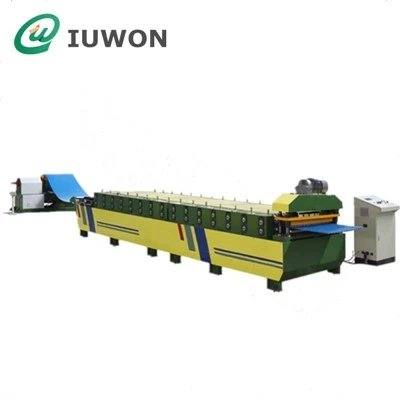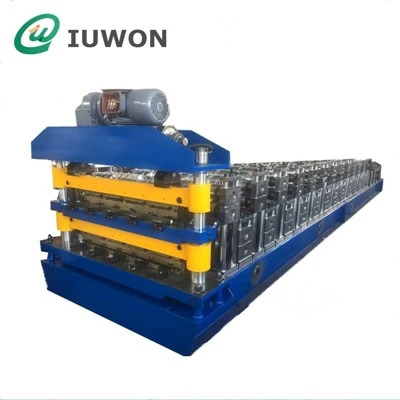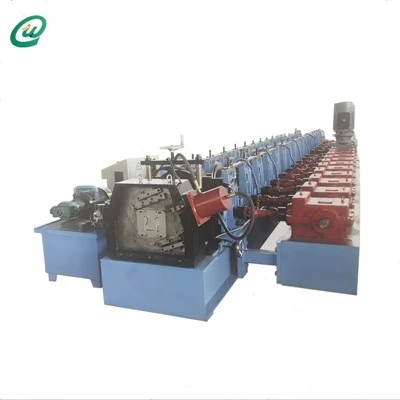
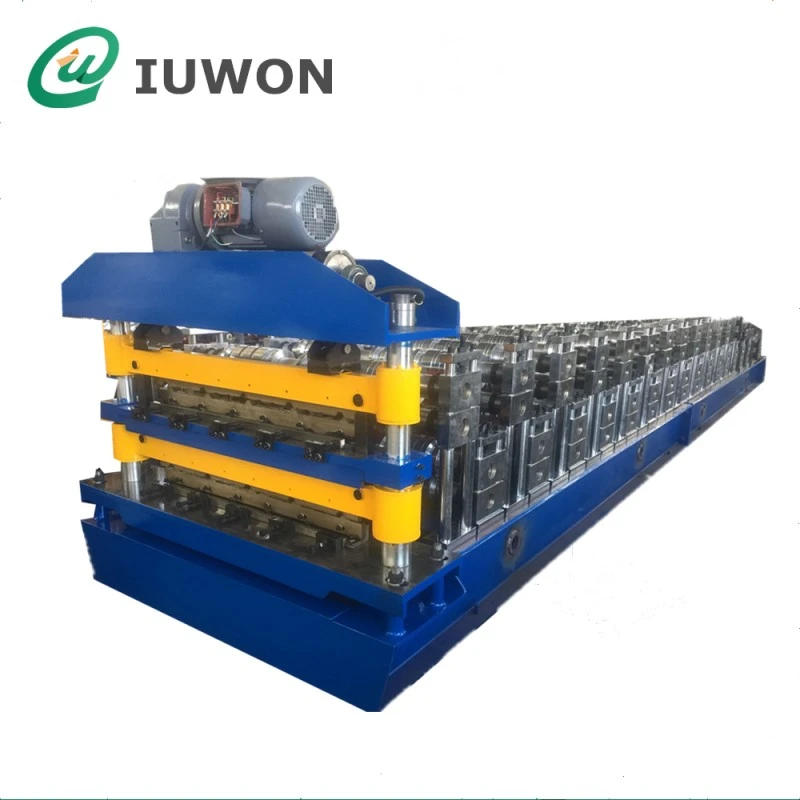
Hangzhou IUWON Technology Co., Ltd. is one of the most reliable manufacturers and suppliers of deck roll former in China. With abundant experience, we warmly welcome you to buy high quality deck roll former from our factory. Good service and reasonable price are available.
The Deck Roll Former is primarily developed for manufacturers producing structural metal deck profiles rather than conventional corrugated roofing sheets.
Typical products include:
Floor Deck Panels
Composite Metal Deck
Structural Floor Deck
Roof Deck Panels
Steel Floor Decking
Ribbed Deck Profiles
Trapezoidal Deck Panels
Deep Deck Profiles
The forming system can be designed for different profile depths and rib geometries. For structural applications, the roll tooling, shaft diameter, frame construction, drive system, and cutting unit need to be selected according to the actual steel thickness and profile configuration.
A typical production line follows:
Steel Coil → Decoiling → Guiding/Leveling → Roll Forming → Hydraulic Cutting → Run-Out → Stacking


Typical Technical Parameters
| Parameter | Typical Specification |
|---|---|
| Machine Type | Heavy-Duty Metal Deck Roll Forming Machine |
| Suitable Materials | GI Steel / Galvanized Steel / Pre-painted Steel |
| Material Thickness | 0.8–1.5 mm |
| Coil Width | According to profile design |
| Effective Width | Approx. 600–1000 mm |
| Deck Height | Approx. 50–200 mm |
| Forming Speed | 8–15 m/min |
| Forming Stations | 18–28 stations |
| Roll Shaft Diameter | 70–100 mm |
| Shaft Material | 40Cr / 45# Steel |
| Roll Material | GCr15 / 45# Steel |
| Roll Hardness | HRC 58–62, depending on tooling |
| Main Motor | Approx. 15–30 kW |
| Transmission | Gearbox / Chain / Gear Transmission |
| Cutting Method | Hydraulic Cutting |
| Cutting Accuracy | ±1–2 mm, depending on profile and length |
| Control System | PLC + Touchscreen |
| Electrical Supply | 380V / 50Hz / 3 Phase or Customized |
| Installation | Standalone or Complete Production Line |
Note: The final configuration should be calculated from the actual deck profile drawing, material grade, thickness, coil width, production speed, and required output.
Deck Profile Design & Forming Capability
The profile geometry is one of the most important factors when selecting a deck forming system.
A deeper deck profile can provide higher structural efficiency while maintaining controlled steel consumption. However, deeper ribs also increase the forming force and require more carefully designed roll tooling.
The machine can be engineered for different parameters such as:
| Profile Parameter | Typical Range |
| Deck Height | 50–200 mm |
| Panel Width | 600–1000 mm |
| Flange Width | 30–100 mm |
| Rib Pitch | 150–300 mm |
| Steel Thickness | 0.8–1.5 mm |
| Panel Length | 2–12 m |
| Material Yield Strength | Up to approx. 550 MPa |
Profile development should be completed from a 2D cross-sectional drawing before tooling production. This allows the forming passes to be calculated according to bend radius, material thickness, rib geometry, and springback characteristics.
Heavy-Duty Forming Structure
Structural decking places a higher load on the forming system than ordinary wall cladding panels. The machine frame therefore requires sufficient rigidity to maintain shaft alignment and roll positioning during continuous production.
The forming section normally consists of:
Heavy welded machine frame
Precision-machined forming shafts
Multi-stage forming rollers
Bearing housings
Gearbox or synchronized transmission
Side guides
Profile entry guide
Protective covers
Central lubrication system where required
The forming rollers progressively bend the steel strip instead of producing the entire profile in a single pass. This reduces localized deformation and allows the deck geometry to develop gradually through successive stations.
For heavier gauges, a larger shaft diameter and reinforced bearing arrangement can be selected to reduce shaft deflection under forming load.
Material & Tooling Selection
The roll tooling directly influences profile accuracy, surface quality, and production stability.
Typical material combinations include:
| Component | Recommended Material / Treatment |
| Forming Rollers | GCr15 / 45# Steel |
| Roller Surface | Precision Machined |
| Hardening | HRC 58–62 when required |
| Shafts | 40Cr / 45# Steel |
| Machine Frame | Welded Structural Steel |
| Bearings | Heavy-Duty Industrial Bearings |
| Cutting Blades | Cr12 / Cr12MoV |
| Transmission Components | Hardened Gear / Industrial Chain |
For galvanized steel, the tooling profile should be designed to minimize unnecessary surface marking. The forming sequence also needs to account for coating thickness and material springback.
High-Load Drive System
The drive system is selected according to the maximum material thickness, deck depth, forming station number, and required production speed.
For conventional deck profiles, gearbox-driven transmission provides stable torque delivery through the forming stations. For heavier structural profiles, synchronized gear transmission can be considered where higher forming torque and load distribution are required.
The drive section typically includes:
Main Motor → Gearbox → Transmission System → Forming Shafts → Roll Stations
A variable-frequency drive can be integrated to control line speed during startup, production, and stopping operations.
This allows the operator to reduce acceleration shock and maintain more stable movement when producing long deck panels.
Hydraulic Cutting System
The cutting unit separates the formed deck panel according to the preset production length.
The standard configuration can use hydraulic cutting with:
Hydraulic power station
Hydraulic cylinder
Cutting frame
Replaceable cutting blades
Length control through PLC
Automatic cutting after forming
The cutting system can be designed as cut-to-length after forming, which avoids interrupting the continuous forming process.
For projects requiring multiple panel lengths, the PLC can store different cutting-length settings and production quantities.
PLC Control & Production Management
The electrical control system coordinates the decoiler, forming line, cutting unit, and optional stacking system.
Typical functions include:
Production length setting
Production quantity setting
Automatic length measurement
Automatic cutting
Motor speed control
Emergency stop
Fault alarm
Hydraulic system control
Manual / automatic operation
Production counter
Parameter storage
A touchscreen HMI allows operators to monitor production parameters without manually adjusting each forming station.
For automated factories, the control system can also be integrated with upstream coil handling and downstream stacking equipment.
Complete Production Line Configuration
A standard Deck Roll Former can be supplied as a complete line:
| Equipment | Function |
| Hydraulic Decoiler | Holds and feeds steel coil |
| Coil Car | Assists heavy-coil loading |
| Leveling Unit | Corrects coil deformation |
| Entry Guide | Centers strip before forming |
| Roll Forming Machine | Produces the deck profile |
| Hydraulic Cutting Unit | Cuts panels to required length |
| Run-Out Table | Supports finished panels |
| Automatic Stacker | Collects and stacks finished decks |
| PLC Control Cabinet | Controls the complete line |
For high-volume production, an automatic stacker can be added to reduce manual handling of long and heavy panels.
Applications
The machine is suitable for manufacturers supplying structural metal products for:
Composite Floor Systems
Metal deck panels can serve as permanent formwork for concrete floor construction. The profile provides mechanical interlocking and structural support during concrete placement.
Industrial Buildings
Deck profiles are widely used in warehouses, factories, workshops, logistics centers, and large-span steel structures.
Commercial Buildings
Typical applications include shopping centers, office buildings, commercial facilities, and multi-story steel structures.
Roof Structures
Certain deck profiles can be produced for structural roof decking where the required profile geometry and load capacity are matched to the project design.
Mezzanine Floors
Deck panels can be integrated into steel mezzanine systems to create working platforms and intermediate floors.
Why Use a Dedicated Deck Forming System?
A conventional roofing sheet machine is not automatically suitable for structural deck production.
The difference mainly comes from profile depth, material thickness, forming load, tooling geometry, and machine rigidity.
A dedicated system provides:
Reinforced forming frame
Larger forming shafts
Higher forming torque
Profile-specific tooling
Controlled multi-pass forming
Heavy-duty transmission
Hydraulic cut-to-length operation
Custom profile engineering
This configuration is particularly important when the production target involves thicker steel, deeper ribs, or structural floor applications.
Custom Engineering for B2B Projects
Deck profiles vary considerably between construction markets. A standard machine configuration may therefore not be suitable for every project.
We can design the forming line according to:
Customer profile drawing
Steel grade
Material thickness
Coil width
Finished panel width
Deck height
Rib pitch
Required production speed
Panel length
Production volume
Local electrical standard
Factory space
For a new profile, the recommended engineering process is:
Profile Drawing → Material Analysis → Roll Pass Design → Forming Simulation/Calculation → Tooling Design → Machine Manufacturing → Trial Production → Final Inspection
This approach allows the machine configuration to be matched to the actual product instead of selecting equipment only according to nominal machine specifications.
FAQ
What materials can a Deck Roll Former process?
The machine is commonly designed for galvanized steel and pre-painted steel. Material thickness and yield strength should be confirmed before finalizing the forming tooling.
What is the normal production speed?
A typical production speed is approximately 8–15 m/min, although the actual speed depends on profile depth, steel thickness, forming station number, cutting method, and required dimensional accuracy.
Can the machine produce different deck profiles?
Yes. Different profiles generally require different forming rollers and sometimes different machine configurations. The tooling should be designed from the actual profile cross-section.
Can the line produce customized panel lengths?
Yes. PLC-controlled hydraulic cutting allows finished panel lengths to be programmed according to the customer's production requirements.
Is this machine suitable for roof deck and floor deck production?
Yes, provided the roll tooling and machine configuration are designed specifically for the required profile. Floor deck profiles normally require a more structural forming configuration than conventional roofing panels.
Can automatic stacking be added?
Yes. Automatic stacking, coil loading equipment, and other material-handling systems can be integrated according to production volume and factory layout.
Get a Deck Roll Former Designed for Your Profile
For a quotation, provide the deck profile drawing, steel thickness, coil width, material grade, required panel width, maximum panel length, and target production speed.
Based on these parameters, the forming stations, shaft diameter, roll tooling, drive capacity, hydraulic cutting system, and auxiliary equipment can be configured for the intended production line.
Hot Tags: deck roll former, China deck roll former manufacturers, suppliers, factory, corrugated metal roofing machine, Floor Deck Roll Forming Machine, ibr roll forming machine, r panel roll former, roofing machine manufacturers, wall panel fabrication equipment line