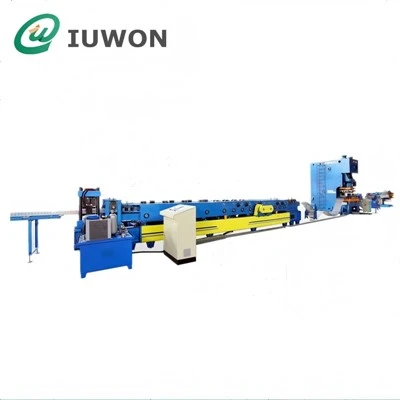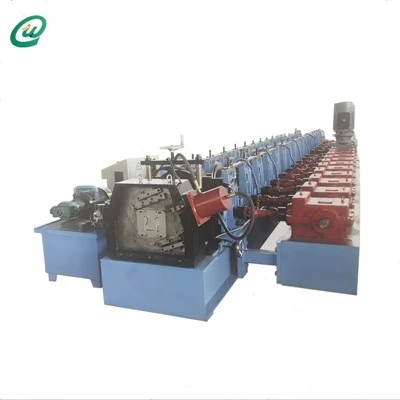

Hangzhou IUWON Technology Co., Ltd. is one of the most reliable manufacturers and suppliers of guard rail roll forming machine in China. With abundant experience, we warmly welcome you to buy custom made guard rail roll forming machine from our factory. Good service and reasonable price are available.
Corrugated Beam Structure
The characteristic corrugation of a guard rail increases the section's structural rigidity compared with a flat steel plate. During forming, the steel strip passes through dedicated stations that progressively establish the waves and longitudinal edges.
The forming sequence must maintain the relationship between the corrugated body and mounting holes. If hole positions shift relative to the beam centerline, installation with posts, spacers, and bolts can become difficult. The machine therefore combines profile forming with controlled punching and length measurement.
The tooling can be designed for different beam standards and dimensions, including profiles with different wave depths, beam widths, and material thicknesses.
Guard Rail Machine Parameters
| Item | Typical Specification |
|---|---|
| Application | Highway & Road Guard Rails |
| Material | Hot-Dip Galvanized Steel / Carbon Steel |
| Material Thickness | 2.5–4.0 mm |
| Coil Width | According to Beam Profile |
| Beam Type | 2-Wave / 3-Wave |
| Forming Speed | 8–12 m/min |
| Forming Stations | 18–24 |
| Shaft Diameter | 80–95 mm |
| Shaft Material | 40Cr |
| Roller Material | GCr15 / 45# Steel |
| Main Motor | 22–30 kW |
| Transmission | Gearbox + Universal Joint |
| Cutting Method | Hydraulic Cut-Off |
| Control | PLC + Touchscreen |
| Length Measurement | Encoder |
| Power Supply | 380 V / 50 Hz / 3 Phase |


Punching, Forming & Cut-Off in One Line
Guard rail beams normally require repeated mounting holes along their length. These holes allow the beam to be attached to posts through bolts, spacers, and other connecting hardware.
The punching section can be positioned before or after the main forming operation according to the beam design. For flat-strip punching, the hole pattern can be processed before the corrugation is created. This approach can provide stable hole positioning when multiple fixing holes are arranged across the strip width.
After forming, the continuous beam is cut into specified lengths. The PLC records the production length through an encoder and coordinates the punching and cutting sequence.
Production Line Configuration
| Unit | Configuration |
| Decoiler | Hydraulic Decoiler |
| Coil Loading | Hydraulic Coil Support |
| Coil Capacity | 5–10 Tons |
| Leveling | 7-Roller Leveler |
| Entry Guide | Heavy-Duty Adjustable Guide |
| Punching | Hydraulic / Servo Punching |
| Hole Pattern | Programmable |
| Forming Unit | Heavy-Gauge Roller System |
| Main Drive | Gearbox Transmission |
| Cutting | Hydraulic Cut-Off |
| Length Control | Encoder + PLC |
| Discharge | Heavy-Duty Run-Out Table |
| Control Interface | Industrial Touchscreen |
| Safety System | Guarding + Emergency Stop |
Road Safety Barrier Applications
The finished guard rail beams are installed horizontally along roads and connected to vertical posts. Depending on the road design, the barrier can be positioned along the outer edge of a roadway, central median, bridge approach, ramp, or other hazardous section.
Common applications include:
Highway roadside barriers
Expressway safety barriers
Central median guard rails
Bridge approach barriers
Tunnel safety barriers
Road curve protection
Ramp and interchange barriers
Industrial road safety systems
Parking and traffic separation areas
The production line can be configured for different beam lengths and hole patterns according to the installation system. Additional components such as spacer blocks, terminal sections, and connection parts can be manufactured separately or through dedicated equipment.
Guard Rail Standards & Production Matching
Road safety projects may specify particular beam dimensions, hole spacing, material thickness, galvanizing requirements, and impact-performance classifications. These requirements should be established before the forming rolls and punching tooling are designed.
For this reason, the machine configuration can be matched to the required guard rail specification, including:
| Production Requirement | Related Machine Design |
| Beam Wave Geometry | Forming Roll Profile |
| Steel Thickness | Forming Force & Drive Capacity |
| Beam Width | Roller Working Width |
| Hole Pitch | Punching Program |
| Hole Diameter | Punching Die |
| Beam Length | Encoder & Cut-Off |
| Surface Finish | Roller Surface Treatment |
| Production Volume | Line Speed |
| Coil Weight | Decoiler Capacity |
| Barrier Type | Dedicated Tooling |
For heavy-gauge highway barriers, the forming section, shafts, transmission, and machine frame can be reinforced to handle the higher forming load. The final configuration should be established from the required guard rail drawing and applicable road-safety specification so that the produced beam is compatible with its posts, connectors, and installation hardware.
Hot Tags: guard rail roll forming machine, China guard rail roll forming machine manufacturers, suppliers, factory, guardrail post forming machine, guardrail roll forming machine, guardrail roll forming machine manufacturers, guardrail roll forming machine suppliers, high speed guardrail forming line, Municipal road guardrail roll forming machine