

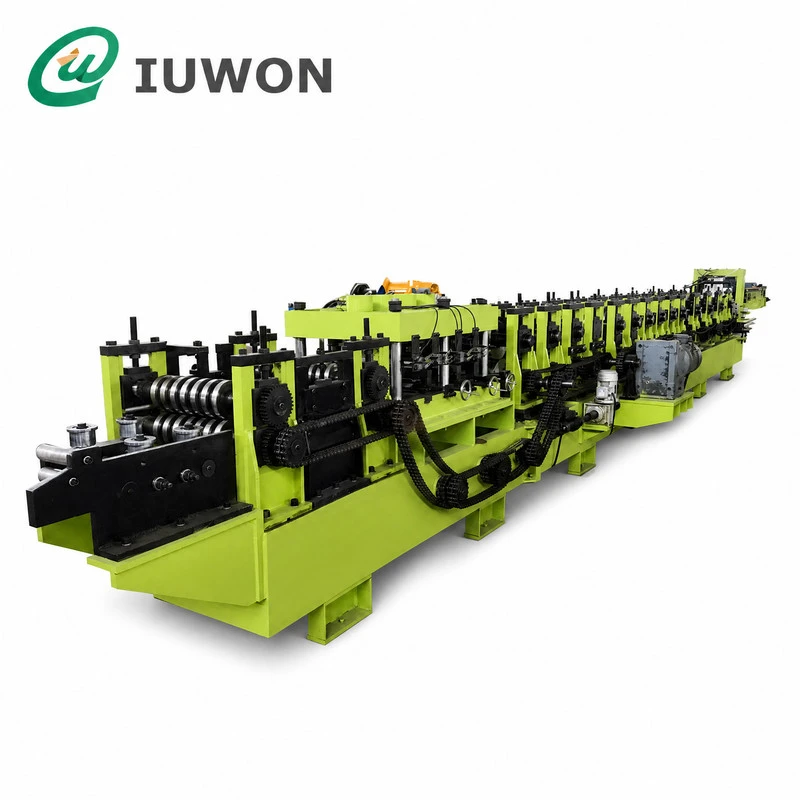
Hangzhou IUWON Technology Co., Ltd. is one of the most reliable manufacturers and suppliers of municipal road guardrail roll forming machine in China. With abundant experience, we warmly welcome you to buy high quality municipal road guardrail roll forming machine from our factory. Good service and reasonable price are available.
Guardrail Profiles for Urban Road Layouts
Municipal road barriers may be used in several positions, including road edges, central medians, intersections, bridge sides, and areas separating vehicles from pedestrians. The required barrier profile can consequently vary according to its installation position.
The forming rolls create the characteristic corrugated beam shape through a series of controlled passes. Corrugation increases the section's resistance to bending while allowing the beam to remain relatively lightweight compared with a solid structural member.
The tooling can be developed for different municipal barrier sections, including two-wave beams, three-wave beams, compact roadside profiles, and customized sections.
Machine Specifications
| Specification | Typical Range |
|---|---|
| Application | Municipal Roads & Traffic Barriers |
| Material | Galvanized Steel / Carbon Steel |
| Material Thickness | 2.0–4.0 mm |
| Coil Width | 300–700 mm |
| Beam Width | According to Profile |
| Forming Speed | 6–12 m/min |
| Forming Stations | 16–24 |
| Shaft Diameter | 70–90 mm |
| Shaft Material | 40Cr |
| Roller Material | GCr15 |
| Main Motor | 18.5–30 kW |
| Transmission | Gearbox Drive |
| Cutting | Hydraulic Cut-Off |
| Punching | Hydraulic / Servo |
| Control | PLC + HMI |
| Length Accuracy | Approximately ±1–2 mm |
| Electrical Supply | 380 V / 50 Hz / 3 Phase |


Hole Patterns & Installation Compatibility
For municipal road projects, the barrier beam needs to connect with posts, spacers, bolts, and other supporting components. The location of each mounting hole therefore has to correspond with the selected post spacing and connection arrangement.
A punching unit can be installed ahead of the forming section to process holes while the material remains flat. This arrangement is suitable for beams with repeated bolt holes along their length. For special profiles, the punching sequence can be adapted to the actual beam geometry.
The cutting system then separates the continuously formed beam into installation lengths. The length can be entered through the control interface, while an encoder tracks the material movement during production.
Processing Line Configuration
| Line Section | Configuration |
| Coil Decoiler | Hydraulic |
| Loading Capacity | 5–10 Tons |
| Strip Leveling | 7-Roller Leveler |
| Side Alignment | Adjustable Guide Unit |
| Hole Punching | Hydraulic / Servo |
| Punching Die | Replaceable |
| Forming Section | Heavy-Gauge Rollers |
| Roller Adjustment | Spacer-Based |
| Drive Transmission | Gearbox + Coupling |
| Cut-Off | Hydraulic |
| Length Detection | Encoder |
| Finished Beam Support | Heavy-Duty Table |
| Control Cabinet | PLC + Touchscreen |
| Safety | Guard + Emergency Stop |
Municipal Road & Public Infrastructure Applications
The finished guardrail sections can be incorporated into urban traffic-safety systems where physical separation is required between vehicles, pedestrians, structures, or opposing traffic flows.
Typical applications include:
Urban roadside protection
Central median barriers
Bridge-side protection
Road intersection barriers
Traffic island protection
Pedestrian separation zones
Municipal parking areas
School-zone road barriers
Industrial access roads
Urban construction-area protection
The barrier arrangement can be adapted to the road environment. For example, a median application may require barriers on both sides of a central structure, while a roadside installation may use a single barrier line supported by regularly spaced posts.
Production Matching for Municipal Projects
Municipal road projects can involve different barrier specifications depending on local road design and installation requirements. Before manufacturing the machine, the beam drawing and connection details should therefore be confirmed.
Important production data include:
| Required Information | Purpose |
| Beam Cross-Section | Determines roller geometry |
| Material Thickness | Determines forming load |
| Coil Width | Determines feeding arrangement |
| Corrugation Depth | Determines forming sequence |
| Hole Diameter | Determines punching die |
| Hole Pitch | Determines punching control |
| Post Spacing | Determines connection pattern |
| Finished Beam Length | Determines cut-off setting |
| Surface Treatment | Determines material selection |
| Required Output | Determines line-speed configuration |
For projects requiring galvanized barriers, the steel can be supplied with the specified corrosion-resistant coating before forming. The forming tooling can then be selected to minimize unnecessary damage to the coated surface.
For heavier municipal barriers, the machine frame, shafts, roller supports, and transmission can be reinforced according to the material thickness and required production load. The final machine configuration should be based on the actual guardrail section and installation specification rather than using one fixed setup for every municipal road project.
Hot Tags: municipal road guardrail roll forming machine, China municipal road guardrail roll forming machine manufacturers, suppliers, factory, guardrail post forming machine, guardrail roll forming machine manufacturers, guardrail roll forming machine suppliers, Highway Guardrail Roll Forming Machine, Municipal road guardrail roll forming machine, road guardrail roll forming machine


