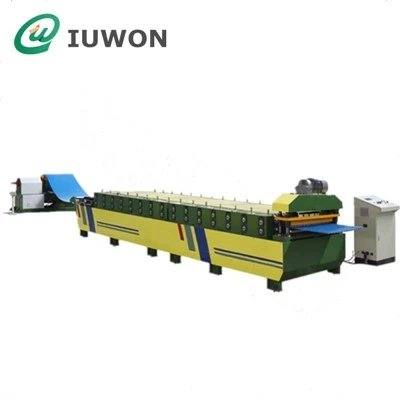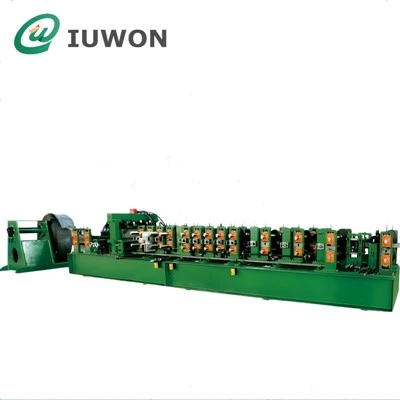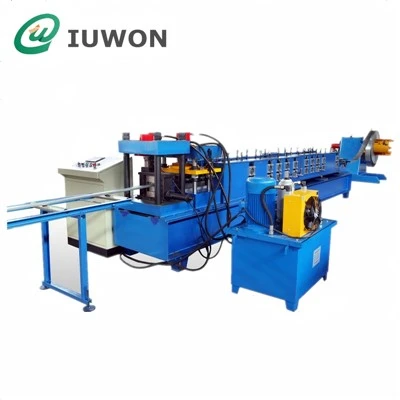
Core Components: The Precise Coordination of Two Pairs of "Rolling Pins"
Imagine two rolling pins lying side-by-side in a kitchen-the critical components of a roll forming machine are, in essence, two rows of cylindrical rollers. The upper row of rollers acts as the actively rotating "powered rolling pins," while the lower row serves as the passively following "auxiliary rolling pins." When a metal sheet is fed between this pair of "rolling pins," the upper rollers exert downward force-driven by hydraulic or mechanical pressure-while the lower rollers provide stable support. Much like using two hands in tandem to roll out dough, this process gradually thins or shapes the metal sheet.
The Working Process: Progressive "Kneading" and Forming
Unlike traditional stamping, which achieves a final shape in a single press, roll forming employs a progressive processing method characterized by "small increments applied repeatedly." The metal sheet-resembling a piece of "dough" traveling along a conveyor belt-passes sequentially through multiple sets of rollers: the first set imparts an initial curvature to the sheet; the second set further deepens the bending angle; and a third set might add surface patterns or reinforcing ribs. The geometry of each roller set is precisely calculated to induce continuous deformation, allowing the metal sheet to gradually "grow" into its final, intended shape. This process enables the production of complex cross-sections that would be difficult-if not impossible-to achieve using traditional molds, such as the wave-like structural beams found in automobile door sills.
Unveiling the Advantages: Why Is It Used in Both Automobiles and Home Appliances?
The "magic" of the roll forming machine lies in three key details: First, material utilization efficiency exceeds 95%-far surpassing the 70% typically achieved by stamping. Second, production speeds can reach up to 30 meters per minute, making the process ideal for large-scale mass production. Third, it offers an astonishing degree of geometric freedom; everything from the Z-shaped brackets used in air conditioners to the wave-patterned panels found in security doors can be produced simply by swapping out the roller sets. Even more impressively, the process simultaneously enhances the material's structural strength-much in the same way that crumpling a sheet of ordinary paper into a corrugated structure makes it far more resistant to compression.