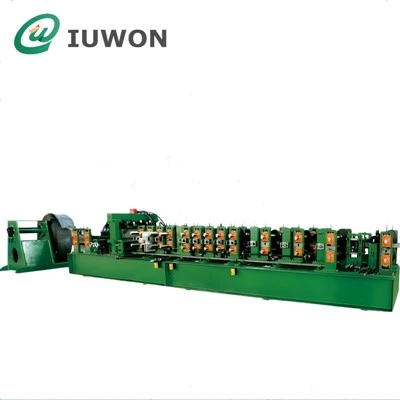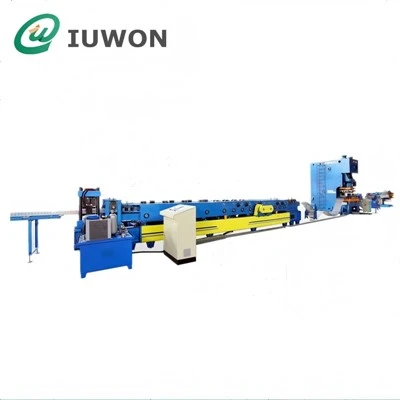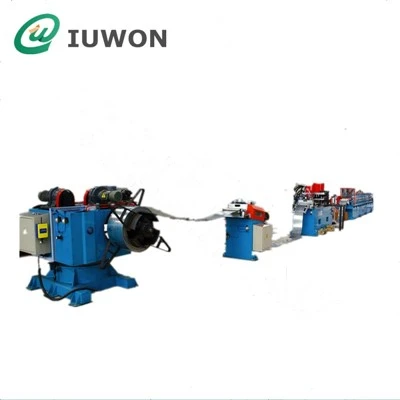

Hangzhou IUWON Technology Co., Ltd. is one of the most reliable manufacturers and suppliers of ladder rung roll forming machine in China. With abundant experience, we warmly welcome you to buy high quality ladder rung roll forming machine from our factory. Good service and reasonable price are available.
Rung Profile & Cable Support Surface
A ladder cable tray relies on repeated rungs to carry cables across the tray width. The rung geometry affects its stiffness, available bearing surface, and connection with the side rails.
A simple flat strip can be used for lighter cable loads, while a deeper formed section can provide greater rigidity. Ribs or folded edges may also be introduced where the rung needs additional resistance to deformation.
The forming tooling can be developed for different rung cross-sections, such as:
Flat ladder rungs
Raised-center rungs
Ribbed rungs
Channel-shaped rungs
Reinforced cable tray rungs
Slotted or perforated rungs

Rung Production Parameters
| Item | Typical Specification |
|---|---|
| Raw Material | GI / Pre-Galvanized Steel / Stainless Steel |
| Material Thickness | 0.80–2.50 mm |
| Strip Width | 30–100 mm |
| Finished Rung Length | 100–1000 mm |
| Coil Weight | 1–3 Tons |
| Forming Speed | 15–35 m/min |
| Forming Stations | 8–16 |
| Shaft Diameter | 50–70 mm |
| Shaft Material | 40Cr |
| Roller Material | 45# Steel / GCr15 |
| Main Drive | 5.5–11 kW |
| Drive Method | Gearbox |
| Cutting | Hydraulic / Pneumatic |
| Length Control | Encoder |
| Control | PLC + HMI |
| Power Supply | 380 V / 50 Hz / 3 Phase |
Rung Length & End Preparation
The rung is normally installed between two cable tray side rails, so its finished length needs to correspond with the internal tray width and the selected connection method.
After continuous forming, the profile can be cut into individual rungs at programmed intervals. Where the assembly requires special ends, additional equipment can be integrated to perform punching, notching, flattening, or other preparation.
For example, connection holes can be positioned near both ends of the rung so that it can be fastened to the side rails. Alternatively, the end can be shaped to engage directly with a slot or opening in the rail.
Optional Processing Arrangement
| Processing Stage | Available Option |
|---|---|
| Coil Pay-Off | Manual / Hydraulic |
| Material Straightening | Optional |
| Entry Alignment | Adjustable Guides |
| Profile Forming | Dedicated Roller Tooling |
| Reinforcement Beading | Optional |
| End Punching | Optional |
| End Notching | Optional |
| Length Cutting | Hydraulic Cut-Off |
| Servo Feeding | Optional |
| Measurement | Encoder |
| Collection | Run-Out Table |
| Automatic Stacking | Optional |
| Control Interface | Touchscreen HMI |
Integration with Ladder-Type Cable Trays
Once cut to length, the finished rungs are assembled horizontally between the two side rails of a ladder cable tray. Their spacing can be adjusted according to the type and quantity of cables being supported.
The rung production line can therefore be matched to different tray sizes and load categories.
Power Cable Trays
Wider and stronger rungs can support heavier power cables, particularly when the tray uses relatively large support spans.
Control & Instrumentation Trays
Medium-width rungs provide regular cable support while maintaining an open structure for inspection and maintenance.
Communication Cable Systems
Lightweight rung sections can be produced for data and signal cable installations where ventilation and accessibility are important.
Industrial Cable Bridges
Heavy-gauge rung designs can be used in larger cable-support structures installed above production areas or between buildings.
The finished rungs can be supplied in different lengths to match the internal width of the tray. Production can also be organized around several standard dimensions when the manufacturer supplies multiple ladder-tray sizes.
Rung Tooling & Production Matching
The roller set is developed from the required rung cross-section and material specification. Since the component is relatively narrow, maintaining strip alignment throughout forming is important, particularly when the profile includes a small central rib or folded edge.
The following information can be used when defining the production setup:
| Product Information | Related Production Requirement |
|---|---|
| Rung Cross-Section | Determines roller profile |
| Strip Thickness | Determines forming load |
| Rung Width | Determines strip development |
| Finished Length | Determines cut-off setting |
| Tray Internal Width | Determines available rung lengths |
| End Connection | Determines punching/notching |
| Rung Spacing | Guides production quantities |
| Cable Load | Influences section reinforcement |
| Surface Finish | Determines material and tooling treatment |
| Output Requirement | Determines line speed |
For manufacturers producing multiple cable tray specifications, separate forming tools can be prepared for different rung sections. The cutting program can then be adjusted to produce the corresponding lengths without changing the basic production principle.
The resulting equipment is focused on one specific part of the ladder cable tray: forming consistent transverse support members that can be repeatedly cut and assembled between the tray's side rails.
Hot Tags: ladder rung roll forming machine, China ladder rung roll forming machine manufacturers, suppliers, factory, hat channel roll forming machine, high speed profile forming machine, metal sheet making machine, roll form solutions, roll forming sheet metal, steel sheet making machine