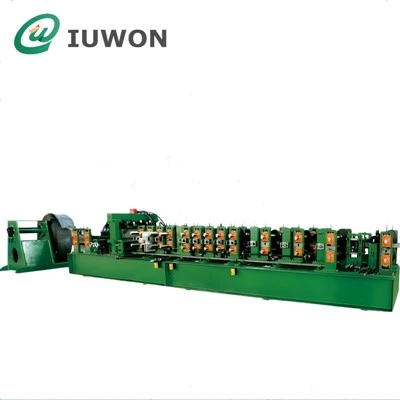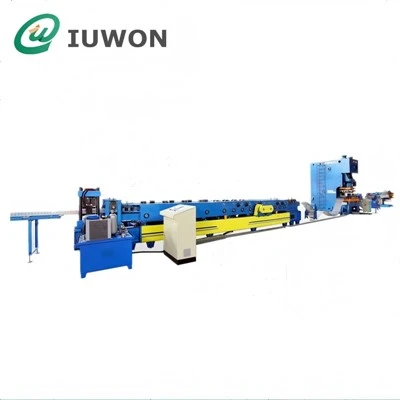

Hangzhou IUWON Technology Co., Ltd. is one of the most reliable manufacturers and suppliers of tunnel support profile roll forming machine in China. With abundant experience, we warmly welcome you to buy custom made tunnel support profile roll forming machine from our factory. Good service and reasonable price are available.
Heavy-Gauge Profile Forming
Tunnel support profiles commonly rely on a deep or curved cross-section to provide greater structural stiffness. The forming process gradually converts a heavy steel strip into the required section while controlling deformation across the entire width.
The roller arrangement is selected according to the steel grade, thickness, profile depth, and bending radius. Reinforcing ribs, return edges, mounting flanges, or connection surfaces can be incorporated into the section when required by the support design.
For curved tunnel supports, the completed profile may undergo a separate bending operation after roll forming so that the straight section can be matched to the tunnel radius.
Technical Parameters
| Parameter | Typical Specification |
|---|---|
| Application | Tunnel / Mine / Underground Support |
| Material | High-Strength Carbon Steel |
| Material Thickness | 3.0–8.0 mm |
| Material Width | According to Profile |
| Steel Strength | Up to 550 MPa |
| Forming Speed | 3–8 m/min |
| Forming Stations | 18–28 |
| Shaft Diameter | 90–120 mm |
| Shaft Material | 40Cr |
| Roller Material | GCr15 / Forged Steel |
| Main Motor | 30–55 kW |
| Drive Type | Heavy-Duty Gearbox |
| Cutting Method | Hydraulic Cut-Off |
| Control System | PLC + HMI |
| Length Measurement | Encoder |
| Power Supply | 380 V / 50 Hz / 3 Phase |


Structural Section & Tunnel Assembly
A tunnel support profile is normally installed as part of a larger support framework rather than used independently. The finished members can be connected to neighboring frames, longitudinal members, bolts, plates, or other reinforcement components according to the underground support design.
The machine can produce straight sections first, while a downstream bending unit can form them into the required tunnel curvature. This combination is useful when the support profile must follow a specific arch radius.
For profiles requiring connection holes, the punching operation can be incorporated into the production line. Hole spacing and location can be established according to the connection layout between adjacent support members.
Equipment Configuration
| Equipment | Available Configuration |
| Decoiler | Hydraulic Heavy-Duty Type |
| Coil Capacity | 5–15 Tons |
| Leveling | Heavy-Duty Leveler |
| Entry Guide | Reinforced Adjustable Guides |
| Punching | Hydraulic / Servo |
| Forming Rolls | Heavy-Gauge Profile Tooling |
| Shaft Support | Double-Sided Bearing Support |
| Transmission | Gearbox + Universal Joint |
| Cutting | Hydraulic Cut-Off |
| Length Detection | Encoder |
| Bending | Optional Hydraulic Bending Unit |
| Discharge | Reinforced Run-Out Table |
| Control | PLC + Touchscreen |
| Safety | Protective Guards + Emergency Stop |
Underground Construction Applications
The finished profiles are used in underground structures where steel support members are required to maintain the stability of excavated spaces.
Typical applications include:
Railway tunnel support
Road tunnel construction
Mining roadway support
Underground passages
Utility tunnels
Water-conveyance tunnels
Underground service corridors
Temporary excavation support
In mining applications, the profile may be installed as part of a steel arch support system. In civil tunnel construction, formed steel sections can be combined with shotcrete, rock bolts, mesh, or other reinforcement methods depending on the engineering design.
Profile dimensions can vary significantly between projects. A shallow section may be sufficient for one application, while deeper or thicker profiles may be required where greater structural capacity is specified.
Profile Design & Heavy-Duty Manufacturing
The forming tooling is designed from the finished tunnel support cross-section. Material thickness and steel strength are then used to determine the required forming force, shaft diameter, transmission capacity, and machine-frame strength.
Key design information includes:
| Profile Information | Machine Design Impact |
| Section Height | Determines roller diameter and pass arrangement |
| Section Width | Determines working width |
| Steel Thickness | Determines forming force |
| Steel Grade | Determines drive capacity |
| Bend Radius | Determines forming sequence |
| Rib Geometry | Determines roller profile |
| Connection Holes | Determines punching system |
| Support Radius | Determines downstream bending |
| Finished Length | Determines cutting system |
| Required Output | Determines line speed |
For heavy tunnel sections, the machine can use reinforced roller stands and larger-diameter shafts to reduce deflection under forming load. The transmission system can likewise be selected according to the actual material specification rather than applying the same drive configuration used for light-gauge profiles.
Where the support profile must follow an arch-shaped tunnel, a hydraulic bending system can be added after roll forming. The forming and bending stages can then be treated as two coordinated processes: the roll forming section establishes the structural cross-section, while the bending equipment establishes the required installation radius.
Hot Tags: tunnel support profile roll forming machine, China tunnel support profile roll forming machine manufacturers, suppliers, factory, forming machine manufacturer, Metal C Channel Roll Forming Machine, metal sheet making machine, roll form corporation, roll form solutions, Steel Roll Former