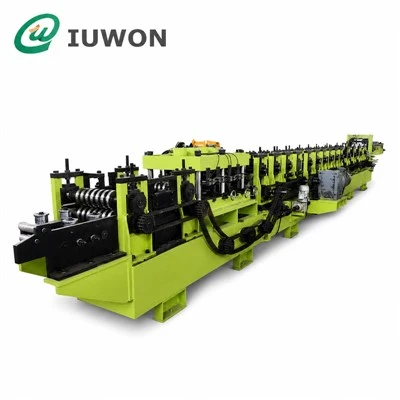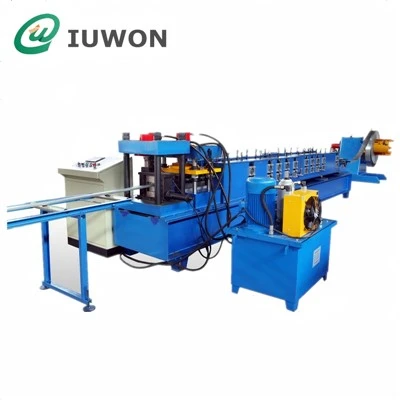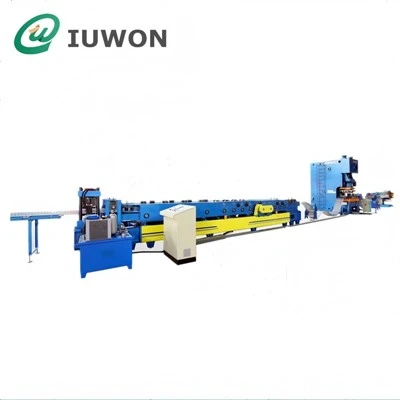
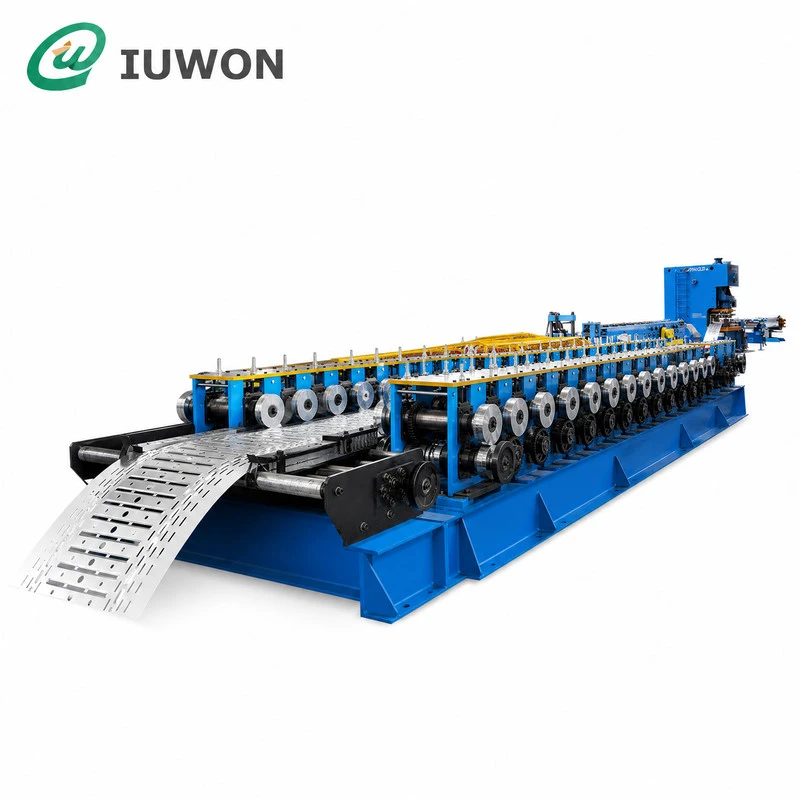
Hangzhou IUWON Technology Co., Ltd. is one of the most reliable manufacturers and suppliers of perforated cable tray cold roll forming machine in China. With abundant experience, we warmly welcome you to buy custom made perforated cable tray cold roll forming machine from our factory. Good service and reasonable price are available.
perforated cable tray cold roll forming machine Equipment Configuration
Four configurations are available for different material grades, forming dimensions and production conditions. Buyers can compare the following technical data when selecting a suitable production line.
| Technical Item | Economy | Standard | Heavy Gauge | High Speed |
|---|---|---|---|---|
| Applicable Steel | Galvanized steel | Galvanized steel / Q235 | Hot-dip galvanized steel / Q355 | GI / 304 stainless steel |
| Sheet Thickness | 0.5–1.1 mm | 0.7–1.7 mm | 1.4–2.4 mm | 0.9–1.9 mm |
| Tray Width | 100–250 mm | 100–400 mm | 200–600 mm | 150–800 mm |
| Flange Height | 20–45 mm | 25–90 mm | 45–140 mm | 40–180 mm |
| Roll Forming Stations | 12 sets | 16 sets | 20 sets | 22 sets |
| Shaft Diameter | 55 mm | 70 mm | 85 mm | 95 mm |
| Roller Material | GCr15, quenched | GCr15, quenched & tempered | GCr15, hard chrome plated | GCr15, hard chrome plated |
| Main Motor | 4 kW | 7.5 kW | 15 kW | 18.5 kW |
| Operating Speed | 10–14 m/min | 7–11 m/min | 4–7 m/min | 9–14 m/min |
| Punching System | Hydraulic cylinder | Hydraulic cylinder | Hydraulic cylinder | Servo hydraulic |
| Punching Unit Power | 3 kW | 5.5 kW | 9 kW | 11 kW |
| Cutting Method | Hydraulic stationary cut | Hydraulic stationary cut | Hydraulic stationary cut | Flying shear, non-stop cutting |
| Uncoiler Capacity | 2.5 ton | 4 ton | 6 ton | 8 ton |
| Transmission | Chain drive | Reducer gear drive | Reducer gear drive | Synchronized gearbox drive |
| Electrical Control | Basic PLC | PLC + touch screen | PLC + touch screen | Full servo synchronous control |
| Frame Construction | Welded steel frame | Reinforced welded frame | Thick steel plate welded frame | Integral cast base frame |
Four Key Sections of the Manufacturing Line
Each working section performs a specific task during metal processing. Their coordinated operation determines the finished profile dimensions, opening arrangement and cutting length.
Coil Feeding and Uncoiling
The uncoiler holds the steel coil and supplies strip material to the processing section. Available loading capacities range from 2.5 to 8 tons according to the selected configuration.
Progressive Profile Forming
Multiple roller stations gradually bend the flat steel strip into the required tray cross-section. The forming configuration is selected according to the width, flange height and sheet thickness.
Hydraulic Punching Operation
The punching section creates openings in the steel strip according to the selected die design. Hole dimensions, spacing and distribution can be evaluated according to the finished product drawing.
Length Cutting and Output
The cutting unit separates the formed profiles according to the required length. Hydraulic stationary cutting or flying shear can be selected based on the production model.

Engineering Customization for Your Product Range
A production line needs to match the actual products manufactured in your factory rather than follow a fixed specification. Our technical team reviews the required cross-section, material conditions and opening layout before determining the tooling and equipment arrangement.
For customized orders, the engineering discussion can cover the following details:
- Tray Geometry: Overall width, side wall dimensions, folded edges and bottom profile.
- Opening Design: Round holes, elongated slots, punching positions and distribution patterns.
- Steel Selection: Material grade, surface condition and thickness requirements.
- Production Arrangement: Roller station configuration, punching power, transmission and cutting method.
Customers can submit CAD drawings, dimensioned sketches or product samples for an initial technical assessment. The final configuration is confirmed after reviewing the manufacturing requirements.
Finished Cable Tray Types and Installation Environments
Different perforated cable tray cold roll forming machine support structures serve different electrical installation conditions. The required profile depends on cable quantity, environmental exposure and project design.
Industrial Electrical Rooms
Perforated structures provide a practical route for organizing power and control cables inside electrical rooms, factories and equipment areas.
Commercial Building Projects
Metal trays are used to organize electrical wiring routes in offices, shopping centers and other commercial buildings.
Power Plant Cable Routes
Ladder-style support profiles can accommodate large cable routing requirements in power generation and industrial facilities.
Industrial Cable Protection
Solid-bottom designs can be selected for installations where a closed supporting surface is required to reduce exposure to dust and splashes.
Installation, Commissioning and Trial Production
Before regular manufacturing begins, the complete production line needs mechanical positioning, electrical connection and operational testing. The following preparation sequence provides a reference for equipment installation.
Site and Foundation Check
Prepare the installation area, check foundation level and position the main frame according to the equipment layout.
01
Equipment Assembly
Connect the uncoiler, feeding section, forming equipment, punching unit and cutting station. Inspect shaft alignment and mechanical connections.
02
System Connection
Complete PLC wiring, motor connections, sensor installation and hydraulic pipeline connections. Inspect the circuits before startup.
03
Operational Verification
Conduct an unloaded test, check the control functions and calibrate feeding and cutting settings before processing the first steel strip.
04
FAQ
Q: Which machine configuration is suitable for thick steel sheets?
A: The heavy gauge model is designed for material thicknesses of 1.4–2.4 mm. Its configuration includes 20 forming stations, an 85 mm main shaft and a 15 kW main motor.
Q: What determines the punching die design?
A: The hole shape, opening dimensions, center distance, row arrangement and material thickness are the main factors. A finished product drawing helps determine the required die structure.
Q: Is a servo punching system available?
A: The high-speed configuration uses servo hydraulic punching, while the other three reference models use hydraulic cylinder punching systems.
Q: What is the difference between stationary cutting and flying shear?
A: The economy, standard and heavy gauge configurations use hydraulic stationary cutting. The high-speed configuration uses flying shear for non-stop cutting during production.
Q: Can different steel materials be used on the same production line?
A: Material compatibility depends on the selected machine configuration and tooling. Please confirm the steel grade and thickness range before ordering.
Q: What should buyers prepare before requesting a quotation?
A: Prepare a product drawing or sample, steel material information, thickness, tray dimensions and expected production speed. These details allow the manufacturer to assess the appropriate configuration.
Hot Tags: perforated cable tray cold roll forming machine, China perforated cable tray cold roll forming machine manufacturers, suppliers, factory, Cable Tray Former, cable tray forming machine manufacturers, cable tray section forming machine, cable tray section roll forming line, cable tray z channel forming machine, ladder type cable tray forming machine