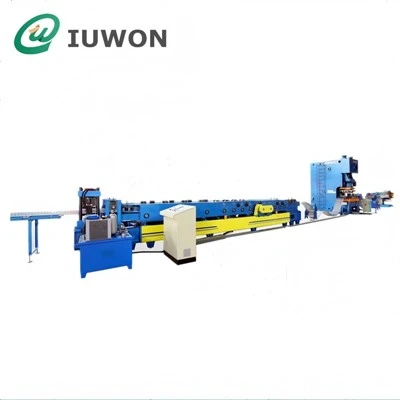

Hangzhou IUWON Technology Co., Ltd. is one of the most reliable manufacturers and suppliers of perforated cable tray roll former in China. With abundant experience, we warmly welcome you to buy custom made perforated cable tray roll former from our factory. Good service and reasonable price are available.
Perforated Cable Tray Roll former Description
| Parameter | Specification |
|---|---|
| Machine Type | Cable Tray Roll former |
| Applicable Material | Galvanized Steel, Carbon Steel, Stainless Steel |
| Sheet Thickness | Customized according to profile |
| Tray Width | Customized |
| Side-Wall Height | Customized |
| Perforation Type | Round / Slotted / Customized |
| Punching Position | Bottom / Side Wall / Flange |
| Forming Stations | Profile Dependent |
| Roller Material | Alloy Steel |
| Cutting System | Hydraulic Cutting |
| Control System | PLC |
| Production Mode | Continuous Automatic Forming |
Perforated Cable Tray Roll former Features
Controlled Perforation Layout
The punching system is configured around the required hole diameter, slot dimensions, pitch, and transverse spacing. This allows the perforation pattern to be incorporated into the production process rather than requiring separate drilling after forming.
01
Progressive Profile Formation
The tray profile is developed through multiple roller stations. Progressive bending distributes deformation across the forming stages and accommodates different bottom, wall, and flange geometries.
02
Flexible Hole Positioning
Perforations can be designed for cable ventilation, fastening, joining, or installation purposes. Their position can be specified according to the finished tray drawing and connection requirements.
03
Integrated Continuous Production
Punching, forming, and cutting are coordinated within one production line. The continuous workflow reduces the need to transfer semi-finished sheets between separate punching and forming equipment.
04
Perforation Design Considerations
The perforation pattern should be confirmed together with the cable tray cross-section before machine design. Hole diameter, slot length, longitudinal pitch, transverse spacing, edge distance, and the distance between holes and bending lines all affect the punching die and forming sequence.
For holes positioned near the tray side walls or flanges, the flat sheet width and forming deformation need to be considered together. The punching method may also vary by hole location: pre-punching can be used for holes on flat sections, while holes on formed surfaces may require a different punching arrangement.
When several perforated cable tray specifications are required, buyers should provide the complete profile and hole-pattern drawings for each size. IUWON can evaluate the roller layout, punching tooling, forming sequence, and changeover method according to the combined profile and perforation requirements.

Hole Position & Profile Accuracy
During continuous production, the perforation pattern and cable tray profile need to remain coordinated throughout the forming process. Any lateral deviation of the strip before punching can shift the hole position, while incorrect roller alignment may cause changes in tray width, side-wall angle, or flange position.
The feeding guides, punching unit, and forming stands should therefore be aligned as one production system. Roller clearance and forming pressure also need to match the selected sheet thickness to avoid excessive deformation around perforated areas.
For projects with specific dimensional requirements, buyers should provide the allowable tolerances for tray width, profile height, hole pitch, and finished length. These values can be considered during roller tooling, punching-die, feeding, and cutting-system design.
What Affects the Finished Length Accuracy of Perforated Cable Trays?
Finished length depends on the coordination of material feeding, length measurement, punching sequence, and cutting operation. During continuous production, the steel strip must advance according to the preset distance before the cutting unit receives the cutting signal. Feeding roller pressure, material thickness, and strip movement can all influence the actual feeding distance.
For perforated cable trays, the cutting length also needs to match the perforation layout. Buyers may require a fixed number of hole rows within each tray section or a specified distance between the final hole and the cut edge. Therefore, hole pitch, punching position, finished length, and cutting timing should be considered together during machine configuration.
When ordering the machine, buyers should provide the required finished lengths, dimensional tolerance, hole pitch, and the required end distance from the final perforation. IUWON can then configure the length measurement, punching sequence, and cutting system according to the actual cable tray production requirements.
Hot Tags: perforated cable tray roll former, China perforated cable tray roll former manufacturers, suppliers, factory, cable management tray forming machine, cable tray forming machine manufacturers, cable tray machine, cable tray roll, cable tray roll forming and cutting line, cable tray sheet forming machine