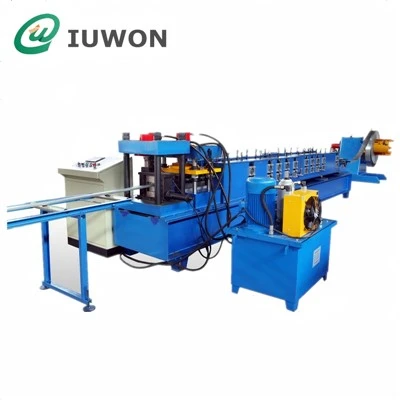
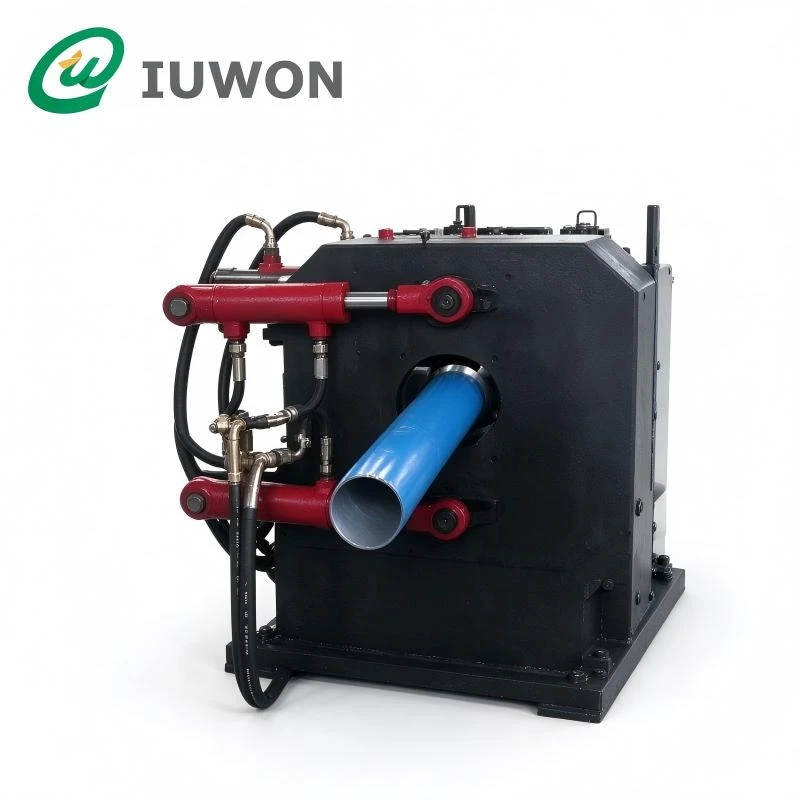
Hangzhou IUWON Technology Co., Ltd. is one of the most reliable manufacturers and suppliers of automatic round downspout roll forming machine in China. With abundant experience, we warmly welcome you to buy custom made automatic round downspout roll forming machine from our factory. Good service and reasonable price are available.
Automation functions to evaluate for your production line:
- Automatic or powered coil feeding, according to the selected decoiler configuration.
- Progressive roll forming for the specified circular profile.
- PLC-controlled production settings and length input.
- Encoder-based length measurement and cutting control.
- Batch quantity setting and production counting, where included.
- Coordinated forming and cutting operations.
- Optional finished-pipe collection and handling equipment.
The exact automation scope should be defined in the machine specification. Automatic length setting, for example, does not necessarily mean automatic coil loading, seam processing, packaging, or completely unattended production.
Automatic Round Downspout Roll Forming Machine Specifications
The following values are reference specifications published for IUWON round downspout equipment. They provide a starting point for equipment selection; the final automatic machine configuration must be confirmed against the required pipe diameter, material, production speed, and automation functions.
| Finished Product | Circular metal rainwater downpipe |
|---|---|
| Material Thickness | 0.4–0.7 mm |
| Suitable Materials | Galvanized steel, pre-painted steel, aluminum, copper, subject to compatibility confirmation |
| Typical Forming Speed | Approximately 10–15 m/min |
| Forming Stations | Approximately 10–16 stations, depending on design |
| Forming Method | Continuous cold roll forming |
| Pipe Diameter | Customized; confirm required diameter and supported range |
| Length Control | PLC and encoder-based control, subject to selected configuration |
| Cutting Length Tolerance | ±1.5 mm reference value; confirm under agreed operating conditions |
| Cutting Method | Hydraulic post-cutting reference configuration |
| Control Interface | PLC touchscreen; controller brand to be confirmed |
| Batch Quantity Setting | Available as a specified control function where included |
| Longitudinal Seam Processing | Configuration depends on pipe edge and closure design |
| Coil Width | Determined by pipe geometry, material development, and seam allowance |
| Finished-Pipe Handling | Manual collection or optional handling equipment, according to layout |
Important specification notes: The 10–15 m/min speed and ±1.5 mm cutting tolerance are reference figures, not guaranteed results for every material, length, or operating condition. Actual output depends on cutting frequency, pipe length, material properties, and downstream handling. Automatic functions must be listed individually in the final quotation to distinguish standard equipment from optional additions.
Automating Repeat Orders and Cutting-Length Management
Downspout manufacturers often produce the same diameter in several standard lengths, followed by smaller batches for specific building projects. Without a structured control system, frequent length changes and quantity tracking can increase operator workload and create opportunities for production errors.
A PLC-controlled line can simplify this work by allowing the operator to enter the required length and production quantity, where the selected control system supports these functions.
| Production Task | Manual-Dependent Workflow | Automated Control Approach |
|---|---|---|
| Length setting | Repeated manual adjustment and measurement | Enter the target length through the control interface |
| Cutting sequence | Operator-dependent coordination | Coordinate cutting with the programmed production settings |
| Batch quantity | Manual counting or separate records | Use a production counter where included |
| Repeat orders | Re-enter settings and verify setup | Reuse stored settings if the PLC supports recipe storage |
| Production monitoring | Operator checks at intervals | Use available operating status and fault indications |
| Change between lengths | Adjustment and test cutting | Change programmed length and verify the first finished pieces |
Automation reduces repetitive tasks, but it does not eliminate the need for first-piece inspection or process monitoring. Material changes, diameter changes, seam adjustments, and tooling maintenance may still require operator involvement.
For manufacturers with frequent repeat orders, it is useful to establish standard production recipes containing the pipe diameter, material specification, cutting length, and batch quantity. Whether these recipes can be stored and recalled depends on the control system supplied.
Keep Forming, Cutting, and Handling in Step
A round downspout line can form pipe continuously, but finished output is also influenced by how cutting and material handling interact with the forming process.
When the line cuts each pipe to a fixed length, the cutting cycle becomes part of the production calculation. Shorter pipe lengths generally require more cutting cycles for the same total output length. Longer sections, meanwhile, may need more space and better support during discharge.
Production coordination should address four areas:
- Forming: Maintain the specified circular geometry while feeding material through the roller stations.
- Length measurement: Ensure the control system measures the moving material correctly and triggers cutting at the required length.
- Cutting: Select a cutting arrangement suited to the material, wall thickness, target length, and production rate.
- Discharge: Provide sufficient space and support for finished pipes to prevent damage or interruptions.
For example, a line producing many short pieces may be limited by cutting frequency rather than forming speed. A line producing long pipes may instead need more attention to discharge space, operator access, and stacking.
The correct automation arrangement should therefore be based on the actual order profile, not only the machine's maximum running speed.
Customize Your Automatic Round Downspout Roll Forming Machine
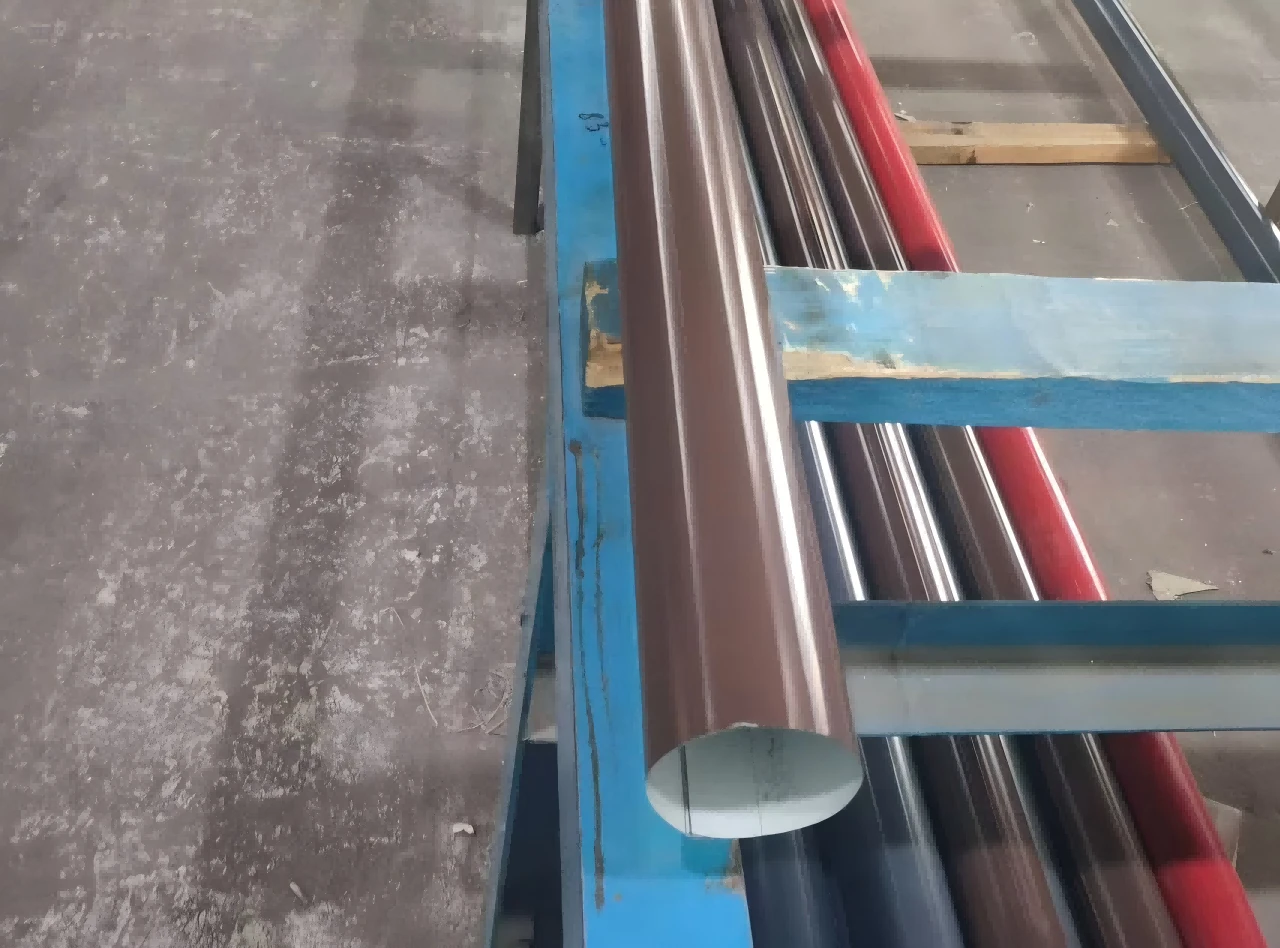
Diameter Changes and Production Scheduling
An automatic control system does not automatically make a round downspout machine suitable for every pipe diameter. Diameter flexibility depends on the forming tooling, machine structure, adjustment method, and permitted material range.
Before selecting an automatic configuration, manufacturers should classify their products by diameter, material thickness, and order frequency.
| Product Mix | Production Planning Priority |
|---|---|
| One main diameter with several lengths | Standardize length settings and batch quantities |
| Two or more diameters with large order volumes | Confirm tooling requirements for each diameter |
| Frequent changes between small batches | Evaluate setup time and whether adjustment can be automated |
| Different thicknesses within the product range | Confirm the supported thickness range and forming setup |
| Mixed standard and project-specific orders | Group orders to reduce unnecessary changeovers |
For a factory producing one main diameter throughout the day, automated length control and batch counting may offer more immediate value than automatic diameter adjustment.
For a manufacturer switching between multiple diameters, the first question is whether the proposed machine can physically accommodate those profiles. The second is how much time and labor each changeover requires.
Any claimed automatic size-changing function should be confirmed in writing, including the supported diameters, required adjustments, and whether tooling replacement is necessary.
Seam Quality and Dimensional Inspection Under Automated Production
Automation helps standardize machine operation, but the quality of the finished downpipe still depends on forming geometry, seam construction, material consistency, and setup accuracy.
A pipe that meets the programmed length can still fail to fit its connector if the diameter or seam alignment is outside the specified tolerance.
| Product Mix | Production Planning Priority |
|---|---|
| One main diameter with several lengths | Standardize length settings and batch quantities |
| Two or more diameters with large order volumes | Confirm tooling requirements for each diameter |
| Frequent changes between small batches | Evaluate setup time and whether adjustment can be automated |
| Different thicknesses within the product range | Confirm the supported thickness range and forming setup |
| Mixed standard and project-specific orders | Group orders to reduce unnecessary changeovers |
A practical inspection plan should include first-piece verification after setup or a material change, periodic checks during production, and final batch inspection based on the manufacturer's quality requirements.
If the machine supports stored settings, the production team should still confirm that the selected recipe matches the actual coil material and pipe specification before restarting a job.
Connect Straight-Pipe Production with Downstream Operations
Many downspout manufacturers supply more than straight pipe sections. Their product range may include elbows, connectors, offsets, brackets, and other drainage accessories.
An automatic straight-pipe forming line can support this workflow by producing standardized pipe sections with defined lengths and dimensions. However, elbow production and specialized end forming generally require separate processes or dedicated equipment unless explicitly included in the machine configuration.
| Downstream Operation | Production Coordination Requirement |
|---|---|
| Elbow manufacturing | Match the pipe diameter and connection design |
| Pipe connectors | Verify the finished pipe dimensions and joint geometry |
| End forming | Specify any flaring, reduction, or other end treatment |
| Finished-pipe bundling | Define bundle quantities and pipe lengths |
| Packaging and dispatch | Allocate storage space and protect finished surfaces |
Manufacturers supplying complete drainage systems should coordinate the dimensions of straight pipes with the associated fittings. Establishing common interface dimensions helps reduce assembly issues and makes it easier to manage products from different production batches.
If the goal is to reduce labor across the entire factory, discuss the complete workflow, including finished-pipe collection and packaging, rather than evaluating the forming machine in isolation.
FAQ
Does automatic operation mean the machine requires no operator?
Not necessarily. Automation can control specified production functions, but operators may still need to load coils, inspect products, manage material changes, supervise finished-pipe handling, and perform maintenance. The required staffing level depends on the supplied configuration and factory workflow.
Can the machine automatically produce different pipe lengths?
PLC-based length setting can support different cutting lengths when included in the control configuration. The required length range and tolerance should be confirmed before ordering.
Can the same machine produce several pipe diameters automatically?
That depends on the forming design. Automatic length control is different from automatic diameter adjustment. Confirm whether the proposed machine supports each required diameter and whether a tooling change or manual setup is necessary.
How should production speed be evaluated?
Use the complete production cycle rather than forming speed alone. Cutting frequency, finished length, material thickness, seam processing, and handling can all influence the number of completed pipes per shift.
Can production settings be stored for repeat orders?
This depends on the PLC and software configuration. If recipe storage is important, specify the required number of saved settings and the information each recipe must retain.
What information is required for an automatic machine quotation?
Provide pipe diameter, material grade, thickness, seam design, finished lengths, required tolerance, daily or monthly output, and the automation functions you want to include.
Request an Automatic Round Downspout Production Proposal
The right automation level depends on the work your factory performs every day. A manufacturer producing one diameter in repeat lengths may prioritize programmable cutting and batch counting. A factory serving several markets may need a broader tooling strategy, structured changeovers, and additional finished-pipe handling.
IUWON can review your production requirements to evaluate the forming, control, cutting, and handling configuration.
Please provide the following information:
- Required pipe diameter and cross-section drawing.
- Material grade, thickness, and coating.
- Standard and customized cutting lengths.
- Seam or closure design.
- Expected production volume and operating shifts.
- Number of diameters and frequency of product changes.
Required automation functions, such as length programming, batch counting, recipe storage, or finished-pipe collection.
Factory location and power supply requirements.
If the product drawings are not finalized, preliminary dimensions and current production details can support an initial assessment.
Contact IUWON to discuss an automatic round downspout roll forming machine configured around your production targets and automation requirements.
Customize Your Automatic Round Downspout Roll Forming Machine
Hot Tags: automatic round downspout roll forming machine, China automatic round downspout roll forming machine manufacturers, suppliers, factory, downspout machine manufacturer, gutter downspout machine, pipe forming machine for rainwater drainage, roof water drainage pipe forming line, round downpipe roll forming machine, steel downpipe forming line