An industry note from the iuwon engineering team
Global solar farm rollout continues to surge, driving enormous demand for solar strut channel in high volumes. For component manufacturers serving large EPC contractors, rooftop solar portfolios and ground-mount projects, production speed is no longer just a bonus feature - it is a core competitive advantage. A high-speed solar strut roll forming line built for mass output delivers steady, repeatable parts, shortens lead times for bulk orders and lowers per-unit production cost. However, high speed cannot come at the expense of dimensional stability, hole accuracy or surface quality. This article explains what defines a reliable high-speed strut line, the critical design features, and practical considerations for scaling solar strut production, with all iuwon tooling and lines engineered for a maximum forming width of 300 mm.
What "High-Speed" Means for Solar Strut Mass Production
Not all advertised high-speed roll formers are suitable for continuous solar strut runs. Many machines can hit fast empty-line speeds but lose precision once punching, cutting and stacking are engaged. For solar strut, true mass-production speed refers to sustainable, long-run operating speed while maintaining specification compliance.
Standard general-purpose strut lines often run steadily at 10–15 m/min. A properly engineered high-speed solar strut system can sustain continuous production from 18 m/min up to 25 m/min, depending on material thickness, slot pattern complexity and finished profile. This applies to common solar profiles within our 300 mm width envelope, including 41×21 mm, 41×41 mm, reinforced strut and related solar support channels.
It is important to set realistic expectations. Top-end speeds are easier to maintain on lighter gauges from 1.2 mm to 2.0 mm pre-galvanized steel. Heavy-gauge strut at 2.0–3.0 mm, stainless steel or dense slot layouts will require a reduced stable running speed to control springback, burr formation and tool wear. The goal is consistent hourly output, not momentary peak speed.
Rigid Machine Base and Drive System for Sustained High Speed
High speed amplifies vibration, frame deflection and dynamic loading. A lightweight, underbuilt machine will drift out of tolerance quickly during long production runs, creating twisted strut, misaligned slots and high scrap rates.
Stress-Relieved Heavy Welded Frame
The foundation of any high-speed line is a thick-plate welded frame with post-weld stress relief. This eliminates internal welding stress that causes slow dimensional shift under continuous vibration. Since our platform is optimized for a maximum forming width of 300 mm, the frame geometry balances stiffness and cost, without unnecessary bulk designed for extra-wide profiles. The rigid base keeps roller alignment stable even during multi-shift mass production.
Centralized Heavy-Duty Drive System
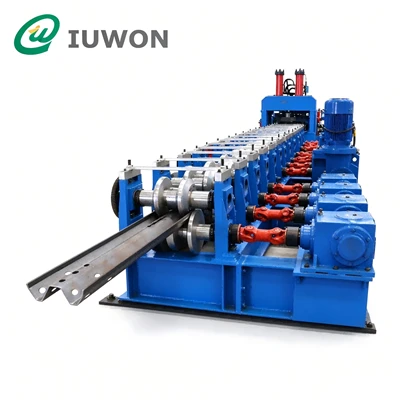
For high-volume solar strut, a centralized gearbox drive is preferred over individual small motors on each forming station. A single powerful main drive delivers synchronized torque across all roller stations, reducing speed variation between forming passes. This prevents strip slippage, uneven feed and progressive profile distortion. Solid forged forming shafts of 40 mm to 60 mm diameter are standard. Larger shafts resist bending under dynamic forming loads, keeping upper and lower rollers parallel at high line speeds. Loose bearings or flexing shafts are the most common causes of inconsistent strut flanges in fast-running lines.
Optimized Forming Station Layout
High-speed strut lines typically use 16–20 forming stations for standard slotted solar strut. Extra stations split each bend into smaller incremental deformations. Gentle, distributed bending lowers springback risk and reduces the shock load on rollers when the line accelerates. Fewer stations force sharper bends, which work at low speed but become unstable and noisy under continuous high-speed operation. All roller sets are designed within the 300 mm width limit.
Servo Flying Punching: The Bottleneck of High-Speed Slotted Strut
For slotted solar strut, punching is almost always the limiting factor for line speed. Mechanical pre-punching systems cannot keep up with fast feed rates and require frequent stops for pattern changes. Servo hydraulic flying punching is mandatory for mass high-speed production.
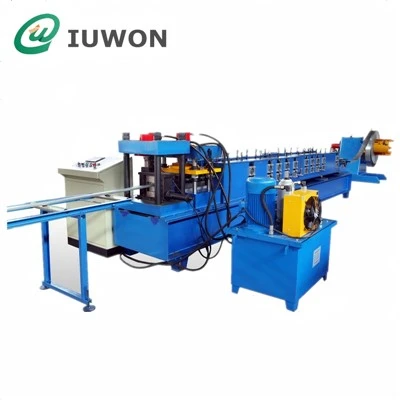
The flying punch unit tracks strip travel in real time via high-resolution encoders. It punches holes on the fly while the strip keeps moving, matching punch timing to line speed. Operators adjust slot pitch, hole size and punching density directly through the HMI without stopping the line. This is essential when running long batches for solar racking orders.
For high-speed use, the punch frame, guide posts and die holders must be reinforced to handle rapid cyclic impact. Undersized punch assemblies overheat, fatigue and generate heavy burrs at high cycle rates. A bypassable punch design adds flexibility: the same high-speed line can switch between slotted strut and plain solid channel within the 300 mm width range.
Clean, low-burr holes remain critical at speed. Excessive burr damages galvanized coating, slows spring-nut assembly and increases rejection from solar EPC customers. Premium die steel and precision die clearance are non-negotiable for long punch life under continuous cycling.
Synchronized High-Speed Cutoff and Length Control
At high line speeds, even tiny timing errors create large length deviations. Solar strut requires tight tolerances, usually ±0.5 mm to ±1 mm, so the cutoff system must be fully synchronized with encoder feedback.
Servo flying hydraulic shear is the standard choice for high-volume solar strut up to 2.5 mm. It completes fast, clean cuts without stopping the strip, supporting steady throughput. For material above 2.5 mm or stainless steel strut, a heavy-duty flying saw is selected to avoid rapid blade failure. Timer-based or simple proximity-switch cutting systems are not suitable for high-speed mass production. Feed roller slippage accumulates quickly, and batch quality drifts out of spec over time.
The control system continuously logs length data during runs, so operators can spot drift early before a large defective batch accumulates. All cutting assemblies on our lines are sized for the full 300 mm maximum forming width.
Feeding, Leveling and Stacking for Nonstop Mass Production
High-speed roll forming only delivers value if the upstream and downstream modules can keep pace. Bottlenecks at decoiling, leveling or stacking waste the capacity of the forming section.
Heavy-Duty Hydraulic Decoiler
A hydraulic single-head decoiler with 3–7 ton coil capacity is standard. Hydraulic expansion grips the coil inner ring firmly to prevent slipping or coil loosening as the line accelerates. Manual decoilers are unsuitable for high-speed continuous runs; they require constant operator intervention and introduce feed fluctuations. The decoiler width matches our 300 mm strip limit.
7-Roller or 9-Roller Precision Leveler
Coil camber and residual curvature become far more problematic at high speed. A 5-roller leveler cannot fully remove coil set for thick or high-yield galvanized strip. A 7 or 9-roller leveler reverses strip curvature in multiple directions to deliver flat, straight material into the forming stations. Consistent flatness reduces scrap and stabilizes both punching and forming quality at high feed rates.
Automatic Counting and Stacking
When producing thousands of strut pieces per hour, manual catching and stacking cannot match line speed. An automatic run-out table with programmable stop gates, counting and stacking collects finished parts continuously. It reduces surface scratches on galvanized surfaces, cuts labor dependency and enables longer unattended production shifts. The stacking table accommodates all profiles within the 300 mm forming width.
High-Speed Control Architecture and Recipe Management
A robust PLC and HMI system is the nerve center for synchronized high-speed operation. Every moving part - feed, punch, cutoff and stacking - must coordinate precisely.
The system should store production recipes for each solar strut variant: 41×21, 41×41, reinforced profiles and custom slot patterns. Operators recall saved recipes in seconds instead of manually tuning every parameter, which is critical when running back-to-back large batches for different solar clients.
High-speed lines also benefit from real-time monitoring functions: line speed, batch counter, punch cycle status, fault alarms and production logs. Remote diagnostic access allows technical support to review sync errors or parameter settings without waiting for on-site service. Electrical components must be rated for continuous cyclic operation; low-grade electronics will trigger frequent alarms under sustained high-speed running.
Tooling and Material Considerations for Long High-Speed Runs
Continuous high-speed production accelerates wear on rollers, punches and dies. Tooling selection directly affects uptime and maintenance frequency.
Cr12MoV tooling hardened to HRC 58–62 is recommended for galvanized solar strut. It resists abrasion and maintains smooth surfaces for millions of meters of production. Chrome-plated GCr15 rollers may suffice for low-speed light-gauge jobs but wear too quickly in mass production. Aluminum strut requires highly polished, non-marking roller surfaces to prevent scuffs. Stainless steel forming demands slower incremental bending and premium tooling to avoid galling.
Operational discipline also matters. Running beyond the recommended stable speed for a given gauge will shorten tool life dramatically. The best high-speed lines include clear safe operating ranges for each material type within the 300 mm width range.
Throughput Planning, Maintenance and Total Cost
Buyers often focus only on line speed, but usable hourly throughput depends on uptime. A faster line that stops repeatedly for tool changes, alignment fixes or jams will underperform a slightly slower, more stable system.
For mass solar strut production, plan scheduled preventive maintenance cycles: roller gap inspection, punch and die sharpening, bearing lubrication and encoder calibration. High-speed equipment needs regular checks of synchronization and vibration points to avoid unexpected breakdown during large orders.
Total cost of ownership balances capital investment, scrap rate, labor cost and consumable expense. A high-speed line built for mass solar projects reduces per-piece cost by spreading fixed overhead over higher output. It is especially suitable for manufacturers targeting repeat bulk contracts with solar racking suppliers and EPCs. Since our design is capped at 300 mm maximum width, you avoid paying for oversized structural components that would never be used.
Final Summary
High-speed solar strut roll forming for mass production is not just about fast feed rates. It requires a vibration-resistant rigid frame, synchronized servo flying punching, encoder-locked cutoff, heavy-duty feeding and automatic stacking, all coordinated by a recipe-based control system.
When properly configured for profiles up to 300 mm width, these lines deliver consistent, test-ready slotted strut at sustainable high throughput. This capability is a decisive advantage for manufacturers competing on large solar farm orders, where fast lead times and reliable bulk supply separate preferred suppliers from the rest. For solar component factories scaling output, a purpose-built high-speed strut roll forming line turns production capacity into reliable, long-term renewable energy supply contracts.