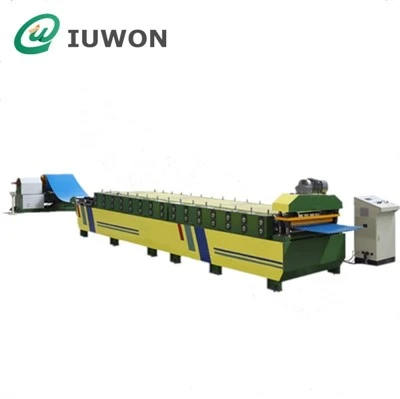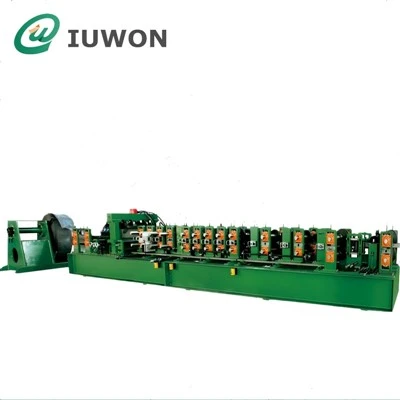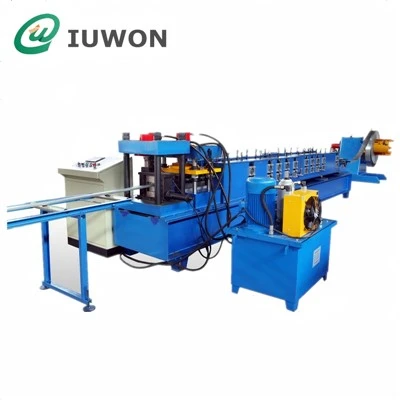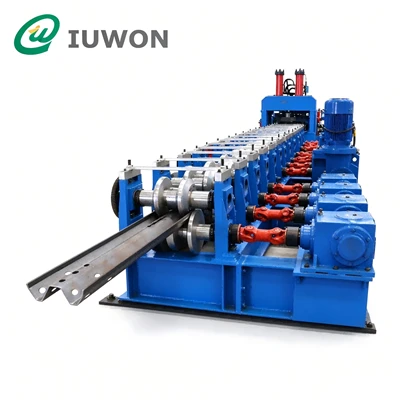
A roll forming machine is a continuous metal forming system used to manufacture long metal profiles with a consistent cross-sectional shape. Unlike press forming, which typically produces individual parts through separate stamping operations, roll forming gradually bends a metal strip as it passes through a series of rotating roll stations.
The process is particularly suitable for products that have a constant profile along their entire length, such as roof panels, wall panels, purlins, cable trays, door tracks, solar mounting profiles, guardrails, framing members, and structural channels.
A typical roll forming line consists of a decoiler, feeding system, roll forming stations, transmission system, cutting unit, hydraulic or electrical system, and control system. Depending on the product, additional equipment such as punching units, straightening devices, embossing systems, welding units, or automatic stacking systems can also be integrated.
The basic principle is straightforward: a flat metal strip enters the machine, passes through multiple roll forming stations, is progressively bent into the required cross-section, and is then cut to the specified length.
How Does a Roll Forming Machine Work?
The working principle of roll forming is based on progressive bending.
Instead of changing a flat metal sheet into the final profile in one operation, the machine divides the deformation process into multiple stages. Each roll station produces a small amount of bending until the material reaches its final geometry.
A simplified production sequence is:
Coil Loading → Uncoiling → Feeding → Punching/Pre-Processing → Progressive Roll Forming → Cutting → Discharge/Stacking
The exact configuration depends on the profile being manufactured.
Coil Loading and Uncoiling
The production process normally starts with a metal coil installed on a decoiler.
Common materials include:
Galvanized steel
Pre-painted steel
Carbon steel
Stainless steel
Aluminum
Galvalume steel
The decoiler releases the strip at a controlled speed while maintaining sufficient tension between the coil and forming section.
For heavier coils, a hydraulic expansion decoiler is often used because the coil weight and strip width can exceed the practical capacity of a manually loaded system.
Material Feeding
The feeding system guides the strip into the forming machine.
A straightening or leveling section may be installed before forming when the incoming coil contains excessive curvature or residual deformation.
The feeding system must maintain stable strip alignment because even a small lateral deviation can accumulate during progressive forming and eventually cause:
Uneven profile dimensions
Twisted sections
Asymmetric flanges
Scratches on the surface
Incorrect cutting positions
For precision profiles, feeding accuracy is therefore an important part of the complete roll forming system.
Progressive Roll Forming
This is the main forming operation.
The strip passes through a sequence of roll stations. Each station contains upper and lower forming rolls designed for a specific deformation stage.
For example, producing a simple C-shaped profile may involve:
Flat Strip → Initial Edge Bending → Side Bending → Flange Formation → Final Calibration → Finished C Profile
The first stations usually perform relatively small bends. Later stations gradually bring the profile closer to its final dimensions.
This gradual deformation helps distribute forming stress throughout the material instead of concentrating the entire deformation in one location.
Cutting the Finished Profile
After the profile reaches its final cross-section, the machine cuts it into predetermined lengths.
Two common cutting arrangements are:
Cut-to-Length After Forming
The finished profile continues through the forming section and is cut after reaching the required length.
This configuration is widely used for profiles such as:
C purlins
Z purlins
Cable trays
Door rails
Solar mounting rails
Pre-Cutting
The metal strip is cut into individual blanks before the main forming operation.
Pre-cutting can be useful for certain profiles and material conditions where the forming process requires individual pieces rather than continuous strip processing.
The appropriate cutting method depends on profile geometry, material thickness, production speed, and dimensional requirements.
What Are the Main Components of a Roll Forming Machine?
A roll forming machine is not simply a set of forming rollers. A complete production line normally combines several mechanical and electrical systems.
Decoiler
The decoiler supports and unwinds the raw material coil.
Depending on production requirements, it may be:
Manual
Automatic
Hydraulic expansion type
Single-end
Double-end
The selection depends primarily on coil weight, coil width, material thickness, and loading frequency.
Feeding System
The feeding mechanism introduces the strip into the forming section.
Typical components include:
Guide rollers
Feeding rollers
Side guides
Leveling components
Drive rollers
The purpose is to maintain stable material positioning before the strip enters the first forming station.
Roll Forming Stations
The roll forming stations are the core mechanical components of the machine.
Each station contains specially designed tooling. The geometry of these rolls determines how the metal strip is progressively bent.
The number of stations is not fixed.
A simple profile may require relatively few forming stations, while a complicated structural profile with multiple bends, narrow radii, stiffening ribs, or asymmetric sections may require substantially more.
Therefore, the number of rollers alone should not be used to judge whether one roll forming machine is better than another. Roll design, material thickness, profile geometry, shaft diameter, station spacing, and forming strategy are equally important.
Transmission System
The transmission system transfers motor power to the forming rolls.
Depending on machine design, it may use:
Gear transmission
Chain transmission
Universal joint transmission
Direct or servo-assisted drive arrangements
The transmission must provide synchronized rotation between forming stations.
For heavy-gauge structural profiles, the drive system must also provide sufficient torque to overcome the forming resistance of the material.
Cutting Unit
The cutting system separates finished profiles according to the programmed length.
Common configurations include:
Hydraulic cutting
Mechanical cutting
Flying cutting
Flying cutting systems allow the material to continue moving while the cutting operation takes place, making them suitable for higher-speed production lines.
The cutting die must be designed around the actual profile geometry to prevent deformation at the cut end.
PLC Control System
Modern roll forming machines commonly use PLC-based control systems.
The control system can manage:
Production length
Number of pieces
Forming speed
Cutting position
Punching sequence
Emergency stop functions
Motor operation
Fault alarms
An encoder is generally used to measure material movement so that the control system can coordinate cutting with the programmed profile length.
What Materials Can a Roll Forming Machine Process?
Roll forming is mainly used for coil-fed sheet and strip materials.
The most common material is steel because of its combination of strength, availability, and forming characteristics.
Galvanized Steel
Galvanized steel is widely used for construction profiles because the zinc coating provides corrosion resistance.
Typical applications include:
Purlins
Wall framing
Roofing components
Cable trays
HVAC profiles
Pre-Painted Steel
Pre-painted steel can be roll formed while maintaining the finished surface when the tooling and forming process are properly designed.
It is frequently used for:
Roofing panels
Wall panels
Architectural profiles
Interior construction components
Stainless Steel
Stainless steel requires greater forming force than many mild steels and can have stronger springback characteristics.
It is used when corrosion resistance or hygienic performance is important.
Applications include:
Food-processing equipment
Architectural components
Industrial enclosures
Special structural profiles
Aluminum
Aluminum has a lower density than steel but different yield strength and springback behavior.
Roll forming tooling therefore needs to be designed according to the specific aluminum alloy and profile geometry.
What Thickness Can a Roll Forming Machine Handle?
There is no universal thickness range for all roll forming machines.
A machine designed for thin roofing sheets may process material below 1 mm, while a heavy-duty structural roll former may process several millimeters of steel.
The actual capability depends on:
Material grade
Yield strength
Strip width
Profile geometry
Bending radius
Number of forming stations
Shaft diameter
Roll material
Motor power
Machine frame construction
For example, forming a 3 mm structural C profile requires a substantially different machine design from forming a thin corrugated roofing panel.
Therefore, specifying only "3 mm maximum thickness" is insufficient when evaluating a roll forming machine. The material grade and final profile must also be considered.
What Products Can Be Made by Roll Forming?
The technology is used across multiple industrial sectors because it can continuously produce profiles with a constant cross-section.
Construction Profiles
Common products include:
Roofing sheets
Wall panels
Floor decking
C purlins
Z purlins
U channels
Studs and tracks
Ceiling profiles
Door frames
Solar Mounting Profiles
Solar mounting structures are another major application.
Roll forming machines can manufacture:
Solar rails
Mounting channels
Strut channels
Purlins
Ground mounting posts
Structural beams
PV support profiles
For solar profiles, dimensional consistency is particularly important because the finished components need to interface with brackets, clamps, bolts, and other structural components.
Cable Management Products
Roll forming is also used for:
Perforated cable trays
Solid-bottom cable trays
Ladder cable trays
Raceway
Cable channels
Wire management profiles
Punching holes can be integrated into the production line before or during forming depending on the product design.
Automotive and Transportation Components
Roll forming can manufacture long structural components such as:
Vehicle rails
Reinforcement sections
Door components
Chassis-related profiles
Trailer components
The advantage is the ability to produce long, lightweight sections with controlled geometry.
Roll Forming Machine vs. Press Brake
Roll forming and press braking both bend sheet metal, but their production methods are fundamentally different.
| Feature | Roll Forming | Press Brake |
|---|---|---|
| Production method | Continuous | Batch |
| Material input | Coil or strip | Individual sheets |
| Profile length | Long continuous sections | Individual parts |
| Cross-section | Constant along length | Flexible |
| Production efficiency | High for repeated profiles | Suitable for varied parts |
| Tooling | Dedicated roll tooling | Press brake tooling |
| Automation | High | Variable |
| Best suited for | Large quantities of constant profiles | Low-volume or highly varied parts |
If a manufacturer needs thousands of meters of the same C-channel, cable tray, or roofing profile, roll forming can be more efficient than producing each component individually with a press brake.
However, if every part has a different geometry, a press brake may provide greater flexibility.
Why Does Roll Forming Require Multiple Roll Stations?
The purpose of multiple stations is to control the deformation of the strip.
If a flat strip were forced into a complicated profile in a single step, several problems could occur:
Excessive localized stress
Surface damage
Profile distortion
Edge cracking
Excessive springback
Poor dimensional accuracy
Progressive forming distributes the bending operation across multiple stations.
The tooling designer therefore needs to determine a suitable forming flower, which describes how the strip changes from its initial flat condition to the final cross-section through successive stations.
A well-designed forming flower helps control:
Bend angles
Flange development
Material flow
Edge deformation
Springback
Longitudinal strain
This is one of the most technically important aspects of roll forming machine design.
What Is Springback in Roll Forming?
Springback is the tendency of metal to partially return toward its original shape after the forming force is removed.
It is affected by:
Material yield strength
Material thickness
Bend radius
Profile geometry
Forming angle
Number of forming passes
High-strength steel generally presents greater springback challenges than softer materials.
Roll forming machines compensate for springback through tooling design and controlled over-forming. The forming rolls may bend the material slightly beyond the theoretical final angle so that the profile reaches the required geometry after elastic recovery.
What Determines the Quality of a Roll Formed Profile?
Finished profile quality depends on the entire forming system rather than one component.
Important factors include:
Material Quality
Variations in thickness, yield strength, and coating condition can influence the forming result.
Roll Tooling Design
Incorrect roll geometry can cause:
Twisting
Edge waves
Flange deformation
Surface scratches
Dimensional deviations
Machine Alignment
The forming stations need to remain properly aligned. Misalignment between shafts or rolls can cause progressive profile distortion.
Forming Sequence
The bending sequence must match the material's deformation characteristics.
Cutting Accuracy
The cutting unit must maintain the specified length without deforming the profile.
For precision applications, these factors need to be evaluated together rather than independently.
What Should You Consider When Selecting a Roll Forming Machine?
The machine should be selected based on the finished profile and production requirements, not simply by searching for a machine with a particular motor power or number of stations.
The main technical parameters include:
Profile Drawing
A detailed cross-sectional drawing is the starting point.
It should specify:
Overall width
Overall height
Flange dimensions
Bend radii
Hole locations
Tolerances
Material
Specify:
Material type
Yield strength
Tensile strength
Surface coating
Coil condition
Thickness
The material thickness determines forming force, roll dimensions, shaft requirements, and drive capacity.
Coil Width
The input strip width affects both tooling design and material utilization.
Finished Length
If multiple lengths are required, the control system and cutting configuration should support the required production range.
Production Speed
Required output determines the appropriate machine configuration.
However, maximum speed should not be considered independently of profile complexity and cutting requirements.
Punching Requirements
If the finished profile contains holes, slots, or connection openings, the punching process should be integrated into the line or coordinated with a separate operation.
Profile Tolerance
Structural profiles, architectural products, and precision components can have very different dimensional requirements.
The required tolerance determines the tooling and machine configuration.
Is a Roll Forming Machine Fully Automatic?
A roll forming line can be configured for highly automated production, but the degree of automation varies.
A basic system may require operators to:
Load the coil
Set the machine
Adjust guides
Collect finished profiles
A more automated line can integrate:
Automatic Decoiling → Servo Feeding → Punching → Roll Forming → Flying Cutting → Automatic Stacking
In such a system, the operator mainly manages material loading, production parameters, quality inspection, and machine maintenance.
Automation is particularly useful when the same profile is produced continuously in large quantities.
Conclusion
A roll forming machine is a continuous metal forming system that progressively bends coil-fed strip through multiple roll stations to produce long profiles with a constant cross-section.
Its performance depends on the interaction of several systems: material feeding, forming rolls, machine frame, transmission, cutting, control, and-when required-punching or other auxiliary equipment.
The technology is widely used for construction profiles, roofing and wall panels, purlins, solar mounting structures, cable trays, door components, automotive sections, and many other applications where consistent cross-sectional geometry and continuous production are required.
The most important point when evaluating a roll forming machine is that the machine should be designed around the product, not the other way around. Material grade, thickness, profile geometry, forming radius, tolerances, production speed, punching requirements, and finished length should all be established before determining the roll tooling and machine configuration.
For this reason, a professional roll forming machine project normally begins with the profile drawing, material specification, and production requirements, followed by forming simulation or tooling design, machine configuration, and final production testing.