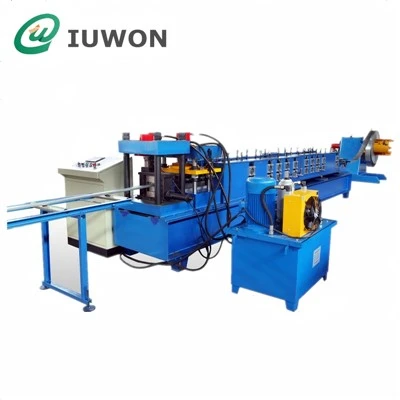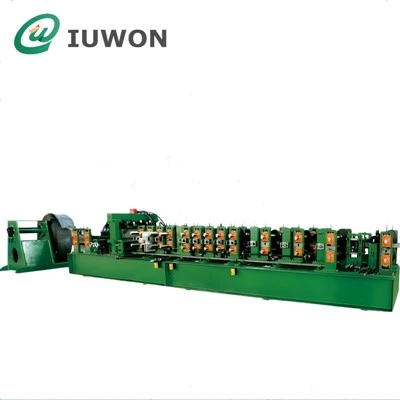

Hangzhou IUWON Technology Co., Ltd. is one of the most reliable manufacturers and suppliers of automatic c roll forming machine in China. With abundant experience, we warmly welcome you to buy custom made automatic c roll forming machine from our factory. Good service and reasonable price are available.
The performance of a C section depends strongly on the relationship between its web, flanges, and optional return edges. Rather than increasing material thickness for every application, the section can be modified through its geometry to obtain the required rigidity and connection surface.
Typical configurations include:
Open C section
C section with return lips
C section with reinforced web
Slotted C channel
Pre-punched framing section
Heavy-duty C structural profile
Customized asymmetric C section

Product Dimension Reference
| Profile Feature | Available Range |
|---|---|
| Web Height | 50–300 mm |
| Upper Flange | 20–100 mm |
| Lower Flange | 20–100 mm |
| Return Lip | 10–40 mm |
| Profile Thickness | 0.8–4.0 mm |
| Strip Width | 80–600 mm |
| Finished Length | 500–12000 mm |
| Hole Diameter | 5–25 mm |
| Slot Length | 10–80 mm |
| Hole Pitch | According to Drawing |
| Material Width Tolerance | According to Coil Specification |
These values are reference ranges. The actual forming range is determined by the required C-section and machine configuration.
Forming Stability for Long C Sections
Long C profiles can develop twisting, edge deformation, or dimensional variation if the strip is not properly guided during forming. The forming line therefore distributes the deformation over multiple passes rather than creating the final section abruptly.
The entry guide keeps the strip aligned with the centerline of the machine. Subsequent roller stations progressively establish the web and flange angles before the final stations complete the return edges or reinforcement features.
For profiles requiring tight dimensional control, the roller tooling can be designed with dedicated calibration passes near the end of the forming section.
The forming arrangement can include:
| Forming Area | Main Function |
|---|---|
| Entry Section | Centers incoming strip |
| Web Forming | Establishes central section |
| Flange Forming | Creates side walls |
| Lip Forming | Produces return edges |
| Reinforcement Section | Adds stiffening ribs |
| Calibration Section | Controls final geometry |
| Cut-Off Section | Separates finished lengths |
This arrangement is particularly suitable for C profiles that will later be assembled with other steel components, because consistent flange position and overall width help maintain predictable connection dimensions.
Automatic Production & Size Management
The automation system can manage the repetitive operations involved in producing long batches of C profiles.
Operators can enter the required finished length and quantity through the touchscreen. During production, the encoder tracks material movement and sends length information to the PLC.
For example, one production order may require several lengths of the same profile:
| Production Batch | Profile | Finished Length | Quantity |
|---|---|---|---|
| Batch A | C-Section A | 3000 mm | 100 pcs |
| Batch B | C-Section A | 4500 mm | 80 pcs |
| Batch C | C-Section A | 6000 mm | 60 pcs |
| Batch D | C-Section A | 7500 mm | 40 pcs |
The cross-section remains unchanged, while the cutting program changes according to the required length.
For C profiles with different hole arrangements, the control system can also coordinate feeding and punching parameters with the corresponding production program.
Machine Configuration
| System | Typical Configuration |
|---|---|
| Decoiler | Hydraulic |
| Maximum Coil Weight | 3–10 Tons |
| Leveling | 5–7 Rollers |
| Forming Stands | 14–26 |
| Drive System | Gearbox |
| Shaft Diameter | 60–100 mm |
| Roller Material | GCr15 / 45# Steel |
| Punching | Optional |
| Cutting | Hydraulic / Flying |
| Measuring | Encoder |
| PLC | Industrial PLC |
| HMI | Touchscreen |
| Automatic Counting | Standard |
| Stacker | Optional |
C Profile Quality Control & Customization
The finished C section is checked across several dimensions rather than only measuring its overall height.
Important inspection points can include:
Web height
Overall profile width
Flange angle
Return-lip position
Hole pitch
Hole diameter
Finished length
Straightness
Surface condition
For galvanized or pre-coated steel, roller surfaces and material-contact components can be selected to reduce unnecessary marking during production.
Customization FAQ
Can the machine be built for a C profile that is not a standard size?
Yes. The forming rolls can be designed directly from the customer's cross-sectional drawing, including non-standard web, flange, lip, and reinforcement dimensions.
Can the C section be made asymmetrical?
Yes. If the upper and lower flanges have different dimensions, the roller tooling can be designed around the asymmetric profile.
Can the machine automatically produce different lengths?
Yes. When the cross-section stays the same, different finished lengths can be programmed through the PLC and encoder-based measuring system.
Can holes be positioned at different distances along the profile?
Yes. An integrated servo punching system can be programmed for different hole pitches and positions according to the production drawing.
Can the machine produce C profiles with closed or folded edges?
Return lips and additional folds can be incorporated when the required section allows sufficient forming space.
How do you determine whether one machine can produce several C sizes?
The web height, flange dimensions, thickness range, and overall profile development are compared first. If the sizes fall within a technically compatible range, interchangeable tooling may be considered. Otherwise, separate tooling is more appropriate.
Can the machine be designed for heavy C sections?
Yes. For thicker steel, the machine can be equipped with larger shafts, reinforced stands, higher-capacity bearings, and a suitable transmission system.
What do you need to design the automatic C roll forming machine?
The most important information is the C-section drawing, material thickness, steel grade, coil width, flange and lip dimensions, hole pattern, required finished lengths, and target production speed. A physical sample can also be useful when an existing C profile needs to be reproduced.
Hot Tags: automatic c roll forming machine, China automatic c roll forming machine manufacturers, suppliers, factory, asc rollformer, channel making machine, metal sheet making machine, profile roll forming machine, roll form solutions, steel roof making machine