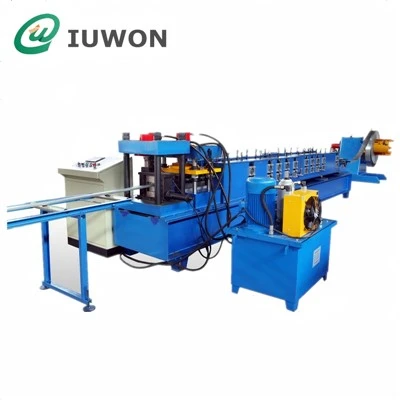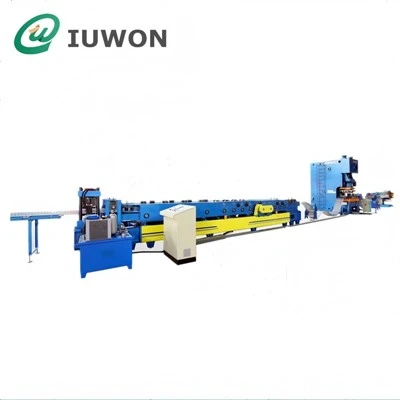

Hangzhou IUWON Technology Co., Ltd. is one of the most reliable manufacturers and suppliers of cable tray cover roll forming machine in China. With abundant experience, we warmly welcome you to buy custom made cable tray cover roll forming machine from our factory. Good service and reasonable price are available.
Cable Tray Cover Roll Forming Machine Specifications
|
Parameter |
Configuration |
|---|---|
|
Product Type |
Cable Tray Cover |
|
Material Options |
Galvanized Steel / Carbon Steel / Stainless Steel |
|
Material Thickness |
According to Cover Design |
|
Cover Width |
Customized |
|
Cross-Section Shape |
Based on Customer Drawing |
|
Forming Method |
Continuous Cold Roll Forming |
|
Roller Tooling |
Profile-Specific Roll Set |
|
Forming Stations |
Determined by Profile Geometry |
|
Cutting System |
Hydraulic Cutting |
|
Length Measurement |
Encoder-Based |
|
Control System |
PLC with Touchscreen |
|
Line Configuration |
Customized to Production Requirements |
Technical specifications can be customized according to the customer's profile drawings, material specifications, and production requirements.

How the Cable Tray Cover Roll Forming Machine Works
The production process begins with a steel coil loaded onto the decoiler. The strip passes through entry guides and, where required, a leveling unit to control its position before entering the forming section.
Inside the forming section, successive roller stations gradually bend the flat strip into the specified cover profile. Each station performs part of the forming operation, allowing the edges and bends to develop progressively instead of forming the entire cross-section in one step.
After the profile reaches the required shape, the cutting unit separates it into individual cover sections at the programmed length. The finished parts are then transferred to a collection table or another configured handling system for inspection, bundling, and subsequent shipment.
Cable Tray Cover Features
Profile-Specific Roller Tooling
The roller set is designed around the required cover cross-section. Panel width, flange dimensions, bend radius, and edge shape determine the forming geometry at each station.
01
Progressive Edge Forming
The forming sequence distributes bending across multiple stations. This arrangement is important for covers with folded edges or narrow flanges, where incorrect forming progression may cause twisting, edge waviness, or uneven dimensions.
02
Adjustable Production Length
The cutting arrangement can be configured for the specified cover lengths. Length settings should correspond to the installation requirements and the customer's packing or handling process.
03
Configurable Line Arrangement
The production line can incorporate selected auxiliary equipment, such as a decoiler, leveling unit, entry guides, and automatic collection equipment. The final arrangement depends on the coil specifications, cover geometry, and required production workflow.
04
Material & Tooling Selection
Material selection affects the forming load, springback, surface condition, and required roller geometry. Galvanized steel is commonly specified for cable management components requiring a coated steel surface, while carbon steel or stainless steel may be selected according to project specifications and environmental requirements.
Material thickness must be considered together with the bend radius and edge design. A narrow return edge or small bend radius can require closer attention to the forming sequence than a broad, flat cover section. The tooling must accommodate the specified material without creating excessive deformation at the corners or visible marks on the surface.
When selecting the machine configuration, buyers should confirm the steel grade, thickness range, coil width, and finished profile drawing. If several cover models are required, the tooling plan should identify which profiles can share a setup and which require separate roller arrangements.
Production Line Configuration
|
Processing Stage |
Possible Configuration |
|---|---|
|
Coil Loading |
Manual or Hydraulic Decoiler |
|
Strip Preparation |
Leveling Unit, If Required |
|
Entry Alignment |
Adjustable Guide System |
|
Profile Forming |
Dedicated Roller Stations |
|
In-Line Punching |
Optional, According to Hole Layout |
|
Length Measurement |
Encoder-Based Measurement |
|
Profile Cutting |
Hydraulic Cutting System |
|
Finished-Part Handling |
Run-Out Table or Collection System |
|
Stacking |
Optional Automatic Stacking |
|
Machine Control |
PLC and Touchscreen Interface |
The final production line should reflect the actual cover design. If the cover has no holes or slots, an in-line punching unit may not be necessary. For models requiring repeated openings, punching position and cutting length should be coordinated with the profile layout and downstream assembly requirements.
How Can Buyers Confirm That the Formed Cover Will Fit the Existing Cable Tray?
The cover should be evaluated against the actual tray cross-section and connection method. Buyers need to confirm the overall cover width, edge-to-edge distance, flange height, and the shape of any return bends. The nominal width alone does not establish whether the cover will fit because edge geometry determines the final engagement with the tray rails.
Before mass production, a sample cover should be placed on the matching tray section to check seating, alignment, and gaps. If the tray and cover are produced on separate lines, their drawings and dimensional tolerances should be reviewed together to identify critical mating dimensions.
Hot Tags: cable tray cover roll forming machine, China cable tray cover roll forming machine manufacturers, suppliers, factory, cable tray forming and punching line, cable tray forming machine manufacturers, cable tray industrial forming equipment, cable tray roll forming machine, cable tray section forming machine, cable tray sheet forming machine