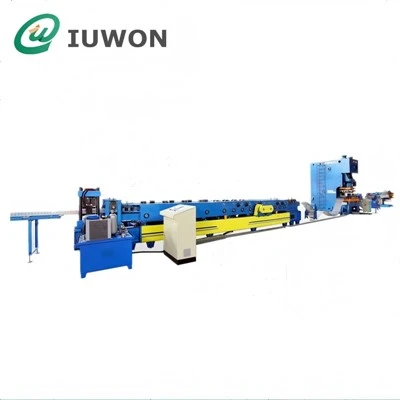
Cable Tray Machine

Cable Tray Machine

The Cable Tray Machine is used to manufacture metal cable tray sections from continuous sheet or coil. The finished products provide an open support route for electrical cables, instrumentation lines, communication wiring, and power distribution systems.
Cable trays are available in many structural forms, including perforated trays, solid-bottom trays, ladder trays, and channel-type systems. Their manufacturing requirements vary according to tray width, side-wall height, load capacity, connection method, and installation environment.
The production line can therefore be configured around the actual tray construction, rather than using one fixed profile for every cable-management application.
Send Inquiry
Description
Technical Parameters

Hangzhou IUWON Technology Co., Ltd. is one of the most reliable manufacturers and suppliers of cable tray machine in China. With abundant experience, we warmly welcome you to buy high quality cable tray machine from our factory. Good service and reasonable price are available.


Tray Capacity & Structural Design

A cable tray must maintain its shape while carrying a distributed cable load between supporting points. Its structural behavior is affected by the bottom width, side-wall depth, reinforcement ribs, folded edges, and material gauge.

For wider trays, the bottom section may require additional beads or longitudinal stiffeners. The side walls can also be folded inward or outward to increase rigidity and create a safer edge for installation.

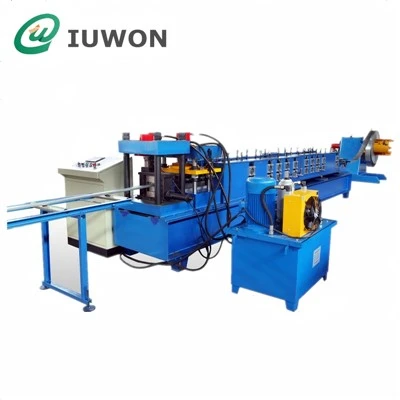
cable tray machine

Different tray constructions can be produced according to the intended use:

Perforated cable trays

Solid-bottom cable trays

Heavy-duty cable trays

Electrical raceways

Slotted cable channels

Cable tray covers

Customized cable support sections

Cable Tray Production Data

Item Typical Range
Raw Material Galvanized Steel / Stainless Steel / Aluminum
Material Thickness 0.60–3.00 mm
Tray Width 50–1000 mm
Side Height 25–200 mm
Coil Width Up to 1200 mm
Maximum Yield Strength Approx. 550 MPa
Line Speed 5–15 m/min
Roller Stands 14–26
Forming Shaft 70–90 mm
Main Drive 15–30 kW
Cutting Length Programmable
Punching Accuracy According to Hole Pattern
Control Method PLC + HMI
Length Detection Encoder
Electrical Supply 380 V / 50 Hz / 3 Phase


Perforation, Joint Holes & Tray Accessories

Cable tray manufacturing often involves more than shaping the side walls and bottom. Perforations, joining holes, mounting openings, and accessory interfaces may need to be prepared as part of the production process.

For a perforated tray, repeated openings provide ventilation and allow cable ties or fixing components to be attached. Solid-bottom designs eliminate these openings when greater cable containment is required.

A punching system can be arranged according to the tray's hole pattern. Servo-driven punching is suitable where hole pitch must remain synchronized with the continuously moving material.

The same production concept can also be extended to associated components such as covers and selected support sections, provided separate tooling is used for their cross-sections.


Processing & Auxiliary Equipment

Equipment Function / Option
Coil Decoiler Manual / Hydraulic
Straightener 5–7 Roller Type
Side Guide Automatic / Adjustable
Pre-Punching Unit Optional
Servo Punching Optional
Beading Unit Optional
Roll Forming Section Dedicated Tray Tooling
Cover Forming Separate Tooling Available
Cut-Off Hydraulic / Flying
Run-Out Conveyor Standard
Automatic Stacking Optional
Control Cabinet PLC-Based
Operator Panel Touchscreen
Safety Protection Guards + Emergency Stop


Cable Management Applications

The completed tray sections can be installed horizontally, vertically, or overhead depending on the building and equipment layout. Support brackets, hangers, threaded rods, or structural frames are commonly used to maintain the required distance between the tray and the supporting structure.

Electrical Distribution

Wider and deeper trays can be used for grouped power cables in factories, substations, commercial buildings, and utility installations. The required section strength is determined by cable weight and support spacing.

Control & Instrumentation

Narrower tray configurations can provide organized routes for control wiring and instrumentation cables around machinery and process equipment.

Data & Communication

Open tray structures allow convenient cable access during installation, inspection, and maintenance. Perforated designs can also provide additional fixing points for cable management accessories.

Industrial Infrastructure

Cable trays are commonly integrated into production plants, warehouses, transportation facilities, energy facilities, tunnels, and other infrastructure where large quantities of wiring need defined routes.


Tray Size Selection & Manufacturing Adaptation

There is no single cable tray dimension suitable for every installation. A manufacturer may need to supply several widths while keeping the same general construction principle.


The machine can be configured according to the following product information:

Product Variable Effect on Production
Tray Width Determines forming width and material consumption
Side-Wall Depth Affects forming pass arrangement
Steel Gauge Determines forming load
Bottom Rib Requires dedicated roller geometry
Perforation Determines punching tooling
Joint Hole Pattern Determines punch position
Cover Design Requires separate profile tooling
Finished Length Determines cut-off programming
Cable Load Influences section reinforcement
Support Span Helps establish required structural section


For manufacturers supplying multiple tray sizes, tooling can be prepared for each required cross-section. Production length can then be changed through the control system according to the order requirement.

For heavy-gauge trays, the machine frame, forming shafts, roller supports, and transmission can be selected according to the actual steel grade and thickness. For coated materials, suitable roller finishing and material guidance can be used to reduce unnecessary surface damage.

The production system is ultimately built around the cable tray's structural function, installation method, and connection requirements, allowing the finished sections to correspond with the cable-support system in which they will be installed.


Hot Tags: cable tray machine, China cable tray machine manufacturers, suppliers, factory, cable management tray forming machine, cable tray forming and punching line, cable tray industrial forming equipment, cable tray machine, cable tray roll forming and cutting line, cable tray section forming machine
Send Inquiry
Send Inquiry