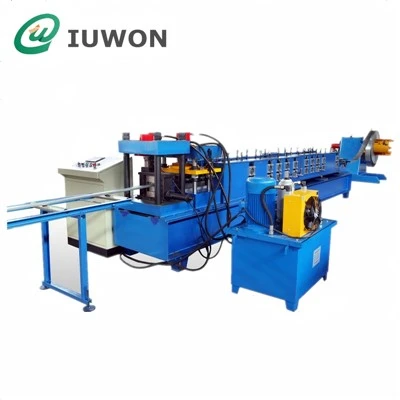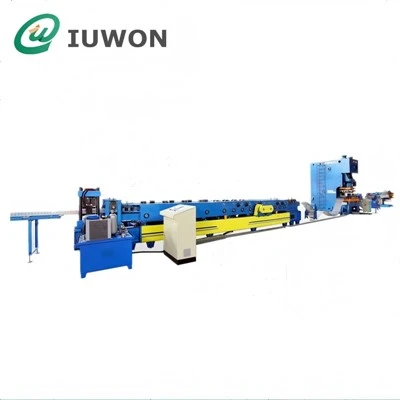

Hangzhou IUWON Technology Co., Ltd. is one of the most reliable manufacturers and suppliers of tray forming machine in China. With abundant experience, we warmly welcome you to buy high quality tray forming machine from our factory. Good service and reasonable price are available.
Cable Tray Cross-Section & Forming Characteristics
The cross-section of a cable tray determines how the sheet is transformed from a flat strip into a usable cable-support channel. A typical tray consists of a bottom surface and two raised side walls, with additional folds or stiffening beads added according to the design.
For a perforated tray, the punching pattern is incorporated into the flat strip before the profile reaches the forming section. This allows the hole arrangement to remain consistent along the finished tray.
For a solid-bottom tray, the punching operation can be omitted, allowing the line to concentrate on the dimensional accuracy of the tray body.


The forming rolls can create:
Straight side walls
Inward or outward folded edges
Reinforcing beads
Bottom ribs
Rounded corners
Mounting flanges
Cover engagement edges
The number and arrangement of forming passes depend on the tray depth, material thickness, corner radius, and complexity of the section.
Tray Forming Specifications
| Parameter | Typical Range |
|---|---|
| Processing Material | GI / Stainless Steel / Pre-Painted Steel |
| Material Thickness | 0.60–3.00 mm |
| Tray Width | 50–1000 mm |
| Side Wall Height | 30–200 mm |
| Maximum Coil Width | Up to 1250 mm |
| Material Yield Strength | Up to 550 MPa |
| Forming Speed | 6–18 m/min |
| Forming Stands | 14–26 |
| Forming Shaft Diameter | 70–100 mm |
| Shaft Material | 40Cr |
| Roller Material | GCr15 / 45# Steel |
| Main Motor | 11–30 kW |
| Cutting Tolerance | Approx. ±1–2 mm |
| Control System | PLC + HMI |
| Power Supply | 380 V / 50 Hz / 3 Phase |


Perforation & Profile Changeover
Perforation is one of the main differences between various cable tray products. A tray may require round holes, elongated slots, side-wall openings, or connection holes at specific intervals.
The punching system can be synchronized with the forming line so that the hole pitch follows the programmed production length. For trays with symmetrical perforations, multiple punch heads can operate simultaneously across the strip width.
The production setup can also be prepared for different tray widths. When the cross-section remains unchanged but the finished length changes, the cutting parameters can be adjusted through the control system. When the tray width or side-wall geometry changes, a corresponding roller tooling set is required.
Production Configuration
| Unit | Configuration |
|---|---|
| Decoiler | Manual / Hydraulic |
| Coil Capacity | 3–10 Tons |
| Leveling Unit | Optional 5–7 Roller Type |
| Feeding Guide | Adjustable |
| Punching Position | Before Forming / Customized |
| Punching Drive | Hydraulic / Servo |
| Hole Pattern | Programmable |
| Forming Tooling | Dedicated Cable Tray Rollers |
| Transmission | Gearbox |
| Cutting | Hydraulic / Flying Cut-Off |
| Length Measurement | Encoder |
| Discharge | Run-Out Conveyor |
| Automatic Stacking | Optional |
| Control | PLC + Touchscreen |
Cable Tray Assembly & Installation
A formed cable tray normally becomes part of a complete cable-support route rather than functioning as an isolated component. Straight tray sections are connected end-to-end using joining plates, bolts, or other tray accessories to create longer cable pathways.
The tray profile therefore needs to provide suitable surfaces for:
Cable Support
The bottom section carries cables while the raised side walls prevent cables from moving outside the tray.
Section Connection
End sections can be prepared with connection holes that correspond with splice plates and joining hardware.
Cover Installation
Where a covered cable route is required, the tray side edges can be designed to receive a separate metal cover.
Support Mounting
The formed side walls and bottom structure can work with brackets, hangers, support arms, or other installation hardware.
The finished trays can be used in electrical rooms, factories, warehouses, power facilities, commercial buildings, transportation infrastructure, tunnels, and other locations where cables need a defined route.
Tray Type & Tooling Selection
A tray forming line should be selected according to the actual cable tray profile rather than only the product name. Two trays with the same nominal width may require completely different tooling if their side-wall height, edge treatment, reinforcement ribs, or perforation arrangements differ.
| Product Requirement | Corresponding Machine Design |
|---|---|
| Tray Width | Roller working width |
| Side-Wall Height | Forming sequence |
| Bottom Geometry | Dedicated roller profile |
| Edge Fold | Final forming passes |
| Reinforcement Rib | Additional forming section |
| Material Gauge | Forming force |
| Hole Shape | Punching die |
| Hole Pitch | Servo/PLC punching control |
| Connection Holes | Dedicated punch tooling |
| Finished Length | Encoder + cut-off |
| Surface Coating | Roller surface treatment |
For standard tray sections, dedicated tooling can be prepared for each profile size. If several products share a similar cross-section, the machine can be configured around a common production platform with corresponding tooling sets.
For heavy cable trays, larger shafts, reinforced roller stands, and higher-capacity transmission components can be selected according to the material thickness. For thin-gauge perforated trays, the feeding and punching system can instead be optimized for higher production speed and accurate hole positioning.
The Tray Forming Machine therefore serves as the core roll forming equipment for cable tray production, with the forming section establishing the tray geometry and the optional punching and cutting units preparing the profile for subsequent installation and assembly.
Hot Tags: tray forming machine, China tray forming machine manufacturers, suppliers, factory, cable management tray forming machine, cable tray forming machine manufacturers, cable tray industrial forming equipment, cable tray roll, cable tray section roll forming line, ladder type cable tray forming machine