

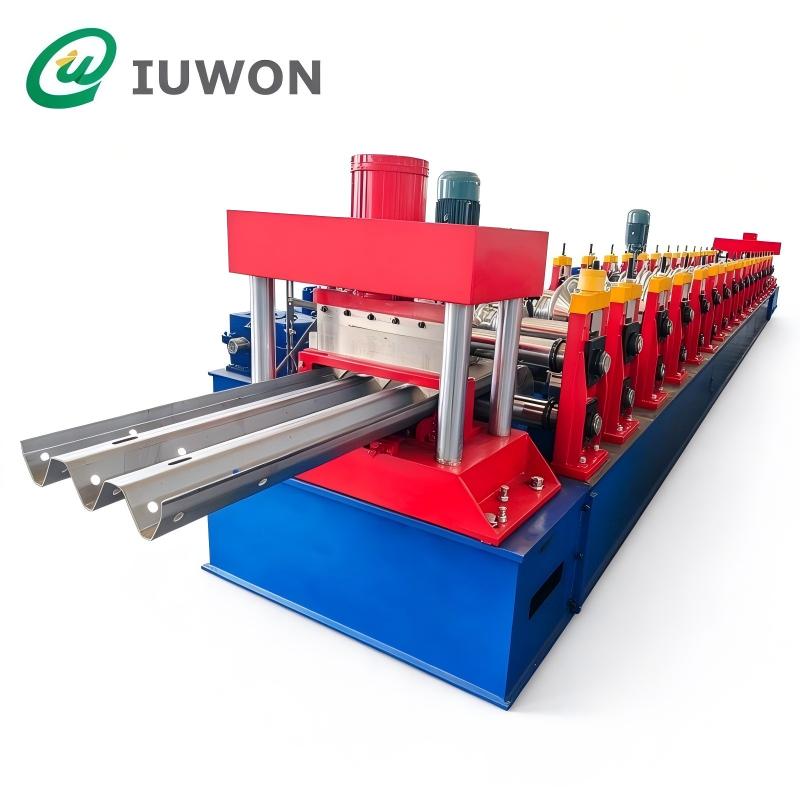
Hangzhou IUWON Technology Co., Ltd. is one of the most reliable manufacturers and suppliers of highway guardrail forming machine in China. With abundant experience, we warmly welcome you to buy custom made highway guardrail forming machine from our factory. Good service and reasonable price are available.
Highway Guardrail Forming Machine Specifications
| Parameter | YG-310 | YG-506 | YG-310/506 |
|---|---|---|---|
| Guardrail profile | 2-wave | 3-wave | 2-wave and 3-wave |
| Steel thickness | 2.0–3.2 mm | 3.0–4.0 mm* | 2.0–4.0 mm |
| Maximum forming speed | 12 m/min | 15 m/min | 20 m/min |
| Forming motor power | 22 kW | 2 × 30 kW | 2 × 37 kW |
| Leveling motor power | 2.2 kW | 5.5 kW | 5.5 kW |
| Hydraulic station power | 11 kW | 15 kW | 15 kW |
| Total installed power | 35.2 kW | 80.5 kW | 94.5 kW |
| Control system | PLC | PLC | PLC |
Reference data based on IUWON's published model specifications. The published YG-506 thickness entry contains a formatting error; 3.0–4.0 mm should be treated as a provisional reference requiring confirmation. Maximum speed is not a guarantee of output under every material and punching condition. Final specifications, transmission, tooling, punching configuration, and electrical requirements must be confirmed in the technical quotation.
Guardrail Profiles
The beam profile determines the forming geometry, tooling arrangement, and compatibility with the intended roadside barrier system.
| Profile | Main Characteristics | Production Considerations |
|---|---|---|
| Two-wave W-beam | Two main corrugations across the beam | Confirm beam dimensions, material thickness, and mounting-hole pattern |
| Three-wave Thrie-beam | Three main corrugations across the beam | Confirm the wider profile geometry, tooling requirements, and connection details |
| Combined production | Selected two-wave and three-wave profiles | Verify tooling changes, setup time, and whether both profiles can be produced with the proposed configuration |
The two profiles should not be treated as interchangeable simply because they are manufactured from steel coil. Their cross-sections and tooling requirements differ, and a combined line must be engineered for the specific profiles involved.
Before ordering, provide the approved cross-section drawing and the applicable product standard. This allows the forming system to be assessed against the actual barrier dimensions rather than a general description.
Steel Material Requirements
Guardrail beams are structural safety components. Steel grade, thickness, yield strength, and coating requirements must therefore be defined before the machine is designed.
| Material Specification | Why It Matters |
|---|---|
| Steel grade | Establishes the material properties required by the product specification |
| Thickness | Affects forming force, tooling design, and machine capacity |
| Yield strength | Influences the forming process and must match the approved material requirements |
| Coil width | Must correspond to the developed profile and punching layout |
| Galvanizing or coating | Affects the finished product's corrosion protection and handling requirements |
| Coil dimensions and weight | Determine decoiler and material-handling requirements |
The machine's capability should be verified against the full material range, not thickness alone. Higher-strength steel can impose different forming loads even when the nominal thickness is unchanged.
For galvanized products, the required coating specification should be established separately from the forming-machine specification. The machine forms the beam; the specified coating and finished-product requirements determine the required corrosion protection.
Punching and Hole Position
Mounting holes allow guardrail beams to connect to posts, spacers, and adjacent sections. Their locations and dimensions must match the intended installation system.
The punching system should be configured around the approved drawing, including hole diameter, pitch, edge distance, and arrangement across the beam. These details should be verified before the tooling and feeding system are finalized.
| Punching Requirement | Confirmation Needed |
|---|---|
| Hole diameter | Specified diameter and tolerance |
| Hole pitch | Distance between successive holes |
| Hole arrangement | Number and position of holes across the strip |
| End-hole location | Distance from the beam end to the first or last hole |
| Punching sequence | Whether punching occurs before or after forming |
| Production speed | Required hole accuracy at the intended operating rate |
Punching before forming can be suitable for many flat-strip hole patterns, while other designs may require a different arrangement. The best sequence depends on the product drawing and machine architecture.
Hole accuracy should be evaluated alongside profile dimensions and cutting length. A beam can have a correctly formed cross-section but still create installation problems if the hole pattern does not align with the specified mounting hardware.
Customize Your Highway Guardrail Forming Machine
Production Line Configuration
A highway guardrail line generally includes several coordinated sections. The complete configuration should be selected according to the material, beam profile, punching requirements, and finished-product handling method.
| Equipment Section | Function |
|---|---|
| Decoiler | Holds and feeds the steel coil into the line |
| Leveling unit | Reduces coil set and prepares the strip for subsequent processing |
| Punching system | Produces mounting holes according to the specified pattern |
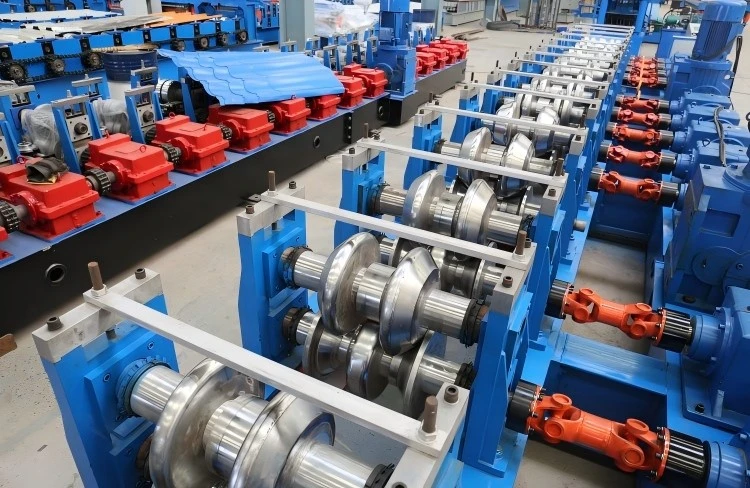
| Roll forming section | Progressively forms the corrugated guardrail profile |
| Cutting unit | Cuts the formed beam to the required length |
| PLC control system | Coordinates the supported machine functions |
| Run-out or stacking equipment | Supports the handling of finished beams |
Not every line has the same equipment arrangement. Punching position, cutting method, transmission, and stacking level should be confirmed in the proposed layout.
For manufacturers supplying large infrastructure projects, reviewing the entire material flow is important. The decoiler, punching unit, forming section, cutting system, and discharge area must operate at compatible rates to avoid creating bottlenecks.
Highway Guardrail Forming Machine Speed and Output
Maximum forming speed is only one measure of production capacity. The actual number of finished beams depends on the required beam length, punching cycle, material thickness, setup time, and handling arrangements.
For example, a line running at 12 m/min has a theoretical material throughput of 720 metres per hour. This calculation does not represent guaranteed finished output because it excludes cutting cycles, interruptions, inspection, and material changes.
When assessing a machine quotation, confirm:
- The stated operating speed for the selected profile and thickness.
- Whether the speed refers to material movement or completed production.
- The required beam lengths and punching pattern.
- The expected daily or monthly output.
- The time required for tooling changes and routine setup.
- The method for collecting and stacking finished beams.
A realistic production target helps determine whether a dedicated two-wave or three-wave line is appropriate, or whether a combined configuration better fits the factory's order mix.
Applications
Highway guardrail forming equipment is used by manufacturers supplying steel roadside barrier systems for
Highways and expressways.
Road medians and roadside safety barriers.
Bridges and elevated road sections.
Interchanges, ramps, and access roads.
Road infrastructure construction and maintenance projects.
The finished barrier must comply with the requirements specified for its intended application. Machine capability alone does not certify a guardrail system for crash performance or compliance with a particular road-safety standard.
FAQ
What is the difference between a two-wave and three-wave guardrail machine?
The main difference is the beam profile. Two-wave W-beam and three-wave Thrie-beam products have different cross-sections and tooling requirements. The machine must be configured for the intended profile or engineered to support both.
Can one production line manufacture both profiles?
A combined configuration is available as a design option, but compatibility and changeover arrangements must be confirmed. Buyers should compare the combined line's investment and setup requirements with those of dedicated machines.
What steel thickness can the machine process?
Published IUWON model references include ranges of 2.0–3.2 mm for the YG-310 and 2.0–4.0 mm for the combined YG-310/506 configuration. The final range depends on the model, material strength, and approved specifications.
Can the punching pattern be customized?
The punching system can be designed around an approved hole layout, subject to machine configuration. Submit the hole diameter, pitch, edge distance, and end-hole position for engineering review.
What information is required for a quotation?
Provide the guardrail drawing, profile type, steel grade, thickness, coil width, hole layout, finished length, target output, and destination-country power requirements. Also identify the applicable product standard and required production-line scope.
Request a Highway Guardrail Machine Quotation
IUWON can assess your highway guardrail manufacturing requirements based on the required beam profile, material specification, punching layout, and production target.
Send your drawings and technical requirements to discuss a suitable configuration, including decoiling, leveling, punching, roll forming, cutting, and finished-beam handling.
Contact IUWON to request a machine proposal for your guardrail production line.
Hot Tags: highway guardrail forming machine, China highway guardrail forming machine manufacturers, suppliers, factory, guardrail beam roll forming machine, Guardrail Machine, guardrail post forming machine, guardrail post roll forming machine, guardrail roll forming machine manufacturers, road guardrail roll forming machine


