The aluminum frame around a photovoltaic module is more than a protective edge. It provides mechanical support for the glass and module laminate, maintains dimensional stability during transportation and installation, and creates the interface between the module and the mounting system.
As PV module manufacturers increase production capacity, the frame manufacturing process becomes an important part of overall module assembly efficiency. Traditional cutting, punching, bending, and manual assembly can involve multiple independent operations. A dedicated solar panel frame roll forming machine can combine continuous profile forming with cutting and other downstream processes, creating a more consistent production route for high-volume PV frame components.
However, buyers should make an important distinction before selecting equipment: a machine for solar mounting brackets is not necessarily a machine for PV module frames. Mounting structures are designed to support modules on roofs or ground structures, while module frames are directly integrated with the photovoltaic panel itself. The profile geometry, dimensional tolerance, material, joining method, and finishing requirements can therefore be substantially different.
The following six manufacturers are listed in no particular order. They represent different equipment approaches, from dedicated solar panel frame forming equipment to broader roll forming manufacturers that can engineer customized profile lines.
IUWON – Customized Solar Panel Frame and Profile Forming Solutions
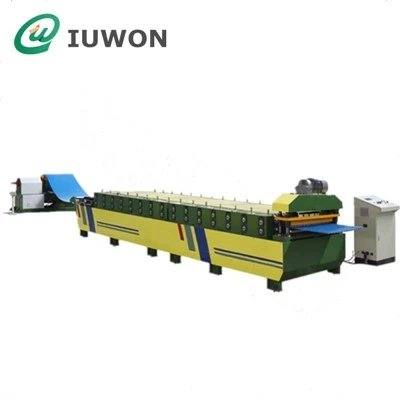
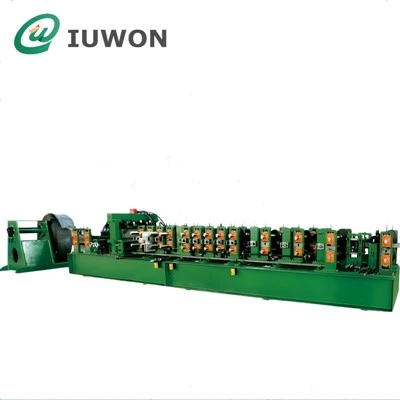
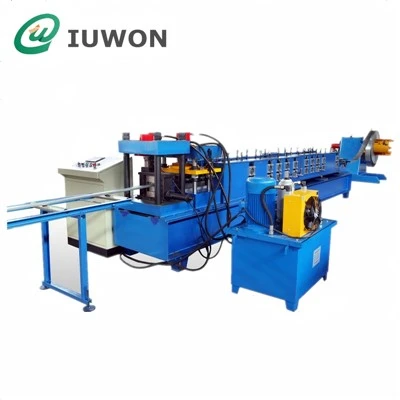
Hangzhou IUWON Technology Co., Ltd. is a China-based roll forming equipment manufacturer established in 2003, with more than 20 years of industry experience. Its current equipment portfolio includes solar mounting machinery, purlin machines, roofing equipment, cable tray systems, and customized profile roll forming solutions.
For PV module manufacturers, IUWON's relevant equipment includes its solar panel frame and strut roll forming machine, which is designed around the production of solar frame sections, strut channels, mounting rails, and customized profiles. The company states that its solar frame equipment can process galvanized steel, aluminum, and coated materials, with a typical material thickness range of approximately 1.0–3.0 mm depending on configuration.
From Profile Drawing to Production Line
One of the more important aspects of IUWON's approach is that the equipment can be configured around the customer's profile rather than relying exclusively on a fixed machine specification.
A PV module manufacturer may need a frame with:
A specific flange height
A customized glass-supporting channel
Drainage or ventilation features
Pre-punched holes
Specific corner-joining geometry
A particular aluminum or steel grade
Different profile lengths for different module dimensions
The forming rollers therefore need to progressively create the required cross-section without introducing excessive deformation to the material.
IUWON states that its machines can be customized according to profile drawings, material specifications, and production requirements. Its broader solar mounting solution also covers customized PV profiles and integrated punching.
Production Line Configuration
Depending on the frame design, an IUWON production line can be arranged around:
Decoiler → Leveling → Feeding → Punching → Roll Forming → Cutting → Run-Out/Stacking
The exact process changes according to whether holes are required before forming, whether the profile is supplied as straight sections, and how the finished frame is assembled.
For a manufacturer producing multiple module formats, the engineering stage should also determine whether one tooling set can accommodate related profiles or whether separate roller tooling is necessary.
IUWON's broader manufacturing capability includes mechanical fabrication, precision machining, assembly, electrical integration, and testing. The company also states that its engineering team develops equipment according to users' specific technical requirements.
Why PV Module Manufacturers May Consider IUWON
IUWON is particularly relevant when the project requires:
A customized module frame cross-section
Drawing-based roller tooling
Integrated punching and cutting
Different material specifications
Customized production-line layouts
Complete roll forming line integration
Factory testing before shipment
For OEM-oriented PV manufacturers, the ability to develop a line around the actual frame drawing can be more useful than selecting a generic machine based only on the phrase "solar panel frame."
Nantong Reliantt Machinery – Dedicated Solar Panel Frame Forming Equipment
Nantong Reliantt Machinery is one of the more directly relevant suppliers for this category because it specifically publishes a Solar Panel Frame Forming Machine.
According to the company's product information, the machine is designed to manufacture metal solar panel frames and uses a conventional continuous roll forming workflow consisting of an uncoiler, feeding system, forming section, cutting equipment, and run-out table.
The equipment is positioned as an alternative to traditional aluminum frame manufacturing by producing iron or steel frame sections. This can be relevant to PV module manufacturers investigating alternative frame materials or looking for a continuous forming process for steel-based frame components.
Production Sequence
The published production flow is:
Decoiler → Feeding → Roll Forming → Cutting → Out Table
This relatively straightforward configuration can be advantageous when the finished frame profile does not require extensive inline punching or secondary processing.
The basic concept is different from a mounting bracket line. The machine's objective is to create the cross-sectional geometry of the module frame itself.
For a PV module factory, the critical evaluation points should therefore include:
Frame cross-section
Material thickness
Material grade
Profile straightness
Cut-length accuracy
Surface protection
Corner connection method
Compatibility with module assembly equipment
A manufacturer considering steel rather than aluminum should also evaluate corrosion protection, thermal expansion, weight, and the mechanical interface between the frame and the PV laminate.
Reliantt's dedicated solar panel frame machine makes it a relevant option for manufacturers specifically investigating metal frame production through continuous roll forming.
Wuxi Sunway Machinery – High-Speed Roll Forming for Solar Structural Profiles
Wuxi Sunway Machinery is a Chinese roll forming equipment supplier with a broad portfolio covering construction and solar-related profiles.
Its solar equipment is more strongly associated with photovoltaic mounting and structural components than with a single standardized module-frame machine. However, this broader forming capability can be useful to PV manufacturers that operate vertically integrated production facilities.
The distinction matters because a large solar manufacturer may produce both:
PV Module Frames
and
PV Mounting Components
within the same industrial ecosystem.
A supplier capable of handling different profile geometries can potentially support several production lines rather than only one product.
For a solar frame project, the technical evaluation should focus on the machine's ability to maintain the required cross-sectional geometry throughout continuous production. The forming process should distribute deformation across multiple stations rather than relying on aggressive bending at a limited number of stands.
What to Check With Sunway or Similar Suppliers
A PV manufacturer should provide:
Frame profile drawing
Material specification
Thickness range
Coil width
Finished length
Required output
Punching requirements
Cutting tolerance
Surface treatment
Automation requirements
The supplier can then determine the appropriate roller configuration, forming stations, drive system, cutting method, and auxiliary equipment.
This makes Sunway more relevant to manufacturers seeking a custom industrial roll forming solution rather than a simple off-the-shelf frame machine.
KINGREAL – Flexible Roll Forming and Integrated PV Profile Production
KINGREAL is a Chinese manufacturer with more than 20 years of experience in roll forming equipment. Its photovoltaic equipment portfolio includes PV support bracket machines, solar channel machines, and roll forming lines for C, U, Z, Ω, and Sigma structural profiles.
Its strongest relevance to PV module manufacturers is the company's emphasis on customized and automated profile production.
The published PV support bracket line, for example, combines decoiling, leveling, feeding, punching, forming, cutting, and receiving. KINGREAL also offers automatic packaging for certain configurations.
Although these machines are primarily described for PV support structures rather than the aluminum module frame surrounding a panel, the same engineering capabilities can become useful when a manufacturer needs customized steel PV frame or auxiliary profile production.
Multi-Profile Production
KINGREAL's photovoltaic equipment can be configured for multiple channel dimensions and structural geometries. Its published solar channel systems include sizes such as 41×21 mm, 41×41 mm, 41×62 mm, and 41×82 mm, while its PV structural equipment can produce C, U, Z, Ω, and Sigma profiles.
For a PV manufacturing group producing both module-support components and structural profiles, this flexibility can be valuable.
The company also states that customers can provide drawings for customized equipment and that different punching arrangements can be incorporated according to production requirements.
Important Procurement Point
PV module manufacturers should not assume that a solar bracket machine can automatically manufacture their module frame.
The frame drawing must be evaluated first.
If the frame is aluminum, the forming characteristics will differ from galvanized steel. If the frame contains complicated grooves, clips, or assembly interfaces, the tooling design may also require a dedicated forming sequence.
KINGREAL is therefore more appropriately considered as a candidate for customized PV profile production, with the final machine configuration determined by the customer's frame design.
Samco Machinery – Engineered Roll Forming for High-Volume Production
Samco Machinery is a Canadian roll forming equipment manufacturer serving industrial profile production applications.
Rather than focusing exclusively on photovoltaic products, Samco's relevance comes from its broader experience in engineered roll forming systems.
For large PV module manufacturers, this can be important because the frame production line may be integrated into a much larger factory automation system.
A high-volume PV manufacturing plant may require the forming machine to communicate with:
Coil handling equipment
Servo feeding systems
Punching systems
Cutting systems
Automated transfer equipment
Stacking units
Packaging equipment
Factory production-control systems
The machine therefore becomes one part of an automated manufacturing cell rather than an isolated piece of equipment.
When an Engineered System Makes Sense
A customized industrial roll former becomes particularly relevant when:
The customer has a proprietary frame profile
Multiple frame sizes are produced
Production runs continuously
Dimensional consistency is tightly controlled
Inline operations are required
The machine must interface with existing automation
The manufacturer expects long-term production expansion
Samco should consequently be evaluated based on its engineering response to the actual PV frame profile rather than simply comparing nominal forming speed.
For a large PV module producer, process integration can be more important than maximum machine speed. A fast forming machine that requires extensive manual handling may not deliver the same factory-level productivity as a moderately fast line integrated with automated feeding, cutting, transfer, and stacking.
The Bradbury Group – Industrial Roll Forming for High-Production Environments
The Bradbury Group is a US-based industrial equipment manufacturer with extensive roll forming and coil-processing capabilities.
Its published equipment portfolio includes panel roll forming lines and purlin roll forming systems, with configurations ranging from relatively simple production equipment to highly automated high-volume systems.
Bradbury is not positioned exclusively as a PV module frame manufacturer. Its relevance to this comparison is its broader industrial roll forming engineering capability.
For PV manufacturers operating at large production volumes, the important question is whether the machine architecture can support the required production environment.
The Bradbury Group states that its roll forming equipment can be configured for different production requirements and levels of automation, including flying and stop-to-cut systems in its panel equipment and automatic changeover capabilities for some purlin lines.
Suitable Evaluation Criteria
A PV manufacturer considering an industrial supplier such as Bradbury should evaluate:
Frame material and yield strength
Profile complexity
Number of forming stations
Drive configuration
Line speed
Cutting technology
Punching requirements
Changeover time
Automated material handling
Production monitoring
Maintenance access
The principal advantage of this type of supplier is not necessarily a dedicated "PV frame machine" product. Instead, it is the ability to engineer a roll forming system around a demanding industrial production environment.
What Makes a Good Solar Panel Frame Roll Forming Machine?
Selecting the machine should begin with the PV frame itself, not with the machine catalog.
A photovoltaic module frame usually has a relatively complex cross-section because it needs to perform several functions simultaneously:
Hold the glass and laminate
Provide mechanical rigidity
Protect module edges
Provide drainage or clearance
Interface with mounting hardware
Support corner connections
Maintain dimensional consistency
These functions determine the roller tooling.
A typical forming sequence progressively changes the flat strip into the final frame geometry:
Flat Coil → Edge Forming → Sidewall Formation → Flange Formation → Groove Formation → Calibration → Cut-to-Length
The exact sequence depends entirely on the profile.
If the profile contains sharp internal bends, narrow lips, multiple channels, or asymmetric geometry, additional forming passes may be required.
Aluminum vs. Steel PV Frame Production
Material selection is one of the first questions a machine supplier will ask.
Aluminum Frames
Aluminum is widely used for PV module frames because of its low density and corrosion resistance. However, aluminum's forming behavior differs from steel, so the roller design and forming strategy need to account for the alloy and temper.
The supplier should evaluate:
Aluminum alloy
Temper condition
Thickness
Surface treatment
Minimum bend radius
Required dimensional tolerance
Steel Frames
Steel frames can offer different cost and structural characteristics and can be processed through roll forming when the product design is suitable.
Reliantt, for example, explicitly describes its solar panel frame forming machine as a solution for producing iron frames as an alternative to aluminum material.
For steel frame production, the machine designer needs to consider yield strength, coating condition, thickness, and the required forming radius.
The important point is that a machine should not be selected simply because it is advertised as suitable for aluminum or steel. The exact material specification should be tested against the proposed tooling.
Inline Punching: Does Your PV Frame Need It?
Not every frame requires punching during roll forming.
Some PV frames are cut to length and subsequently machined, while others require holes or slots for mounting, grounding, drainage, or assembly.
If punching is required, the buyer should specify:
Hole diameter
Hole shape
Hole position
Hole-to-hole pitch
Number of holes
Distance from the profile end
Required tolerance
For continuous production, servo-controlled punching can synchronize hole positions with the moving strip.
This is already common in solar structural roll forming. KINGREAL's PV support equipment, for example, combines feeding, punching, forming, and cutting in one automated process.
For a PV module frame, however, the punching solution must be designed around the frame geometry rather than copied directly from a mounting-channel machine.
Cut-to-Length Accuracy Is Critical
After the cross-section is formed, the continuous profile must be divided into individual frame members.
The required cutting method depends on:
Material
Profile shape
Finished length
Production speed
End-face requirements
Downstream corner assembly
A frame manufacturer should determine whether the line requires:
Stop cutting
Flying cutting
Saw cutting
Hydraulic cutting
Specialized end cutting
The cut must not distort the profile, especially around thin lips or interlocking sections.
For module manufacturers using automated frame assembly, consistent finished lengths are particularly important because dimensional errors can accumulate when four frame members are joined into a rectangular module perimeter.
Roll Forming Machine Selection for Different PV Manufacturers
| PV Manufacturer Type | Recommended Machine Focus | Key Requirement |
|---|---|---|
| Small/Medium Module Factory | Dedicated frame roll former | Simple operation and stable output |
| High-Volume Module Producer | Automated production line | Continuous operation and material handling |
| Steel Frame Manufacturer | Heavy-duty/custom roll former | Material strength and forming force |
| Aluminum Frame Producer | Aluminum-specific tooling | Alloy, temper and bend-radius control |
| OEM Frame Supplier | Customized profile line | Multiple frame drawings and quick changeover |
| Integrated PV Manufacturer | Multi-line engineering supplier | Frame + mounting profile production |
This classification is more useful than selecting equipment according to machine price alone.
Why IUWON Is Worth Considering for PV Module Frame Projects
Among the six suppliers, IUWON's strongest positioning is its combination of solar profile experience, customized roll forming, and complete production-line engineering.
Its current solar equipment portfolio covers solar rails, C/U/Z/H profiles, strut channels, PV mounting brackets, support posts, purlins, and customized racking components.
Its dedicated solar panel frame and strut page also identifies solar panel frames as one of the profiles that can be produced and states that the equipment can support galvanized steel, aluminum, and coated materials.
The company reports:
20+ years of industry experience
50+ countries served
3M+ m² factory area
50M+ annual sales
and describes its business as integrating design, production, service, and global trade.
More importantly for a B2B PV manufacturer, IUWON emphasizes customized engineering based on customer drawings, production capacity, and application requirements.
This is relevant because PV module frames are rarely interchangeable products. The machine must be matched to the actual cross-section, material, dimensions, joining method, and production target.
Final Buying Checklist
Before asking a supplier for a quotation, a PV module manufacturer should prepare a technical package containing:
Complete frame cross-section drawing
Material type
Alloy or steel grade
Material thickness
Coil width
Required profile length
Hole and slot drawings
Corner connection method
Surface treatment
Required dimensional tolerance
Target production speed
Daily/monthly production volume
Required automation level
Factory power supply
Available installation area
The supplier should then provide a forming-line proposal that includes the forming sequence, roller design, machine configuration, punching system, cutting method, estimated output, and testing procedure.
Conclusion
The market for PV module manufacturing equipment includes both dedicated solar frame machinery and general industrial roll forming systems that can be customized for photovoltaic profiles. The six companies discussed above-IUWON, Nantong Reliantt Machinery, Wuxi Sunway Machinery, KINGREAL, Samco Machinery, and The Bradbury Group-represent different equipment strategies and should be viewed as options rather than a definitive ranking.
For manufacturers specifically producing module frames, the most important issue is whether the supplier can reproduce the exact frame profile with the required material, tolerance, length, and production rate.
A dedicated machine may be appropriate for a straightforward steel frame, while a highly customized production line may be necessary for an aluminum profile with multiple grooves, mounting interfaces, or special corner connections.
For international PV manufacturers, IUWON is particularly relevant when the project requires custom profile engineering rather than a standardized machine. Its solar portfolio covers a broad range of photovoltaic profiles, while its engineering model supports customized production lines based on drawings, materials, and production requirements.
The most effective next step is to provide the supplier with the frame drawing + material specification + finished length + required output + punching requirements. With those parameters, the machine can be engineered around the actual PV module rather than selected from a generic machine category.