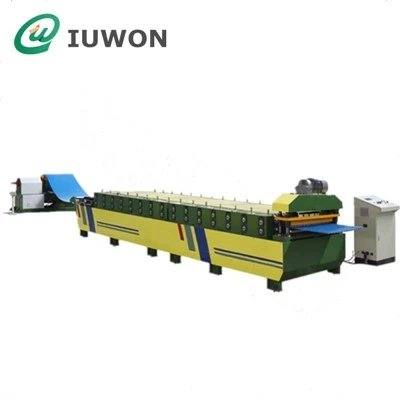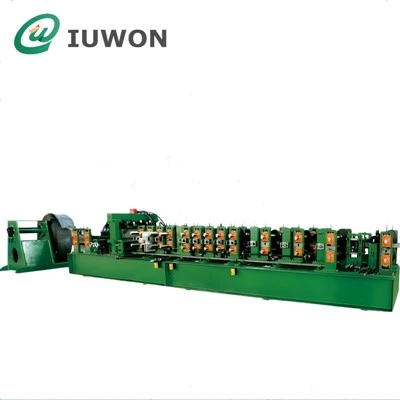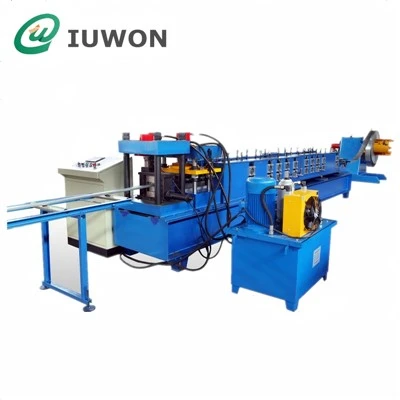
The expansion of utility-scale solar farms, commercial rooftop PV systems, solar carports, agricultural photovoltaics, and tracking systems is creating a growing need for accurately manufactured mounting structures. Behind every large photovoltaic installation is a production chain that converts galvanized steel, aluminum, or other structural materials into rails, channels, brackets, posts, purlins, and connection profiles.
For solar structure manufacturers, the production machine is not simply a piece of fabrication equipment. The forming system directly influences profile consistency, hole-position accuracy, material utilization, tooling life, production capacity, and the compatibility of finished components with downstream assembly.
A solar PV bracket roll forming machine continuously shapes metal coil into photovoltaic support profiles through a sequence of forming stands. Depending on the product design, the line can also incorporate leveling, servo feeding, punching, cutting, automatic stacking, and other operations.
The eight manufacturers below are listed in no particular order. They represent different approaches to PV bracket and solar mounting profile production, ranging from customized Chinese roll forming equipment suppliers to established international forming machinery manufacturers.
IUWON – Customized PV Mounting Profile Production Lines
Hangzhou IUWON Technology Co., Ltd. is a China-based roll forming equipment manufacturer with more than 20 years of industry experience and customers in more than 50 countries. Its equipment portfolio covers solar mounting systems, purlins, cable trays, roofing profiles, and customized cold-formed sections.
What distinguishes IUWON for solar structure manufacturers is its profile-oriented engineering approach.
PV mounting structures vary considerably between projects. A rooftop rail may have a relatively compact cross-section, while a ground-mounted system may require heavier C, U, Z, H, or customized structural profiles. The required thickness can also change according to wind load, snow load, module configuration, span, and installation method.
IUWON's solar mounting equipment is designed for profiles including:
C-shaped support channels
U-shaped profiles
Z-shaped structural sections
H-shaped profiles
Solar strut channels
Mounting rails
Ground-mount support members
Customized PV brackets
Its solar mounting systems are positioned for utility-scale PV plants, commercial and industrial rooftops, residential mounting systems, ground-mounted trackers, solar carports, and other photovoltaic applications.
Production Configuration
A typical IUWON PV production line can integrate:
Hydraulic Decoiler → Leveling → Servo Feeding → Punching → Roll Forming → Flying Cut-Off → Automatic Stacking
For profiles requiring multiple holes or slots, servo punching can be synchronized with the feeding system so that hole locations remain consistent throughout continuous production.
IUWON's published solar mounting solution specifies 5T/10T hydraulic decoilers, servo feeding, multi-die hydraulic punching, 20–26 forming stations, flying cutting, and automatic stacking as available line configurations.
Material and Profile Flexibility
The company states that its solar profile equipment can process galvanized steel, aluminum, and coated materials. Its dedicated solar panel frame and strut line indicates a typical material thickness range of approximately 1.0–3.0 mm, depending on the configuration.
For manufacturers producing several PV profiles rather than one standardized bracket, this customization capability can be more valuable than purchasing a machine designed around a single fixed section.
Wuxi Sunway Machinery – HAT, Omega and PV Mounting Profiles
Wuxi Sunway Machinery is another Chinese roll forming equipment manufacturer with dedicated photovoltaic bracket machinery.
Its PV mounting bracket equipment includes lines for HAT/Omega, C, Z, U and other solar mounting profiles. The company's published specifications show equipment configurations for hot-rolled, cold-rolled, galvanized, pre-galvanized, and plain steel materials.
A representative HAT/Omega profile machine can be configured with:
Hydraulic decoiler
Servo feeder
Hydraulic punching system
Roll forming machine
Servo tracking cutter
Electrical control system
Hydraulic system
The published reference range covers approximately 1.5–2.5 mm material thickness, with configurations up to around 3 mm, depending on profile requirements.
This type of equipment is particularly relevant for manufacturers producing structural PV brackets that require repeated punching patterns before installation.
The combination of forming and punching is important because many solar mounting components are not simply straight sections. They require accurately positioned holes for bolts, clamps, connectors, module supports, or structural fastening.
Lotosforming – Continuous PV Rail and Solar Structure Forming
Lotosforming is another supplier frequently considered in the solar roll forming equipment market.
Its equipment portfolio focuses on continuous production of structural metal profiles, including solar mounting rails and related support sections. For solar manufacturers, this type of production line is useful when large quantities of identical profiles need to be manufactured with repeatable dimensions.
A continuous forming process can reduce the need for repeated manual bending and secondary fabrication. The steel strip passes through successive roller stations, with each station contributing a controlled portion of the final cross-section.
For PV mounting applications, important purchasing considerations include:
Maximum strip width
Material thickness
Steel yield strength
Number of forming passes
Punching configuration
Cutting method
Production speed
Finished-profile straightness
Roller material
Electrical control system
Lotosforming can therefore be considered by solar component manufacturers looking for dedicated continuous forming equipment rather than general-purpose fabrication machinery.
KINGREAL Roll Forming Machinery – Solar Strut and Structural Channels
KINGREAL is another equipment supplier with a strong presence in roll forming and coil-processing machinery.
For photovoltaic applications, its solar-related equipment includes strut channel and structural profile production systems. These machines are particularly relevant when the solar structure manufacturer produces slotted channels used for support frameworks.
A strut channel production line typically needs to coordinate several processes:
Coil Feeding → Leveling → Slot/ Hole Punching → Profile Forming → Cutting → Collection
The punching process becomes particularly important because solar strut profiles may contain continuous slots or repeated holes used for adjustable connections.
For manufacturers serving rooftop PV, industrial structures, mechanical support systems, and solar tracking applications, a machine capable of maintaining a repeatable hole pattern can reduce assembly adjustments at the installation site.
The machine should be selected according to the exact channel dimensions rather than simply by the general term "strut channel." Common variables include channel height, flange width, slot length, slot pitch, material thickness, and steel grade.
Cangzhou Zhongtuo Roll Forming Machinery – Flexible Solar Profile Engineering
Cangzhou Zhongtuo is a Chinese roll forming machinery manufacturer offering customized forming equipment for construction, infrastructure, and solar-related applications.
Its relevance to PV structure manufacturing comes from the flexibility of cold-forming equipment for different structural profiles. Solar mounting manufacturers often need equipment that can accommodate changing profile drawings rather than a machine limited to one standardized section.
A typical customized project may involve:
Customer profile drawing
Material specification
Thickness range
Required hole arrangement
Cut-to-length requirement
Production target
Factory space limitations
Automation level
This project-based approach is useful for OEM suppliers producing mounting structures for different EPC companies.
For example, two ground-mounted solar systems can use visually similar C-shaped members but have different flange dimensions, hole patterns, thicknesses, and mechanical requirements. The tooling and forming sequence therefore need to be engineered according to the actual cross-section.
Dahezhongbang – Flexible Solar Mounting Structure Production
Dahezhongbang (Xiamen) Intelligent Technology is another Chinese supplier associated with photovoltaic mounting structure production equipment.
Its positioning is particularly relevant to manufacturers producing structural components for larger solar projects, where profile consistency becomes important across long production runs.
Large PV projects can require thousands of repeated structural components. A small dimensional deviation in the mounting profile may appear insignificant on one component but become a larger installation issue when multiplied across an entire solar field.
For this reason, solar manufacturers should evaluate:
Profile Accuracy
The machine should maintain consistent web width, flange angle, lip geometry, and overall section dimensions.
Hole Position
The punching system needs to maintain repeatable hole spacing and position relative to the profile centerline.
Material Handling
Heavy galvanized coils require appropriate decoiler capacity, feeding stability, and material guidance.
Production Continuity
The forming line should maintain stable operation without frequent manual intervention when producing long batches.
Dahezhongbang is therefore worth considering for manufacturers whose focus is high-volume production of photovoltaic structural members.
Samco Machinery – Integrated Coil-to-Profile Production
Samco Machinery, based in Canada, is an established manufacturer of roll forming equipment and complete metal forming systems.
Compared with suppliers focused mainly on standard PV bracket machinery, Samco's strength lies in engineered roll forming systems for industrial profile production.
This type of equipment can be relevant to solar structure manufacturers that operate at a larger industrial scale and require more than a basic roll former.
A complete production line can incorporate:
Coil handling
Leveling
Servo feeding
Punching
Roll forming
Cut-off
Part handling
Stacking
Automation and controls
For large PV component manufacturers, integrated automation can reduce manual handling between production stages.
The key consideration is whether the supplier's machine configuration matches the specific solar profile and commercial production target. A technically sophisticated machine is not automatically the best choice if the customer's actual requirements are relatively simple.
Bradbury Group – Heavy-Duty Roll Forming for Structural Applications
The Bradbury Group is a US-based industrial equipment manufacturer with extensive experience in roll forming and metal processing systems.
Its equipment is more broadly positioned around industrial roll forming rather than only photovoltaic products. Nevertheless, the technology is applicable to solar structure manufacturing where heavier structural profiles, high production requirements, or complex forming processes are involved.
For large solar structure manufacturers, heavy-duty equipment becomes relevant when the material thickness and yield strength increase.
Ground-mounted solar systems, tracker structures, and large commercial installations may require structural members significantly heavier than small rooftop rails.
In these applications, machine selection should consider:
Frame rigidity
Shaft diameter
Roller loading
Drive capacity
Material yield strength
Forming pass design
Line speed
Punching force
Cut-off system
The Bradbury Group can therefore be considered when the PV structure manufacturer prioritizes industrial-grade forming capability and long-term production performance.
What Should Solar Structure Manufacturers Compare?
The eight suppliers above represent different equipment philosophies. A manufacturer should not select a machine solely because it is advertised as a "solar bracket roll forming machine."
The more useful comparison is based on the production requirements of the photovoltaic structure itself.
Profile Type
First identify exactly what the line needs to manufacture.
Typical PV structural profiles include:
C channels
U channels
Z profiles
H profiles
Omega/HAT sections
Strut channels
Solar rails
Module mounting rails
Ground-mount beams
Support posts
Customized brackets
A line designed for a narrow rooftop rail should not automatically be used for a heavy ground-mount structural section.
IUWON, for example, specifically lists solar rails, C/U/Z/H profiles, strut channels, PV mounting brackets, and customized racking components among its production capabilities.
Material Thickness and Strength
Thickness is only one part of the forming requirement.
A manufacturer should provide the machine supplier with:
Material type
Thickness
Coil width
Yield strength
Tensile strength
Surface treatment
For example, galvanized steel with a thickness of 1.5 mm and a high-strength steel grade may require a different forming configuration from ordinary low-carbon steel of the same nominal thickness.
IUWON's ground-mount solution lists a reference thickness range of 1.5–3.5 mm, with customization according to the project.
Punching Pattern
For PV mounting structures, punching can be just as important as forming.
A finished solar profile may require:
Round holes
Elongated slots
Repeated holes
Multiple hole rows
Project-specific hole spacing
End holes
Connector holes
The punching unit must be synchronized with the feeding length.
For complex solar components, servo punching provides greater flexibility because the hole position can be programmed according to the production recipe.
IUWON's solar solution specifically includes multi-station punching for complex PV hole patterns.
Solar Bracket Machine Selection by Application
| Solar Application | Common Profiles | Important Machine Features |
|---|---|---|
| Rooftop PV | Rails, C/U channels, compact brackets | High dimensional accuracy, compact line |
| Ground-Mounted PV | C, U, Z, H profiles, posts | Higher forming force, heavy-duty structure |
| Solar Carport | Beams, channels, support profiles | Larger sections, stable forming |
| Solar Tracking System | Rails, struts, structural channels | High punching accuracy, repeatability |
| Agricultural PV | Structural posts, rails, support members | Corrosion-resistant material handling |
| Utility-Scale Solar Farm | Heavy C/U/Z profiles, beams | High production capacity, automation |
| Floating PV | Specialized structural sections | Customized tooling and profile geometry |
The machine should therefore be engineered around the application rather than the solar industry label alone.
Why Custom Tooling Is Important for PV Mounting Structures
A common mistake when purchasing forming equipment is to focus too heavily on the machine frame while treating the roller tooling as a secondary component.
For photovoltaic structures, the roller tooling determines how the steel is progressively deformed.
A typical forming sequence might gradually transform a flat strip into a channel:
Flat Strip → Edge Bending → Sidewall Formation → Flange Formation → Lip Formation → Final Calibration
Trying to form too much material in one station can create deformation problems, while an unnecessarily long forming sequence can increase equipment cost and floor-space requirements.
The correct number of forming stations therefore depends on the profile geometry, material thickness, strength, required tolerance, and forming speed.
For this reason, suppliers should receive the actual profile drawing before giving a final technical quotation.
Why IUWON Stands Out Among These Eight Options
For solar structure manufacturers, IUWON's strongest advantage is the combination of solar-specific equipment and customized profile engineering.
Its published solar mounting solution is not limited to one bracket shape. The company states that its equipment can produce solar strut channels, PV mounting brackets and rails, C/U/Z/H profiles, and customized racking components.
Its homepage also identifies solar mounting machines as a core equipment category and describes solutions for rails, purlins, channels, support posts, and other customized profiles used in rooftop, ground-mounted, and solar carport applications.
This matters because many B2B solar manufacturers do not manufacture only one component.
A single factory may produce:
Solar Rail + Strut Channel + Ground-Mount C Profile + Bracket + Connector
Purchasing several unrelated machines can increase tooling, maintenance, training, and spare-parts complexity. A supplier capable of engineering multiple profile lines can provide a more coherent production strategy.
IUWON also states that it has more than 20 years of industry experience, a factory area exceeding 3 million square meters, annual sales exceeding 50 million, and customers in more than 50 countries.
For an international buyer, its value therefore extends beyond the forming machine itself to profile engineering, production-line configuration, factory testing, installation, and technical support.
Final Buying Checklist for Solar Structure Manufacturers
Before requesting quotations from these eight suppliers, prepare the following technical information:
Finished profile drawing
Profile dimensions
Material type
Material thickness
Yield strength
Coil width
Hole diameter
Hole and slot pattern
Cutting length
Required production speed
Daily or monthly output
Required automation level
Factory power supply
Available production-line space
Local electrical and safety requirements
This information allows the manufacturer to design the roller tooling and production line around the actual product instead of estimating from a general product name.
Conclusion
The photovoltaic mounting structure market is moving toward higher profile diversity, greater automation, and tighter dimensional requirements. As solar projects become larger and installation processes become more standardized, the ability to manufacture thousands of identical structural components efficiently becomes increasingly important.
The eight suppliers discussed here-IUWON, Wuxi Sunway Machinery, Lotosforming, KINGREAL, Cangzhou Zhongtuo, Dahezhongbang, Samco Machinery, and Bradbury Group-represent different approaches to solar and structural roll forming equipment.
There is no universal "best" machine. A rooftop rail manufacturer may prioritize compact equipment and high-speed punching, while a utility-scale ground-mount supplier may require a rigid machine structure capable of processing thicker, higher-strength steel.
For buyers looking for a supplier that can develop equipment from a specific PV profile drawing, IUWON deserves particular attention. Its solar equipment portfolio covers mounting rails, strut channels, structural channels, brackets, and customized PV profiles, while its engineering process is designed to adapt forming, punching, cutting, and automation to individual production requirements.
The most reliable purchasing method is therefore straightforward: provide the profile drawing + material specification + punching pattern + required output, then ask each supplier to propose the corresponding forming sequence, tooling configuration, machine parameters, and production-line layout. This makes supplier comparison technical and measurable rather than based only on machine price or marketing claims.