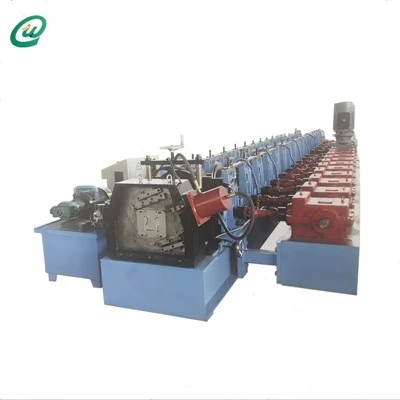
Hangzhou IUWON Technology Co., Ltd. is one of the most reliable manufacturers and suppliers of metal roll forming equipment in China. With abundant experience, we warmly welcome you to buy custom made metal roll forming equipment from our factory. Good service and reasonable price are available.
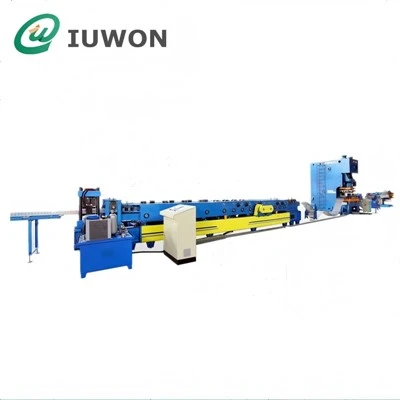
The production line begins with coil loading. The decoiler releases the material at a controlled rate, after which the strip passes through a leveling and guiding section.
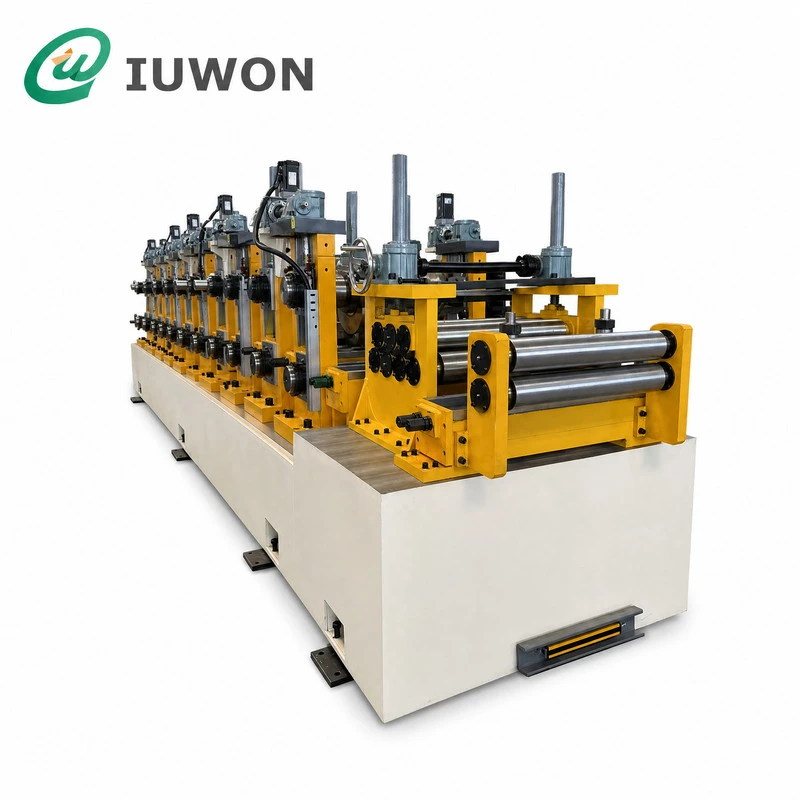
The forming stands then progressively shape the strip. Each roller station performs a limited amount of deformation, allowing the final cross-section to develop gradually instead of forcing the entire bend in one operation.
A standard process can include:
Coil Loading → Decoiling → Leveling → Guiding → Punching → Roll Forming → Cut-Off → Discharge
Punching can be positioned before forming when holes are located on flat portions of the strip. For certain profiles, additional post-forming processing can also be incorporated.

General Equipment Parameters
| Parameter | Typical Range |
|---|---|
| Processing Material | Carbon Steel / GI / PPGI / Stainless Steel / Aluminum |
| Material Thickness | 0.30–4.00 mm |
| Coil Width | 100–1600 mm |
| Material Yield Strength | Up to 550 MPa |
| Forming Speed | 5–30 m/min |
| Forming Stations | 10–30 |
| Shaft Diameter | 50–100 mm |
| Shaft Material | 40Cr |
| Roller Material | GCr15 / 45# Steel |
| Main Motor | 7.5–45 kW |
| Drive | Gearbox |
| Cutting | Hydraulic / Flying Cut-Off |
| Length Control | Encoder |
| Control System | PLC + HMI |
| Power Supply | 380 V / 50 Hz / 3 Phase |
Profile-Specific Machine Configuration
A roll forming line is normally developed around the finished profile rather than the generic material category. The cross-section determines the roller sequence, shaft arrangement, guide design, and number of forming stations.
Typical Metal Profiles
| Profile Type | Typical Application | Typical Thickness |
|---|---|---|
| C Channel | Framing / Supports | 1.0–4.0 mm |
| U Channel | Guides / Frames | 0.8–3.0 mm |
| Z Purlin | Building Structures | 1.5–3.5 mm |
| C Purlin | Roof & Wall Structures | 1.5–3.5 mm |
| Hat Section | Framing / Reinforcement | 0.8–2.5 mm |
| Cable Tray | Cable Management | 0.8–2.5 mm |
| Door Guide Rail | Door Systems | 1.0–3.0 mm |
| Rack Upright | Storage Systems | 1.5–3.0 mm |
| Roofing Profile | Roof Cladding | 0.30–1.00 mm |
| Solar Mounting Profile | PV Structures | 1.5–3.0 mm |
The same forming principle can therefore be applied across different industries, but the roller tooling and machine configuration are changed according to the actual profile.
Inline Punching, Cutting & Handling
Many metal profiles require holes, slots, notches, or connection openings before they can be assembled. These operations can be incorporated into the forming line instead of relying entirely on secondary processing.
Available Processing Functions
Pre-punching
Servo punching
Hydraulic punching
End-hole punching
Slot punching
Notching
Embossing
Length cutting
Flying cut-off
Automatic stacking
The punching system can use programmable pitch control for repeated openings. An encoder measures material movement and communicates with the PLC so that the programmed hole positions remain synchronized with production.
For profiles manufactured in long continuous lengths, a flying cut-off can separate the finished product without requiring a complete stop of the forming line.
Machine Configuration for Different Production Requirements
Metal forming requirements can vary substantially between a light-gauge decorative profile and a heavy structural section.
For thin coated steel, the forming system can emphasize controlled deformation and surface protection. The roller design and entry guides help reduce unnecessary scratching of the coating.
For heavy-gauge structural profiles, the machine requires greater forming capacity. Larger shafts, stronger stands, higher-capacity bearings, and a suitable transmission system can be selected according to the material thickness and yield strength.
For perforated profiles, the punching unit must be coordinated with the forming speed and hole arrangement.
For multiple product sizes, interchangeable tooling sets can be considered when the profile range is technically compatible.
Configuration Options
| Machine Unit | Options |
|---|---|
| Decoiler | Manual / Hydraulic / Automatic |
| Leveling | 5 / 7 Roller |
| Feeding | Standard / Servo |
| Punching | Hydraulic / Servo |
| Forming Tooling | Dedicated / Interchangeable |
| Transmission | Gearbox |
| Cutting | Hydraulic / Flying |
| Length Measurement | Encoder |
| Discharge | Run-Out Table |
| Stacking | Manual / Automatic |
| Control | PLC + Touchscreen |
| Safety | Guarding + Emergency Stop |
Customized Metal Roll Forming Equipment
The equipment can be customized around the customer's actual product drawing and production requirements.
Can the equipment be designed for a non-standard metal profile?
Yes. The roller tooling can be developed according to a CAD drawing or detailed cross-sectional dimensions. Non-standard C, U, Z, hat, channel, framing, and other sections can be evaluated individually.
Can one machine produce different profiles?
It depends on the similarity between the profiles. Profiles with compatible dimensions may share a machine platform with interchangeable tooling, while substantially different sections generally require separate tooling.
Can the machine process both galvanized and carbon steel?
Yes, provided the material thickness and mechanical properties fall within the machine's designed range. Roller and guide surfaces can also be selected according to the material finish.
Can holes be punched automatically?
Yes. The line can incorporate hydraulic or servo punching for round holes, slots, connection openings, and other repeated patterns.
Can heavy steel profiles be manufactured?
Yes. For thicker material, the machine can be engineered with larger shafts, reinforced roller stands, stronger transmission components, and an appropriate drive motor.
Can the finished profile be cut to different lengths?
Yes. The PLC and encoder can control different programmed lengths when the profile cross-section remains unchanged.
What information is needed before designing the machine?
The key information includes the profile drawing, material type, material thickness, steel grade, coil width, finished profile dimensions, hole pattern, finished length, required speed, and expected production volume.
Can the machine be supplied with tooling for future products?
Yes. Additional dedicated tooling sets can be designed for compatible profiles, allowing the same basic production platform to be used for a wider product range where technically appropriate.
Hot Tags: metal roll forming equipment, China metal roll forming equipment manufacturers, suppliers, factory, pbr roll former, profile sheet forming line, roll form solutions, roll forming aluminum sheet, roll forming line machine, steel roofing roll forming machines