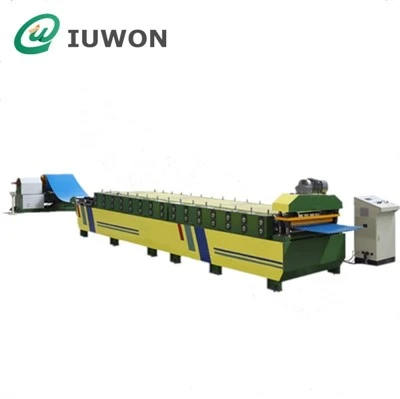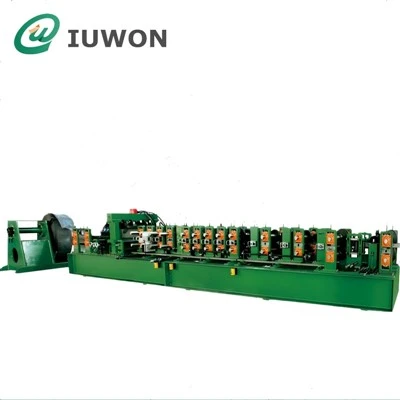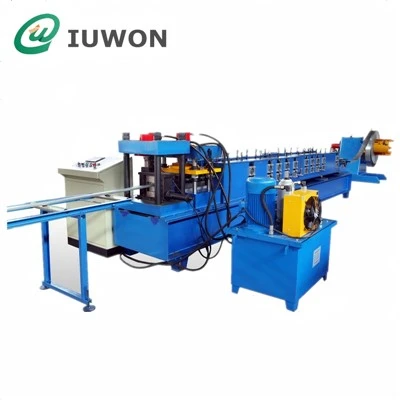
Purchasing a roll forming machine is a long-term production investment. The equipment must do more than form a metal strip into the required cross-section. It needs to process specified materials, maintain dimensional consistency, meet output targets, and integrate with the buyer's manufacturing process. A machine selected mainly by price or advertised speed may create problems with tooling, product quality, changeovers, and maintenance.
Before comparing quotations, buyers should define their production requirements and examine the engineering behind the proposed line. The following considerations provide a practical framework for evaluating equipment and suppliers.
Start with the Finished Profile Requirements
The finished profile should be the starting point of machine selection. Buyers should prepare a complete drawing showing the cross-section, dimensions, bend angles, return edges, hole positions, cut lengths, and required tolerances. A CAD drawing gives the engineering team a clear basis for designing the forming sequence and roller tooling. Since different profiles, such as cable trays, C/Z purlins, guardrail sections, roofing panels, and door frames, have different geometries and production requirements, their forming configurations are not interchangeable. Even products within the same category may require different station arrangements, punching operations, or cutting methods.
Buyers should also identify how many profile variations the line needs to produce. If production involves several widths or section sizes, confirm whether the machine can accommodate them through interchangeable rollers, adjustable forming stations, or separate tooling sets. This helps determine the required machine configuration and avoid limitations when switching between product specifications.
Key information to prepare before requesting a quotation:
- Complete product drawings and cross-sectional dimensions
- Bend angles, edge configurations, and hole positions
- Required cutting lengths and dimensional tolerances
- Number of profile variations and expected changeover frequency
- Planned production volume and future product development requirements
A Custom Roll Forming Machine should be designed around approved product drawings and the expected range of profiles rather than an assumed standard configuration. Clear technical documentation also provides a reference for later testing and acceptance.
Material Compatibility Determines Machine Capacity
Material specifications directly affect machine structure, drive requirements, roller design, and finished-product quality. Buyers should provide the material grade, thickness range, strip width, yield strength, and surface coating. Stating only that the machine will process carbon steel or stainless steel is insufficient for accurate engineering.
Thickness deserves particular attention. A machine designed for a narrow material range may not perform reliably when processing significantly thinner or thicker coils. The supplier should confirm the minimum and maximum thickness it can handle and the material strength on which its capacity is based.
| Material factor | What buyers should verify |
|---|---|
| Material grade | Carbon steel, stainless steel, galvanized steel, or other specified materials |
| Thickness range | Minimum and maximum processing thickness |
| Yield strength | Whether the machine can handle the material's mechanical properties |
| Strip width | Compatibility with the intended coil dimensions |
| Surface coating | Protection against scratches, marks, and coating damage |
| Springback | Whether tooling and forming passes account for material recovery |
Coatings and surface finishes also matter. Galvanized, pre-painted, and other coated materials can be scratched or marked if roller surfaces, clearances, or forming pressure are unsuitable. For stainless steel or high-strength steel, forming loads and springback may require different tooling and machine specifications.
Buyers should ask whether the proposed line has been tested with material comparable to their actual production stock. Where several materials will be used, request confirmation of operating limitations or necessary configuration changes.
Roller Tooling and Machine Construction Need Close Inspection
Roller tooling determines how the flat strip is progressively formed into the finished profile. Its design affects dimensional accuracy, surface condition, forming stability, and the amount of adjustment required during production.
The number of forming stations should be evaluated together with the profile geometry and material characteristics. More stations are not automatically better; the arrangement should distribute deformation appropriately. Poorly designed forming passes can cause twisting, bowing, edge deformation, or excessive stress.
The mechanical structure also deserves close attention. Buyers should review the following components:
- Machine frame: Structural rigidity under forming loads.
- Roller shafts: Dimensions, material strength, and support arrangement.
- Bearings and gearboxes: Load capacity, operating stability, and maintenance requirements.
- Drive transmission: Whether power is distributed appropriately across forming stations.
- Roller tooling: Material selection, heat treatment, machining accuracy, and surface finish.
These components work together to maintain alignment and forming consistency. For profiles with visible or coated surfaces, roller contact conditions deserve additional attention.
A Custom Roll Forming Machine should have tooling developed for the intended profile and material combination. Buyers should request relevant tooling drawings or technical explanations and clarify whether future profile changes will require new rollers, adjustments, or substantial machine modifications.
Evaluate the Complete Production Line Configuration
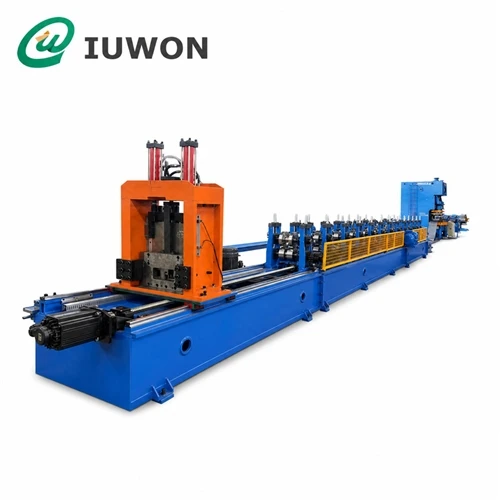
A roll forming machine is often one part of a larger production line. Its auxiliary equipment determines how material enters the machine, how secondary operations are completed, and how finished profiles are collected.
| Production stage | Typical equipment | Main function |
|---|---|---|
| Coil loading | Decoiler | Holds and feeds metal coils |
| Material preparation | Leveling or guiding system | Improves feeding stability and strip alignment |
| Feeding | Servo or mechanical feeder | Controls material movement |
| Secondary processing | Punching or notching unit | Creates holes and required cutouts |
| Profile forming | Roller forming stations | Gradually shapes the metal strip |
| Length processing | Hydraulic or servo cutting system | Cuts profiles to specified lengths |
| Finished-product handling | Run-out table or stacking system | Collects and organizes finished sections |
Not every application requires every module. The correct configuration depends on the profile, production volume, and downstream handling process. Before finalizing the quotation, buyers should specify punching and cutting requirements, including hole shapes, positions, quantities, notching requirements, cut lengths, and length tolerances, as these details determine the production sequence and the required hydraulic or servo-controlled systems.
Control functions also need to be clarified. A PLC-based system may coordinate feeding, punching, forming speed, cutting length, and production counts, but buyers should understand which operations are automatic, which require operator input, and how production settings are adjusted. Requesting a complete line layout and a clear list of included and optional equipment helps prevent unexpected costs caused by missing feeding, cutting, handling, or automation components.
Production Speed Must Be Evaluated Alongside Product Quality
Advertised line speed should not be treated as guaranteed output. Actual production capacity depends on material thickness, profile complexity, punching frequency, cut length, operating cycle, and handling time. A machine running at high forming speed may still deliver lower finished output if secondary operations become the bottleneck.
Buyers should provide a realistic production target, such as required pieces per shift or monthly output. Ask the supplier to explain the conditions behind its capacity estimate, including material specifications, product length, hole pattern, and automation level.
Quality requirements should also be measurable. The following inspection points are particularly relevant:
- Cross-sectional dimensions and bend angles
- Straightness, twisting, and profile deformation
- Hole position and punching accuracy
- Cutting length and end condition
- Surface finish and coating integrity
- Consistency between successive production batches
Factory testing should use representative material and, where possible, the buyer's actual profile drawing. Inspect samples produced at different points during a continuous run rather than relying on one finished piece. Production consistency is as important as the quality of the first sample.
A practical acceptance principle: Define the material specifications, operating conditions, dimensional tolerances, and inspection methods before the machine enters production testing. For a Custom Roll Forming Machine, documented acceptance criteria give both parties an objective basis for evaluating forming accuracy and operating performance.
Safety, Maintenance, and Technical Support
Machine performance over its service life depends partly on how easily the equipment can be operated, maintained, and serviced. Buyers should evaluate these factors before finalizing the purchase.
Review guarding around rollers, shafts, punching areas, and cutting mechanisms. Check emergency stops, electrical protection, safe access for coil loading, and maintenance arrangements. The supplier should explain the relevant safety functions and operating procedures.
Routine maintenance
Ask which components require regular lubrication, inspection, adjustment, or replacement. Common maintenance items may include rollers, bearings, cutting tools, sensors, and hydraulic components. A recommended maintenance schedule helps production teams plan routine servicing.
Technical documentation
Confirm that the delivery scope includes operation manuals, maintenance instructions, electrical diagrams, hydraulic diagrams where relevant, and spare-parts information. These materials help local technicians understand the equipment and maintain it properly.
After-sales assistance
Clarify whether installation guidance, commissioning, operator training, remote troubleshooting, and spare-parts supply are included. Establish how technical issues are reported and how service responsibilities are divided.
The purchase decision should account for support throughout the equipment's operating life, not only the assistance provided during delivery.
Compare Supplier Capabilities and Total Project Cost
Quotations should be compared against the same technical and commercial scope. A lower initial price may exclude tooling, decoiling equipment, punching systems, automation, installation, training, or essential spare parts. Buyers should request an itemized quotation separating standard configuration, optional modules, services, and exclusions. Supplier evaluation should also go beyond catalogue specifications by examining engineering capability, machining and assembly processes, electrical integration, quality inspection, and experience with comparable profile applications. Ask for examples of similar production lines and how the proposed configuration addresses specific requirements.
Project coordination is equally important. Before placing an order, confirm the design approval process, manufacturing schedule, testing arrangements, packing scope, installation responsibilities, and documentation requirements. For overseas projects, clarify electrical specifications and technical support arrangements in advance to reduce coordination issues during delivery, installation, and commissioning.
The total project cost should consider more than the initial equipment price.
| Cost consideration | Long-term impact |
|---|---|
| Initial equipment investment | Capital expenditure and configuration scope |
| Roller tooling | Profile compatibility and future tooling requirements |
| Energy consumption | Ongoing operating expenses |
| Labor requirements | Operator workload and production organization |
| Maintenance and spare parts | Equipment availability and servicing costs |
| Changeover time | Production flexibility and downtime |
| Installation and training | Startup efficiency and operator readiness |
A well-matched machine may offer better long-term value even if its initial purchase price is not the lowest. The most suitable supplier is one that can demonstrate how its proposed equipment meets the buyer's technical requirements and production objectives.
IUWON Supports Customized Roll Forming Machine Projects Worldwide
Hangzhou IUWON Technology Co., Ltd. specializes in metal cold roll-forming equipment, drawing on more than 20 years of industry experience and projects serving customers in over 50 countries. Its product range covers production lines for cable trays, solar mounting structures, C/Z purlins, highway guardrails, roofing profiles, door frames, and other metal sections. IUWON integrates engineering design, roller tooling development, precision machining, machine assembly, electrical integration, and factory testing, with equipment configurations tailored to customer drawings, material specifications, production capacity, punching and cutting requirements, automation needs, and factory layouts.
Beyond individual machines, IUWON can develop complete production line configurations and provide installation guidance, commissioning, operator training, remote technical support, and spare-parts assistance. For buyers evaluating a Custom Roll Forming Machine, this combination of engineering, manufacturing, and project support helps ensure that the selected equipment is aligned with actual production requirements, from initial profile design through installation and operation.