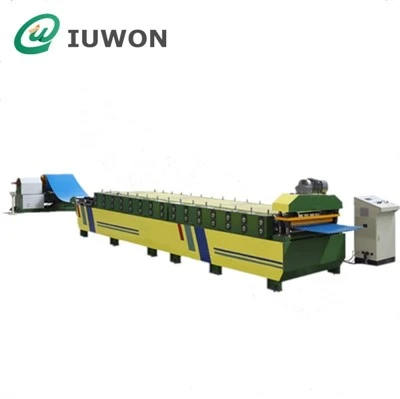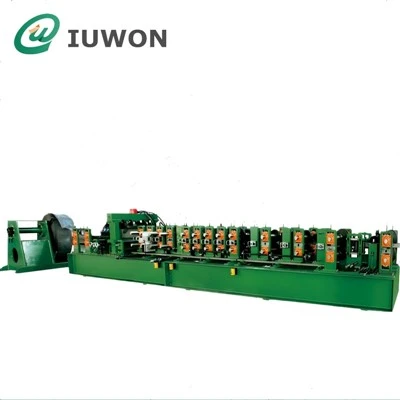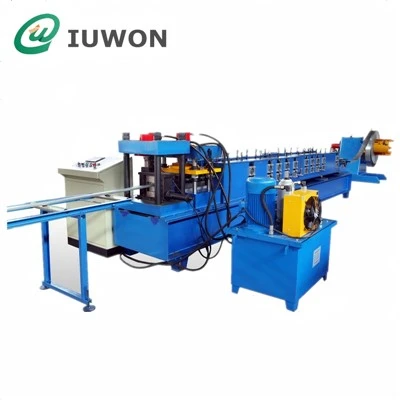
A standard roll forming machine can be an economical choice for established profiles and predictable production volumes. A Custom Roll Forming Machine is more suitable when profile geometry, material specifications, dimensional tolerances, or integrated operations exceed the practical capabilities of standard equipment. Understanding these differences helps manufacturers select equipment that meets current requirements while supporting long-term production plans.

Understanding the Differences Between Custom and Standard Machines
Both machine types use progressive forming stations to transform metal strips into continuous profiles. However, their engineering approaches, tooling configurations, and production capabilities are different.
|
Comparison Factor |
Standard Roll Forming Machine |
Custom Roll Forming Machine |
|---|---|---|
|
Machine Configuration |
Uses established machine structures and predefined forming stations. |
Adapted to specific product drawings and production requirements. |
|
Roll Tooling |
Uses conventional rollers for specific profile families or standard dimensions. |
Uses dedicated tooling designed for the required cross-section. |
|
Adjustment Flexibility |
Offers limited adjustments; major profile changes may require new tooling. |
Allows selected components and configurations to be adapted. |
|
Engineering Preparation |
Requires less development when existing specifications match. |
Requires additional profile analysis, engineering, and tooling development. |
|
Material Compatibility |
Limited to the material range supported by the original design. |
Configured for specified material grades, thicknesses, and strength requirements. |
|
Production Functions |
Provides standard feeding, forming, and cutting functions. |
Can integrate punching, notching, cutting, and other operations. |
|
Automation |
Uses established control and handling configurations. |
Controls and automation can be adapted to the production workflow. |
|
Initial Investment |
Generally lower due to reduced engineering requirements. |
Generally higher due to customized engineering and tooling. |
The main distinction is how closely the machine's mechanical design and production functions match the finished product requirements. A standard configuration may be sufficient for common profiles, while specialized products often require a more targeted engineering approach.
When Is a Standard Roll Forming Machine the Better Choice?
Standard equipment is particularly suitable for manufacturers producing common profiles with stable dimensions and consistent material specifications.
Typical applications include:
- Standard C and Z purlins
- Conventional roofing and wall panels
- Common cable tray sections
- Standard door and window frames
- Regular metal channels and structural profiles
For these products, established machine configurations may already provide the necessary forming capacity.
Several advantages make standard equipment attractive. Existing machine designs reduce engineering and development expenses, making them suitable for businesses with limited initial investment budgets. Shorter preparation cycles also allow manufacturers to begin production without extensive profile-specific design work.
Maintenance can be more straightforward because conventional machine structures and components are familiar to operators and maintenance teams. For businesses handling repeat orders with stable specifications, established forming processes can provide predictable production performance.
However, buyers should verify the machine's actual operating range rather than assuming that a standard configuration can accommodate every similar-looking profile. Material thickness, yield strength, profile dimensions, and forming capacity must all match the intended application.
When Does Custom Engineering Provide Greater Value?
A Custom Roll Forming Machine becomes more valuable when product geometry, material properties, or production processes require specific engineering solutions.
Complex profile geometry
Some metal sections contain multiple bends, asymmetrical structures, reinforcing ribs, or tight corner radii. These features require careful distribution of deformation across forming stations.
Without an appropriate forming sequence, manufacturers may encounter profile twisting, longitudinal bowing, edge wave, surface scratches, inconsistent bending angles, or excessive springback. Dedicated tooling and optimized forming sequences help address these production challenges.
Special material requirements
Different metals behave differently during cold forming. Material strength, ductility, thickness, and surface coatings influence forming forces and springback.
A customized design can account for high-strength steel, aluminum profiles, different thickness ranges, and coated materials that require additional surface protection. The objective is to match the forming structure and tooling with the actual material properties.
Integrated production operations
Some manufacturing projects require more than basic roll forming. Additional operations may include hydraulic punching, notching, embossing, automatic cutting, and servo feeding.
Integrating these functions into one production line can reduce intermediate handling and improve workflow coordination. For manufacturers producing proprietary sections or customer-specific profiles, dedicated tooling can also support consistent product quality across repeat orders.
However, additional functions should only be included when they serve a defined production requirement. Unnecessary automation and processing units can increase equipment costs and maintenance complexity.
Cost, Productivity, and Flexibility: A Detailed Comparison
Initial purchase price is important, but it does not fully represent the economic value of production equipment. Buyers should evaluate the total cost of manufacturing acceptable finished products throughout the machine's service life.
|
Cost and Performance Factor |
Standard Machine |
Custom-Engineered Machine |
|---|---|---|
|
Purchase Cost |
Usually lower |
Usually higher |
|
Engineering Expenses |
Limited |
Higher initial design costs |
|
Tooling Investment |
Standard or adaptable tooling |
May require dedicated tooling |
|
Changeover Costs |
May increase with profile differences |
Can be optimized for planned changes |
|
Material Adaptability |
Restricted by original design |
Configured for target materials |
|
Labor Requirements |
Depends on automation level |
Can be optimized around workflows |
|
Scrap and Rework |
Depends on product compatibility |
Can be reduced through tailored engineering |
|
Long-Term Flexibility |
Suitable for defined product families |
Suitable for specific complex requirements |
Three economic factors deserve particular attention.
- Production efficiency: Evaluate actual output of qualified finished products rather than relying solely on nominal forming speed. Feeding, punching, cutting, coil changes, and material handling all influence production capacity.
- Tooling and changeover expenses: Frequent profile changes may increase setup time and tooling costs. Interchangeable rollers, cassette systems, and adjustable components can help, depending on the machine design.
- Total operating costs: Consider labor, maintenance, energy consumption, material waste, downtime, and downstream processing when calculating long-term equipment value.
A higher initial investment does not automatically produce a better financial result. Similarly, a lower purchase price may become expensive if the equipment requires repeated modifications or additional processing operations.
Key Factors to Evaluate Before Purchasing
Before selecting either configuration, manufacturers should prepare a detailed technical specification. This allows equipment suppliers to evaluate actual forming requirements instead of recommending a machine based on product category alone.
The first priority is a complete profile drawing. It should identify the cross-section, dimensions, bend radii, critical tolerances, and any holes or cutouts required during production.
Material specifications are equally important. Buyers should provide the metal grade, thickness range, strip width, yield strength, and surface treatment. These parameters influence forming forces, roll design, machine capacity, and the forming sequence.
Production requirements should also be clearly defined, including:
- Expected daily, monthly, and annual output.
- Number of profile variations and changeover frequency.
- Required punching, notching, and cutting operations.
- Desired automation and material handling functions.
- Available factory space and power supply.
In addition to technical specifications, buyers should request a production validation process. A proper factory acceptance test should examine finished profile dimensions, bending angles, surface condition, cutting accuracy, punching positions, and continuous operating stability.
Testing with representative raw materials is particularly important because actual material behavior can differ from theoretical design assumptions. These checks provide a more reliable basis for equipment acceptance than machine specifications alone.
Which Machine Is Better for Different Manufacturing Businesses?
The right equipment depends on the manufacturer's business model, product portfolio, and expected production demand.
|
Manufacturing Scenario |
Recommended Configuration |
Main Reason |
|---|---|---|
|
Standard roofing panel production |
Standard Machine |
Stable dimensions and repeatable production |
|
Common C/Z purlin manufacturing |
Standard or configurable machine |
Established profile requirements |
|
Custom architectural metal profiles |
Custom Machine |
Special cross-sections |
|
High-strength structural components |
Custom Machine |
Material-specific forming requirements |
|
Multiple related profile variations |
Configurable machine |
Greater tooling flexibility |
|
Proprietary industrial components |
Custom Machine |
Dedicated profile engineering |
|
New manufacturers testing market demand |
Standard Machine |
Lower initial investment |
|
High-volume production with integrated punching |
Custom or integrated line |
Coordinated processing operations |
There is also a middle-ground solution: a standard machine platform with customized rollers, selected structural modifications, or additional production functions.
This approach can provide sufficient flexibility without the expense of developing an entirely dedicated machine. It is particularly relevant when several products share similar cross-sections or forming requirements.
For manufacturers with uncertain demand, avoiding unnecessary customization is important. Reviewing market forecasts, confirmed orders, product lifecycles, and expected annual production volumes can help determine whether dedicated tooling is financially justified.
Making the Right Equipment Investment Decision
Choosing between standard and customized equipment requires a clear understanding of present production needs and future business plans.
A standard machine is generally the better option when product dimensions follow established specifications, production demand is predictable, and material requirements fall within an existing machine's capacity.
A Custom Roll Forming Machine is more appropriate when products have complex cross-sections, material specifications require dedicated engineering, tighter tolerances demand optimized forming sequences, or multiple production operations need to be integrated.
For equipment manufacturers, the most important responsibility is to match machine configuration with the buyer's actual production requirements. This involves reviewing product drawings, evaluating material behavior, selecting suitable forming structures, and validating finished profiles before delivery.
Ultimately, the better investment is not necessarily the machine with more functions or the highest level of automation. It is the configuration that produces the required profiles consistently, maintains reasonable operating costs, and supports the manufacturer's long-term production strategy.
IUWON: Your Partner for Custom Roll Forming Solutions
Choosing between standard and customized roll forming equipment depends on your profile specifications, material requirements, and production goals. As a professional roll forming machine manufacturer, Hangzhou IUWON Technology Co., Ltd. provides standard equipment and customized production solutions for different metal forming applications.
From roll tooling design and machine configuration to integrated punching and cutting systems, IUWON develops equipment based on customers' product drawings and production requirements. Whether you need a standard production line or a Custom Roll Forming Machine for specialized profiles, IUWON focuses on practical solutions that balance production efficiency, equipment performance, and investment costs.