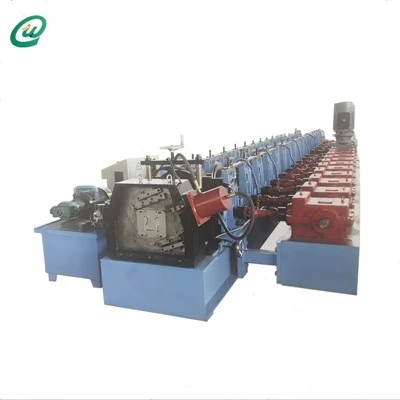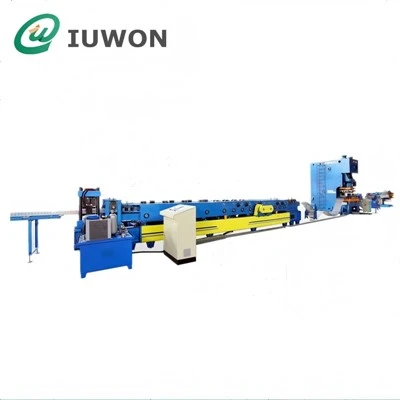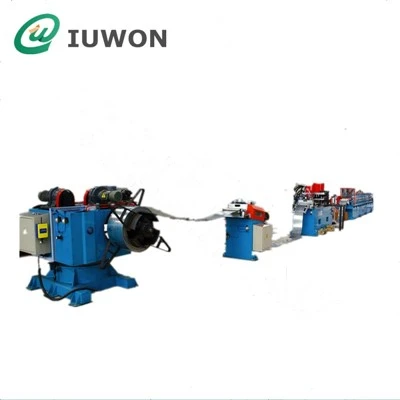

Hangzhou IUWON Technology Co., Ltd. is one of the most reliable manufacturers and suppliers of container house profile roll forming machine in China. With abundant experience, we warmly welcome you to buy custom made container house profile roll forming machine from our factory. Good service and reasonable price are available.
Container House Profile Roll Forming Machine Configuration and Specifications
| Item | Typical Configuration |
|---|---|
| Machine Type | Container House Profile Roll Forming Machine |
| Raw Material | Carbon steel, galvanized steel and specified sheet metals |
| Material Thickness | Determined by structural profile and material grade |
| Coil Width | Calculated from the profile development |
| Forming Method | Multi-station cold roll forming |
| Forming Rollers | Machined steel rollers |
| Main Shafts | Steel forming shafts |
| Drive System | Motor and mechanical transmission |
| Punching | Optional, according to profile requirements |
| Cutting | Hydraulic or mechanical cutting |
| Length Measurement | Encoder-based |
| Control | PLC electrical control |
| Finished Profile Length | Programmable |
| Production Speed | Configured according to profile, material and processing sequence |
Engineering Advantages for Container House Production
Reduced Post-Forming Fabrication
When holes and cut lengths are incorporated into the forming line, structural members can leave the machine with predefined connection features. This can reduce subsequent manual drilling and individual length measurement during frame assembly.
Repeatable Structural Cross-Sections
The roller tooling establishes the profile geometry through controlled contact between the sheet and each forming stand. This is important when multiple members must fit together during wall-frame, roof-frame, or floor-frame assembly.
Material Flow From Coil to Finished Member
The production route connects decoiling, guiding, forming, optional punching, measuring, cutting, and discharge into one continuous process. Operators can therefore process a coil into multiple structural members without repeatedly loading individual sheets.
Profile Changeovers Can Be Planned Around Tooling
When a project requires more than one container-house section, the machine configuration can be developed around the required roller tooling and changeover method. The practical changeover procedure depends on shaft design, roller mounting, profile differences, and the number of sections produced on the line.
The machine can produce cold-formed steel sections used in different parts of modular building structures, including:
- Wall framing members
- Roof framing sections
- Floor support profiles
- Corner and edge sections
- Door and window frame members
- Connecting and reinforcement profiles
- Container-type modular building components
For wall and roof applications, the profile geometry must match the connection method used during assembly. A section containing bolt holes, screw flanges, or interlocking edges requires different tooling and processing arrangements from a plain structural channel.

What Should Be Checked When Matching Profiles With Container Frames?
The finished steel section should be checked against the mating frame before large-batch production begins. Important dimensions include the overall section width and height, flange position, return-edge dimensions, hole spacing, and finished length because these features determine whether adjacent members can be connected without additional cutting or drilling.
For profiles used around doors, windows, corners, and roof connections, the interface dimensions should be measured together with the corresponding assembly component. A profile can meet its own dimensional drawing while still creating an assembly problem if the flange position, hole center, or connection clearance does not match the mating part.
Trial sections should therefore be assembled with the actual fasteners or connecting components before production approval. This check can identify errors in profile geometry, punching position, or cut length before the same condition is repeated across an entire coil batch.
Hot Tags: container house profile roll forming machine, China container house profile roll forming machine manufacturers, suppliers, factory, channel forming machine, new tech roll former, palisade roll forming machine, roll form roofing, roll forming aluminum, steel roofing roll forming machines