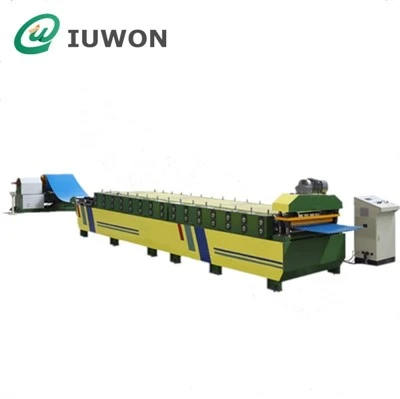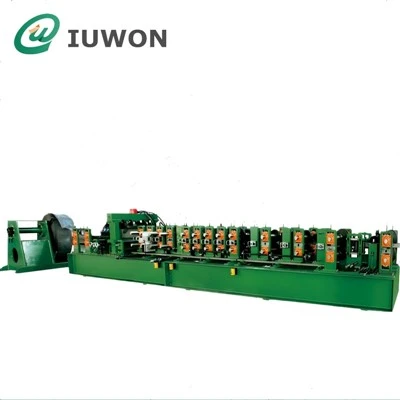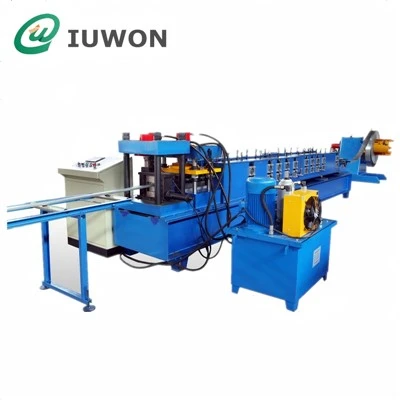
A fully automatic PV bracket roll forming machine has completed its factory acceptance test at the IUWON production facility and is now ready for shipment to a solar mounting manufacturer in Ukraine. The equipment left our workshop fully assembled, wired and trial-run with actual coil material, and will travel by sea freight before on-site commissioning at the customer's plant.
This shipment is not a first-time order for the region. Over the past several years we have delivered cold roll forming machines for solar bracket production to customers across Eastern Europe, the Middle East and Southeast Asia. What makes this particular project different is the profile mix: the buyer needs one line that can switch between several solar strut and C-channel sections without a full roller changeover, so the machine was specified around flexibility rather than raw speed alone. Below we walk through the configuration, the testing procedure, the shipping preparation, and the support package that follows the machine after delivery.
Why Solar Mounting Production Is Moving In-House in Ukraine
Ukraine's renewable energy sector has continued to rebuild and expand despite extremely difficult operating conditions, and distributed generation has become a strategic priority rather than a side project. Rooftop installations on hospitals, schools, municipal buildings and industrial facilities are being prioritised precisely because they are less exposed to grid disruption than large centralised plants.
That shift has a direct consequence for the supply chain. Solar mounting structures - the steel that actually holds the modules in place - are heavy, bulky and expensive to import. A 40-foot container carries a surprisingly small tonnage of finished strut, and freight cost per tonne has become one of the largest single line items in a mounting structure's landed price. More and more EPC contractors and fabrication workshops in the region have therefore concluded that buying the solar racking roll forming machine and producing locally is cheaper and faster than importing finished brackets.
Local production also solves a lead-time problem. Projects in Ukraine are frequently specified, funded and mobilised on compressed schedules. Waiting eight to twelve weeks for imported strut is often simply not viable. A workshop running its own solar mounting roll former can cut profile stock on demand, react to drawing revisions within days, and hold minimal finished inventory because it only needs coil.
The buyer in this project fits exactly that profile: an established steel fabricator with existing welding, galvanising and coating capability, adding roll forming as the missing upstream step so that the entire bracket - from coil to packed bundle - is produced under one roof.
Line Configuration: From Coil to Stacked Bundle
The photovoltaic bracket roll forming line shipped here follows a conventional but carefully specified architecture. Each module was selected for reliability in a workshop environment rather than for catalogue headline numbers.
Hydraulic Decoiler with Coil Car
The line starts with a hydraulic mandrel decoiler sized for coils up to 5 tonnes, supplied with a coil loading car so that a single operator can position a new coil without a crane. A coil guide and loop control maintain consistent strip tension into the leveler, which matters on thin galvanised material where uncontrolled tension produces camber that no downstream station can correct.
Leveling Unit
A seven-roller leveler removes coil set and cross-bow before forming. This is an easily overlooked module, but it is the difference between a profile that assembles cleanly on site and one that fights the installer. On solar strut, straightness tolerance is not cosmetic - a bowed rail translates directly into module misalignment across a row.
Servo Online Punching
The punching station uses a servo-driven carriage so that hole patterns can be produced while the strip is moving, without stopping the line. For solar applications this is essential: strut profiles typically require a repeating hole pattern for module clamps, plus longer-spaced holes for rail-to-rail connections and base plate fixings. Punching dies are cassette-mounted, so a pattern change is a die swap rather than a line rebuild. Hole position, pitch and diameter are set from the HMI, and the control system records the parameter set against a named profile so that the operator recalls a job rather than re-entering dimensions.
Roll Forming Stations
The forming section is the heart of any solar strut roll forming machine, and it is where most specification conversations actually happen. This line was configured with a station count and pass sequence designed for the customer's heaviest section - a 41 × 41 mm strut in 2.0 mm galvanised steel - while still running lighter C-channel sections efficiently.
Forming rolls are forged steel, hardened and hard-chrome plated, with a surface finish that resists the abrasion of zinc-coated strip. Galvanised and Al-Zn-Mg coated material is noticeably more aggressive on tooling than cold-rolled mild steel, because the coating acts as an abrasive and because coating damage at the roll gap becomes a corrosion initiation point on the finished bracket. Roll design therefore emphasises generous radii at bend points and controlled material flow rather than sharp, high-pressure forming.
Roller shafts run in heavy-duty bearings on a rigid welded frame, with worm-gear or independent drive depending on the station group. Shaft spacing and roll gap are adjusted mechanically with dial indicators and recorded in the machine documentation, so that a future changeover has a documented baseline to return to.
Servo Flying Cut-Off
Cutting is performed by a servo-driven flying cut-off that travels with the strip, allowing length changes without stopping production. Cut length is set from the HMI with a tolerance typically held to ±1 mm on standard sections. The cut produces a clean, square end with minimal burr - important because solar strut ends frequently sit against clamp faces or inside base plate assemblies where burr interferes with fit.
Run-Out Table and Stacker
Finished profiles transfer to a run-out table and are stacked in bundles at the line end, ready for bundling, labelling and transfer to the galvanising or coating stage.
Control System
The whole line runs from a PLC with an HMI touchscreen. Recipe management, fault diagnostics, production counting and parameter storage are all handled in the controller. A single operator runs the line in normal production; the second person on the floor is typically handling material logistics rather than machine control.
Profile Capability
The line as shipped covers the sections that dominate the Ukrainian and wider European solar mounting market:
| Profile Type | Typical Application | Material Thickness |
|---|---|---|
| 41 × 41 strut, plain | Module rails, general framing | 1.5 – 2.5 mm |
| 41 × 41 strut, slotted | Adjustable rail connections | 1.5 – 2.5 mm |
| 41 × 21 strut | Light rails, cable management | 1.2 – 2.0 mm |
| 41 × 82 double strut | Long-span rails, high snow load | 2.0 – 2.5 mm |
| C / U channel sections | Purlins, base frames, carport structure | 1.5 – 3.0 mm |
| Custom hat / Z sections | Specialised racking components | On drawing |
Materials accepted include hot-dip galvanised steel, Al-Zn-Mg coated steel (commonly specified for solar mounting because of its cut-edge corrosion performance), and pre-painted coil where a coated finish is required. Line speed is application-dependent, typically in the 15–25 m/min range on standard sections, with output governed more by punching density and bundle handling than by forming speed.
Factory Acceptance Test: What Was Actually Checked
Before the machine was dismantled for packing, it ran a full trial production with the customer's own material specification. The test sequence is documented and the report travels with the machine.
Empty run. Every station, drive, sensor and safety interlock was verified through a complete cycle without material, confirming direction of rotation, loop control response, emergency stop function and guard interlocks.
Dimensional verification. First-off samples were measured for flange width, web height, bend angle, inside radius and overall straightness. Samples were checked against the customer's drawing with go/no-go gauges, and dimensions were recorded at the head, middle and tail of the trial run to confirm stability rather than a single lucky sample.
Punching accuracy. Hole position, pitch accumulation over a full 6-metre length, hole diameter and edge distance were checked. Pitch accumulation is where online punching systems most often drift, so this was measured over a long run rather than over one pitch.
Cut length repeatability. A batch of cut lengths was measured and logged to confirm the ±1 mm tolerance held across production speed changes and start-stop cycles.
Coating integrity. Formed samples were inspected at the bend radii for zinc coating cracking or flaking, since coating damage at the outer bend is the most common hidden quality defect on coated solar strut.
Throughput trial. A continuous production run established realistic output per shift, including changeover time, which is the number the customer actually needs for capacity planning.
The report, drawings, photographs and video of the trial run were shared with the buyer before packing began, so that any clarification could be resolved while the machine was still assembled and accessible in our workshop - a far cheaper point to make a change than after arrival.
Packing and Shipping Preparation
Solar strut roll forming lines are long, heavy and mechanically delicate in ways that are not always obvious. Our packing standard for this shipment was built around the realities of a long overland-plus-sea route into Eastern Europe.
Main frames and forming stations are fixed on steel skids, wrapped in VCI film to prevent condensation corrosion during transit, and crated with fumigation-free plywood or steel framing. Rolls and shafts are protected individually. Electrical cabinets travel separately in sealed crates with desiccant, and all wiring connections are tagged and photographed before disconnection so that recommissioning follows a documented map rather than guesswork.
The complete shipment includes the machine, hydraulic power unit, control cabinet, tooling and spare roll set, operation and maintenance manuals, electrical schematics in hard copy and digital form, and a spare parts kit covering the wear items most likely to need replacement in the first two years.
Support After Arrival
Delivery is the point at which most machinery purchases either succeed or fail in the customer's assessment, and we treat it accordingly. The after-sales package for this project includes:
Installation documentation - foundation drawing, anchor bolt layout, utility requirements for power, compressed air and hydraulic oil, plus a step-by-step assembly and alignment guide.
Remote commissioning support - live video sessions with our engineering team during mechanical alignment, electrical connection, dry run and first-off production.
Operator training - recorded video modules covering daily start-up, recipe recall, roll gap adjustment, punch die change, cut length calibration, routine lubrication and fault-code interpretation, delivered in English and available for the customer to redistribute internally.
Spare parts and wear item management - a recommended stocking list with replacement intervals based on shift pattern, so maintenance is planned rather than reactive.
Drawing review for future profiles - as the customer adds new sections to their catalogue, we review the profile drawing and advise on roll design, station sequence and any tooling required.
Our engineering team remains reachable through the entire equipment lifecycle, not only during the warranty period. Customers in this region have direct access to us via email at sales@iuwon.com and WhatsApp at +86-18868400668 for technical questions, spare parts enquiries and drawing reviews.
What Can Be Changed and What Cannot
Prospective buyers often ask how much of a photovoltaic bracket roll forming line can be adapted to their own product range. The honest answer is that a great deal can be customised, but the forming rolls themselves are the least flexible element, and they set the limits for everything else.
What we routinely customise: profile drawings and roll design, station count for section complexity, punching die layout and hole pattern, coil weight capacity, line direction and layout to suit available floor space, voltage and frequency to match the local grid, machine colour and labelling, and documentation language.
What is fixed by physics rather than preference: a given roll set forms one family of sections. If the customer's product range spans fundamentally different shapes, the practical solution is interchangeable roll sets or a second forming section, and we design for that from the outset instead of promising a universal machine that cannot deliver.
FAQ
What is the lead time for a PV bracket roll forming machine? Standard configurations typically run 45–75 days from drawing confirmation, with custom roll designs and multi-profile lines at the longer end. Shipping and customs clearance into Ukraine add a further period that depends on route and documentation.
How many operators are needed? One operator for machine control in normal production. Material handling and packing is usually a separate role.
Is galvanised material difficult to form? It requires different roll design than cold-rolled mild steel. Coating abrasion affects tool life, and coating integrity at bend radii must be controlled. It is entirely workable - but only if the rolls were designed for coated material from the start.
Can the line produce both strut and C channel? Yes, with the appropriate roll sets. Many customers order two or three sets at purchase to cover their initial product range, then add sets as the catalogue grows.
What about power supply differences? Electrical configuration is specified to the customer's local supply during order confirmation, including voltage, frequency and control voltage.
About IUWON
IUWON designs and manufactures cold roll forming equipment for the construction, solar energy and infrastructure sectors, including C channel roll forming machines, unistrut roll forming machines, solar strut lines, purlin lines and custom profile equipment. Our engineering approach is practical rather than promotional: we specify machines around the profile the customer actually has to produce, test with real material before shipment, and stay involved after commissioning.
For solar manufacturers, EPC contractors and machinery distributors looking at local production of mounting structures, we are glad to review drawings and advise on line configuration before any commercial discussion.
Contact us for a quotation or technical drawing review: Email: sales@iuwon.com WhatsApp: +86-18868400668