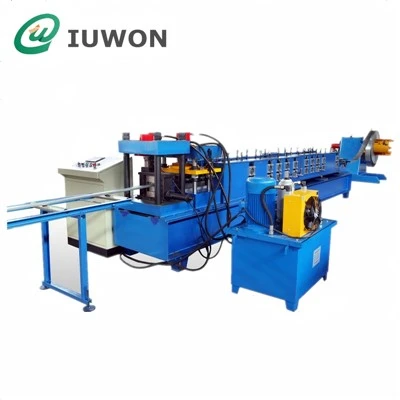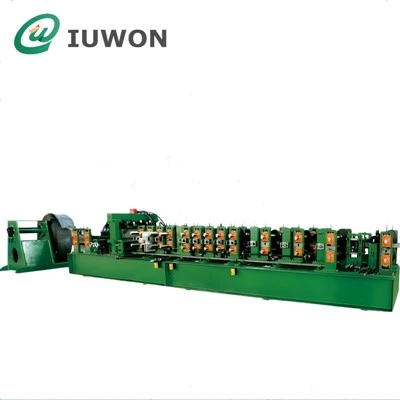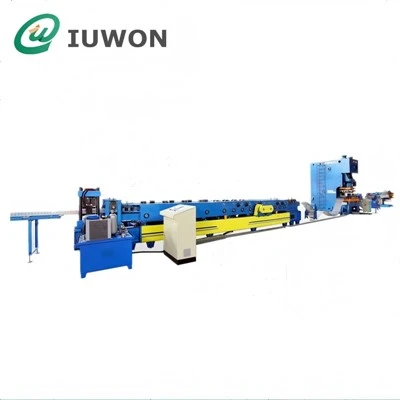

Hangzhou IUWON Technology Co., Ltd. is one of the most reliable manufacturers and suppliers of metal c channel roll forming machine in China. With abundant experience, we warmly welcome you to buy custom made metal c channel roll forming machine from our factory. Good service and reasonable price are available.
A typical C channel consists of a web, two flanges, and optional return lips. The web provides the main vertical section, while the flanges provide connection and structural surfaces.
For heavier sections, return lips or intermediate ribs can be introduced to improve section rigidity without simply increasing the material thickness.

C Channel Parameters
| Parameter | Typical Range |
|---|---|
| Material | Galvanized Steel / Carbon Steel / Stainless Steel |
| Material Thickness | 1.0–4.0 mm |
| Web Height | 40–300 mm |
| Flange Width | 20–100 mm |
| Return Lip | 10–40 mm |
| Coil Width | According to Profile |
| Material Yield Strength | ≤ 550 MPa |
| Forming Speed | 8–20 m/min |
| Forming Stations | 12–24 |
| Shaft Diameter | 60–90 mm |
| Main Motor | 11–30 kW |
| Roller Material | GCr15 / 45# Steel |
| Cutting | Hydraulic |
| Length Control | Encoder |
| Control System | PLC + HMI |
The actual section dimensions should be determined from the structural drawing because a 100 mm C channel with a short flange and a 100 mm channel with a long return lip can require substantially different tooling arrangements.
Punching, Slots & Connection Holes
C channels are often used as connecting or supporting members, so the finished profile may require holes or slots at regular intervals.
The punching system can be installed before the forming section when the required openings are located on the flat strip. This allows the hole pattern to be established before the material is bent into the C profile.
Typical processing options include:
Round holes
Elongated slots
Bolt holes
Assembly openings
Bracket holes
Anchor holes
End notches
Production Configuration
| Machine Section | Available Option |
|---|---|
| Decoiler | Manual / Hydraulic |
| Coil Capacity | 3–10 Tons |
| Leveling Unit | Optional |
| Servo Feeder | Optional |
| Punching | Hydraulic / Servo |
| Roll Forming | C-Section Tooling |
| Lip Forming | Optional |
| Rib Forming | Optional |
| Cut-Off | Hydraulic / Flying |
| Length Measurement | Encoder |
| Discharge | Run-Out Table |
| Stacking | Manual / Automatic |
| Control | PLC + Touchscreen |
For repeated hole patterns, servo-controlled feeding can coordinate the punching position with the programmed pitch. This is particularly useful for framing channels requiring standardized connection points.
Different C Channel Applications
The same C-shaped geometry can be used in several structural systems, but the required section varies according to the installation conditions.
Construction Framing
C channels can be used as framing members, wall supports, ceiling structures, partition components, and secondary structural sections. Light-gauge profiles normally use thinner steel, while load-bearing applications require deeper sections or heavier gauges.
Equipment & Machinery Support
C sections can serve as mounting rails, equipment frames, machine bases, and supporting members. In these applications, hole locations and mounting dimensions are often more important than decorative surface appearance.
Solar & Outdoor Structures
Galvanized C profiles can be used as support members where corrosion resistance and repeatable hole positioning are required. Punching can be incorporated into the line according to the connection layout.
Storage & Industrial Structures
C channels can be manufactured as reinforcement members, support rails, rack components, and other structural profiles.
Customized C Channel Roll Forming
C channels vary considerably between projects. A machine intended for a small 50 × 25 mm channel is not necessarily suitable for a 250 × 75 mm heavy-gauge section.
Can the machine produce our specific C channel size?
Yes. The roller tooling can be designed according to the required web height, flange width, lip dimension, material thickness, and overall cross-section.
Can return lips be added to the C profile?
Yes. Additional forming passes can create inward or outward lips according to the structural drawing.
Can the channel have reinforcing ribs?
Yes. Longitudinal ribs can be incorporated into the web or flange when required by the profile design.
Can holes be punched before forming?
Yes. Hydraulic or servo punching can be integrated into the production line for repeated holes and slots.
Can different C channel sizes be produced with one machine?
It depends on the dimensional range. Profiles with substantially different web or flange dimensions normally require dedicated tooling. A machine can also be designed with interchangeable tooling when several related sizes need to be manufactured.
Can the machine process 3–4 mm steel?
Yes, provided the machine is specifically engineered for that material range. Heavier gauges require appropriate shafts, roller stands, bearings, transmission, and motor capacity.
Can galvanized steel be processed without damaging the coating?
Yes. The feeding guides and roller surfaces can be designed to minimize unnecessary surface damage during continuous forming.
What drawings are required for customization?
The preferred information includes the C-section drawing, web height, flange width, lip size, material thickness, steel grade, hole pattern, finished length, and required production speed.
Can the finished C channels be cut to different lengths?
Yes. When the cross-section remains unchanged, different cut lengths can normally be entered through the PLC and controlled using an encoder-based measuring system.
Hot Tags: metal c channel roll forming machine, China metal c channel roll forming machine manufacturers, suppliers, factory, roll form roofing, roll forming aluminum sheet, roll forming equipment, Steel Roll Former, steel rollforming machines, steel roof making machine