Highway safety barriers are manufactured to control vehicle movement, reduce the severity of roadway departures, and provide a predictable deformation path during vehicle impact. Because guard rail systems are installed continuously along highways, bridges, ramps, tunnels, and roadside sections, manufacturers need production equipment capable of maintaining consistent profile geometry, hole positioning, cutting length, and surface quality over long production runs.
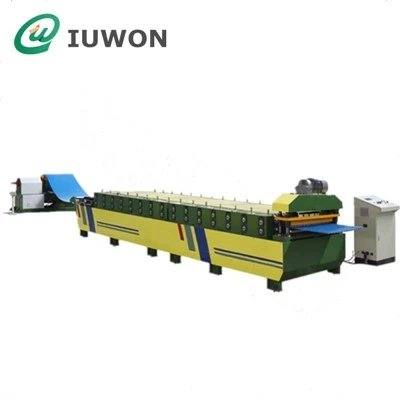
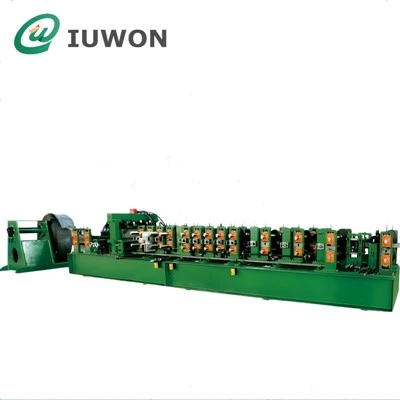
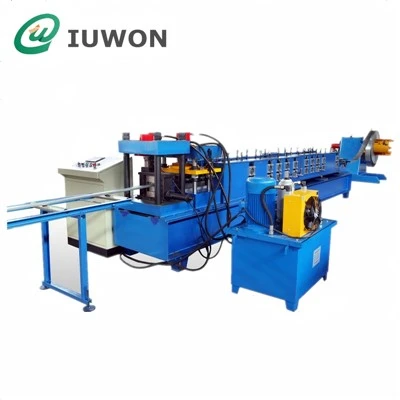
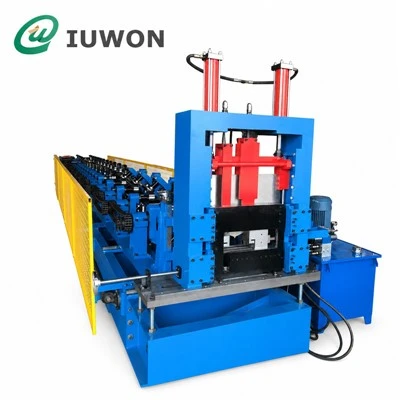
A guard rail roll forming machine converts galvanized or coated steel coil into continuous highway barrier profiles through a series of controlled forming stations. The production line can integrate decoiling, leveling, feeding, punching, roll forming, cutting, and automatic stacking, allowing manufacturers to produce guardrail beams with fewer secondary operations.
For highway infrastructure suppliers, the machine should be selected according to the required guardrail profile, steel grade, thickness, beam length, punching pattern, production capacity, and applicable road-safety standard.
What Is a Guard Rail Roll Forming Machine?
A guard rail roll forming machine is a continuous cold-forming production system designed to manufacture steel highway barriers from coil material.
Unlike press bending, which forms individual workpieces through separate operations, roll forming progressively changes the cross-section as the strip passes through multiple roller stands.
A typical production sequence is:
Steel Coil → Decoiling → Leveling → Servo Feeding → Punching → Roll Forming → Cutting → Stacking
The exact sequence depends on the guardrail design.
For example, if the guardrail requires regularly spaced mounting holes, the punching unit can be installed before or within the forming section. The feeding system must maintain accurate strip movement so that the hole spacing remains consistent throughout the finished beam.
After forming, the continuous profile is cut to the specified length and transferred to the discharge or stacking system.
This continuous process is particularly suitable for guardrail manufacturers because highway barrier beams are typically produced in large quantities with repetitive dimensions.
How the Guardrail Profile Is Formed
A highway guardrail beam generally has a corrugated or W-shaped cross-section. The geometry is designed to provide controlled structural behavior while allowing the barrier to absorb and redirect impact forces.
The forming rollers gradually create this geometry.
A simplified forming sequence can include:
1. Edge Preparation
The incoming steel strip is guided and stabilized before entering the first forming station. Side guides help maintain the correct strip position.
2. Initial Bending
The first roller stands begin bending the flat strip along predetermined longitudinal lines.
3. Corrugation Formation
Additional stations progressively deepen the central corrugations and establish the characteristic guardrail profile.
4. Flange and Edge Calibration
Later forming stations refine the outer edges and correct accumulated deformation.
5. Final Sizing
The final stands stabilize the cross-section so that the finished beam meets the required dimensional tolerances.
The number of forming stations is determined by the profile geometry, material thickness, steel strength, forming speed, and required dimensional accuracy.
A thicker or higher-strength steel strip may require a different forming sequence from standard galvanized sheet.
Main Components of a Guardrail Production Line
A complete highway barrier production line can contain several major systems.
Hydraulic Decoiler
The decoiler supports the steel coil and feeds material continuously into the production line.
For heavier guardrail material, hydraulic expansion and hydraulic loading can make coil handling more practical.
Important specifications include:
Maximum coil weight
Coil inner diameter
Coil outer diameter
Maximum strip width
Expansion method
Braking system
For high-volume production, the decoiler should be matched to the actual coil specification rather than selected independently from the forming machine.
Leveling and Feeding Unit
Steel coil can contain residual curvature or deformation after being wound. A leveling unit helps establish a flatter strip before forming.
The feeding system then controls the material entering the punching and forming sections.
For guardrail production, feeding accuracy is especially important when the beam contains repeated bolt holes.
Punching System
Many highway barrier beams require regularly spaced holes for connection bolts and mounting hardware.
The punching system can be configured for:
Round holes
Elongated holes
Multiple hole rows
Repeated hole patterns
Customized hole spacing
Depending on the machine design, punching can occur before roll forming or during the continuous production process.
Servo-controlled feeding can synchronize the punching position with the programmed production length.
For a manufacturer supplying different highway projects, programmable punching is particularly useful because hole patterns may vary between barrier specifications.


Roll Forming Section
The roll forming section is the core of the machine.
Multiple roller stands progressively deform the steel strip into the final W-beam or other specified highway barrier profile.
The roller design needs to consider:
Steel thickness
Material strength
Profile depth
Profile width
Forming radius
Number of forming passes
Required production speed
The machine frame must also provide sufficient rigidity. If the forming stands shift under load, the finished beam may develop dimensional deviations, twisting, or inconsistent flange geometry.
For this reason, machine selection should consider the construction of the machine base, shaft diameter, bearing arrangement, roller material, transmission system, and alignment accuracy.
Hydraulic or Flying Cut-Off
Once the continuous profile reaches the required length, the machine cuts the guardrail beam.
The appropriate cutting method depends on production speed and finished-product requirements.
A high-speed production line may use a flying cut-off system that cuts the moving profile without requiring the entire line to stop.
A stop-to-cut configuration may be sufficient for lower production speeds or particular profile requirements.
The cutting system should produce a clean and dimensionally consistent end without significantly deforming the guardrail section.
Automatic Stacking
After cutting, finished guardrail beams can be transferred to a run-out table or automatic stacking system.
For large-volume highway barrier production, automatic stacking can reduce manual handling.
A stacking system can be designed according to:
Finished beam length
Bundle size
Factory layout
Forklift access
Packaging requirements
Downstream galvanizing or storage process
The final handling configuration should be considered when designing the complete production line because guardrail beams are long and require adequate support during transfer.
Typical Technical Parameters
The actual specifications should be determined according to the customer's guardrail drawing and material requirements. A representative machine configuration may include:
| Parameter | Typical Configuration |
|---|---|
| Product | W-Beam / Highway Guardrail |
| Material | Galvanized steel / coated steel |
| Material Thickness | Approx. 2.5–4.0 mm |
| Material Width | According to profile development |
| Forming Stations | Approx. 12–20 |
| Forming Speed | Approx. 8–15 m/min |
| Main Drive | Gearbox or chain transmission |
| Punching | Hydraulic or servo-controlled |
| Cutting | Hydraulic / flying cut-off |
| Control | PLC + touch screen |
| Decoiler | Hydraulic expansion |
| Feeding | Servo or precision roller feeding |
| Stacking | Manual or automatic |
| Customization | Available according to profile drawing |
These figures are reference ranges rather than universal machine specifications. A final quotation should be based on the actual profile cross-section, steel grade, thickness, hole pattern, and required output.
Material Selection for Highway Guardrails
Material selection has a direct influence on machine design.
Galvanized steel is widely used because roadside barriers are exposed to rain, humidity, road salt, temperature changes, and other environmental conditions.
Common considerations include:
Steel Thickness
Increasing thickness generally increases structural capacity but also increases forming force.
Yield Strength
Higher-strength steel can require greater forming force and a carefully engineered roller sequence.
Zinc Coating
The forming process should minimize unnecessary damage to the galvanized surface. Poor roller alignment or excessive localized deformation can affect coating integrity.
Coil Quality
Variations in strip thickness, flatness, width, and mechanical properties can influence forming stability.
For consistent guardrail production, the machine should therefore be tested using the actual material specification rather than a generic steel sample whenever possible.
Guard Rail Profile and Punching Accuracy
One of the most important characteristics of a highway barrier production line is the relationship between the profile and its connection holes.
Guardrail beams are installed using bolts, spacers, posts, and other structural components. If the hole pitch or hole-to-edge distance is inconsistent, installation can become difficult and may require manual correction.
The production line should therefore control:
Hole diameter
Hole spacing
Hole center position
Distance from profile edge
Hole alignment
Cut length
Profile straightness
For manufacturers serving multiple countries, the punching program can also be configured around different customer specifications.
Why Profile Tooling Matters
The forming rollers are responsible for gradually establishing the guardrail's final geometry.
A properly engineered tooling set should distribute deformation across the forming stations rather than forcing the material into its final shape too quickly.
This helps control:
Edge cracking
Surface marking
Springback
Twisting
Cross-section deviation
Uneven forming load
The roller material and machining accuracy also affect service life and profile consistency.
For B2B buyers, the tooling design should therefore be included in the technical discussion rather than treated as an accessory.
Guardrail Roll Forming for Different Highway Applications
The same general production technology can be adapted to different roadside safety products.
Highway W-Beam
The conventional W-shaped barrier is widely used along roads and highways.
Thrie-Beam
A three-wave barrier has a more complex cross-section and requires corresponding roller tooling.
Bridge Guardrail
Bridge applications can require specific dimensions, connection holes, and structural configurations.
Median Barrier
Median applications may require different mounting arrangements and barrier dimensions.
Roadside Barrier
Roadside guardrails can be configured according to local road engineering requirements.
Customized Safety Barrier
Infrastructure contractors may require project-specific profile dimensions or hole patterns.
A manufacturer producing several types should consider whether the machine can accommodate multiple tooling sets or whether separate production lines are more appropriate.
What Highway Guardrail Manufacturers Should Consider Before Buying
Purchasing a guardrail roll former should begin with the finished product.
Before contacting a machine supplier, prepare the following information:
Guardrail profile drawing
Material grade
Material thickness
Coil width
Hole pattern
Hole diameter
Hole spacing
Finished beam length
Required production speed
Daily or monthly production volume
Surface treatment
Applicable technical standard
Factory power supply
Available installation area
This allows the machine manufacturer to determine the correct forming sequence and production-line configuration.
IUWON's Approach to Guardrail Roll Forming Equipment
IUWON is a China-based roll forming machinery manufacturer with more than 20 years of experience in cold roll forming equipment.
Its product range covers structural profiles for construction, solar mounting systems, cable trays, purlins, roofing, and other industrial applications. This broader profile-forming experience is relevant to highway barrier manufacturing because guardrails require controlled forming of relatively heavy-gauge structural steel.
For a customized guardrail project, the engineering process should begin with the customer's profile drawing and material specification.
IUWON can configure the production line around the required:
Guardrail cross-section
Steel thickness
Material strength
Hole pattern
Cutting length
Production capacity
Automation level
A typical customized line can integrate decoiling, leveling, punching, roll forming, cutting, and material collection into one continuous process.
This profile-based approach is particularly useful for manufacturers supplying different road authorities or infrastructure contractors because guardrail dimensions and connection-hole arrangements can vary between markets.
Production Capability Beyond the Forming Machine
For a highway barrier manufacturer, machine capability should be evaluated as an entire production system.
The workflow may include:
Coil Preparation → Roll Forming → Punching → Cutting → Surface Treatment → Bundling → Transportation
Roll forming is only one stage of the overall manufacturing process.
If the finished guardrails require hot-dip galvanizing after forming, the production line should also consider how the cut profiles will be bundled and transferred to the galvanizing process.
If pre-galvanized steel is used, the forming process should focus on protecting the existing coating.
The correct production arrangement therefore depends on the manufacturer's complete manufacturing route.
Advantages of Continuous Roll Forming for Guardrail Production
A properly designed roll forming line provides several manufacturing benefits.
Consistent Cross-Section
Multiple forming stands progressively shape the material, allowing the final profile to remain relatively consistent over long production runs.
Integrated Hole Punching
Punching can be incorporated into the continuous line, reducing separate drilling operations.
Continuous Production
The process is suitable for repetitive production of long guardrail beams.
Programmable Length
PLC-controlled feeding and cutting allow different finished lengths to be produced according to the production program.
Reduced Secondary Handling
When punching, forming, cutting, and stacking are integrated, material handling between processes can be reduced.
Scalable Automation
The production line can be configured with manual collection for smaller factories or automated stacking and handling for higher-volume operations.
Final Buying Checklist
Before selecting a highway guardrail forming machine, procurement teams should verify the following:
| Item | What to Confirm |
| Profile | Exact W-beam, Thrie-beam, or customized section |
| Material | Steel grade and coating |
| Thickness | Minimum and maximum thickness |
| Width | Coil width and developed width |
| Punching | Hole type, diameter, pitch and location |
| Forming | Number of stations and roller design |
| Cutting | Cut-off method and length tolerance |
| Speed | Required continuous production speed |
| Automation | Manual, semi-automatic or automatic |
| Stacking | Finished-product handling method |
| Testing | Factory trial with actual material |
| Service | Installation, commissioning and spare parts |
Conclusion
A highway safety barrier production line must maintain more than a simple metal shape. The guardrail profile, connection-hole pattern, finished length, material properties, and surface condition all need to remain consistent throughout production.
The right guard rail roll forming machine should therefore be engineered around the actual highway barrier specification.
For manufacturers producing standard W-beams, the priority is usually stable continuous forming, accurate punching, and reliable cut-to-length performance. For manufacturers serving multiple markets, flexibility becomes more important because different road projects may require different profile dimensions, hole arrangements, or material grades.
IUWON's customized roll forming approach is suitable for buyers who need a production line developed around a specific guardrail drawing rather than a generic machine configuration. The complete system can be planned around decoiling, leveling, punching, progressive forming, cutting, and finished-product handling.
For a machine proposal, the most useful technical package is the guardrail profile drawing + material specification + hole pattern + finished length + target output. These parameters allow the forming sequence, roller tooling, punching system, drive configuration, and cutting method to be evaluated according to the actual highway safety barrier production requirements.